When you use peptide therapy, you’re utilizing molecules that recognize your cell-surface receptors through precise shape matching, binding like a key in a lock without crossing the membrane. This engagement triggers conformational changes that activate intracellular cascades—amplifying signals through second messengers like cAMP and kinase pathways—to ultimately reshape cellular behavior, from gene expression to enzyme activity and secretion. Unlike traditional drugs, peptides employ your body’s natural recognition systems, breaking down into harmless amino acids your cells readily recycle, which minimizes toxicity while demanding careful dosing. Their specificity comes from structural features in both peptide and receptor, including critical terminal residues and extracellular domains that determine which pathways ignite, making them powerful yet metabolically fleeting tools for targeted intervention. What follows examines each mechanistic layer more deeply, so you can see exactly how these molecular conversations unfold inside you.
TLDR
- Peptides recognize receptors through precise molecular matching of sequence and shape.
- Membrane interactions organize peptide conformation for optimal receptor engagement.
- Binding triggers conformational changes that activate receptors as molecular switches.
- Activated receptors initiate intracellular cascades amplified by second messengers.
- Specific signaling pathways control gene expression, metabolism, and cellular responses.
How Peptides Recognize and Bind Cell-Surface Receptors
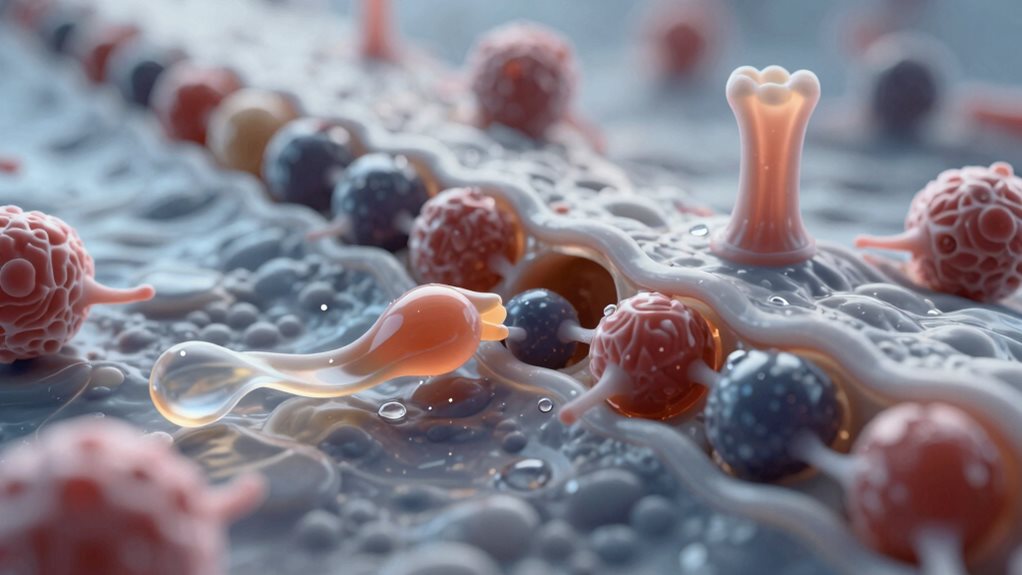
How does a short chain of amino acids find its exact molecular partner among countless surface proteins? You can understand this as a precise molecular matching process, where your peptide’s specific sequence and three-dimensional shape act like a key searching for its lock. You’ll see that molecular complementarity drives this recognition, meaning your peptide’s amino acid composition, terminal groups, and overall conformation must align precisely with your receptor’s binding site.
Before full binding occurs, your peptide often encounters the surrounding membrane first, a membrane-catalysis step that helps organize your peptide into the proper shape for productive docking through electrostatic and hydrophobic interactions.
When your peptide reaches the cell surface, you’ll find it binding to extracellular domains of receptors like GPCRs, never needing to cross the membrane itself. Your receptor’s architecture determines selectivity, with class A GPCRs typically engaging your peptide across multiple regions including the ECL2 β-hairpin, TM2 tip, and TM7-TM6 extracellular half, while fine structural features distinguish closely related peptides through critical differences in their “message” regions. In many cases, cellular water and solvent environment also influence the efficiency and specificity of this recognition process cellular context.
How Receptor Binding Triggers Intracellular Signals
Once a peptide finds its matching receptor on your cell’s surface, the binding event sparks an immediate conformational change that flips the receptor into its active state—think of it as a molecular switch being turned on. This molecular switch then recruits and activates intracellular signaling cascades that propagate the message inside the cell. These pathways translate the extracellular binding event into specific cellular responses such as gene expression, metabolism adjustments, or altered function, depending on the receptor and cell type. Thymosin Alpha-1 helps coordinate immune responses by modulating signaling networks that influence T-cell activity and innate immune functions.
Selective Receptor Recognition
Why do certain peptides trigger distinct cellular responses while others remain inactive, even when they appear structurally similar?
You’ll find that specific residues at opposite ends of homologous peptides dictate receptor choice, with C-terminal positions like Q34 or P34 determining selectivity for Y4 receptors.
These selective binding determinants, confirmed through mutagenesis studies, ensure that peptides employ distinct docking pathways, triggering unique intracellular cascades matched to their molecular structure.
Conformational Change Activation
When you consider how a peptide’s message crosses the cell membrane, you’ll recognize that the critical event isn’t merely attachment—it’s the structural change that follows. Ligand binding reshapes the receptor, transmitting a signal from outside to inside. This conformational switch triggers GDP-GTP exchange in GPCRs, dimerization in RTKs, or releases inhibitory proteins, ultimately activating phosphorylation cascades or direct nuclear signaling to alter cell behavior.
How Peptide Signals Get Amplified Inside Cells
How does a single peptide molecule manage to trigger such sweeping changes inside your cells? The answer lies in signal amplification, a remarkable process that transforms one binding event into a massive cellular response. When a peptide activates your cell-surface receptor, it doesn’t just send one signal—it launches a cascade. Second messengers like cAMP multiply that signal, and kinase cascades extend it further, allowing tiny stimuli to produce powerful, precise biological effects. Modulation of immune pathways depends on context-driven receptor signaling and balanced downstream responses Toll-Like Receptors to prevent overactivation.
How Peptides Change What Cells Actually Do
You have already seen how peptide signals travel through cells, and now you’ll learn how these signals translate into real changes in cell behavior, specifically through three interconnected mechanisms: the control of gene expression, which determines which proteins a cell produces over time; the modulation of enzyme activity, which rapidly alters metabolic pathways and biochemical reactions; and the regulation of secretion, which governs when and what a cell releases into its environment. These processes work together so that a single peptide binding event can reshape everything from a cell’s immediate metabolic state to its long-term identity and function. Understanding these mechanisms will help you grasp why different peptides produce such varied effects across tissues, from stimulating insulin release in the pancreas to triggering collagen synthesis in healing skin, and melanotropin-induced pigmentation can involve coordinated changes in gene expression and enzyme activity that promote melanin production in pigment cells.
Gene Expression Control
Why do some peptides trigger lasting changes in cell behavior rather than fleeting biochemical shifts? You dive membranes and bind directly to DNA, where you regulate transcription, modify epigenetic marks, and influence non-coding RNAs. These actions reshape which genes become active, altering protein production and ultimately determining whether cells proliferate, differentiate, or undergo apoptosis across diverse organisms.
Enzyme Activity Modulation
Peptides reshape cellular function not only by rewriting genetic instructions but also by directly manipulating the enzymes that execute those commands, and this hands-on control over catalytic activity represents one of the most immediate ways you can alter what a cell actually accomplishes. You can block active sites through competitive inhibition, bind distal allosteric sites to conformationally modulate activity, or employ cooperative peptide pairs for enhanced suppression. Covalent modifications and propeptide-based latency mechanisms further expand your regulatory toolkit, allowing precise, reversible, or durable enzyme control without genetic intervention.
Secretion Regulation Mechanisms
How does a cell decide when to release its chemical messengers into the world? You can understand this by examining vesicle transport, where microtubules guide hormone-filled granules toward your cell’s edge while actin filaments manage final tethering. Calcium influx then triggers SNARE complexes, fusing vesicles to release peptides. Feedback loops—like cortisol suppressing ACTH—ensure you maintain precise hormonal balance through demand-based regulation.
Why Peptide Drugs Break Down So Quickly

Three major factors—enzymatic attack, chemical instability, and rapid organ clearance—conspire to dismantle peptide drugs within minutes of entering your body, making their therapeutic window frustratingly brief compared to small-molecule pharmaceuticals.
Proteases cleave peptide bonds everywhere from your gut to your kidneys, while chemical reactions like oxidation and deamidation silently corrupt structure.
Your liver and kidneys then filter fragments, completing rapid elimination that demands inventive delivery solutions.
Regulatory and safety considerations also shape how these agents are studied and used, reinforcing the need for careful evaluation of risks and benefits.
What Makes Peptide Therapy Different From Other Drugs
What truly separates peptide therapy from the drugs you might find in a standard pharmacy aisle? You’re looking at molecules that mimic your body’s own signaling compounds, binding to specific receptors like a key fitting a lock, rather than forcing artificial chemical changes. This precision means peptides target particular pathways with fewer off-target effects, breaking down into harmless amino acids your body already knows how to use. IGF-1 LR3’s extended bioactivity comes from reduced IGFBP binding, enabling longer receptor engagement and signaling without losing potency biomolecule stability.
And Finally
Now that you’ve examined how peptides recognize receptors, trigger signals, amplify messages, and alter cellular behavior, you understand both their therapeutic potential and their limitations, including rapid breakdown. You can see why peptide therapy differs from conventional drugs, offering targeted action with distinct challenges. This knowledge equips you to evaluate whether peptide-based treatments align with your needs, recognizing that their precision comes with practical considerations you’ll want to discuss with qualified healthcare providers.
References
- https://www.peptidejournal.org/reference/how-peptides-work-mechanisms-of-action-explained
- https://pmc.ncbi.nlm.nih.gov/articles/PMC9598582/
- https://pmc.ncbi.nlm.nih.gov/articles/PMC5871973/
- https://www.seekpeptides.com/blog/articles/how-peptides-work
- https://peptideprimer.ca/learn/how-peptides-work
- https://mmrjournal.biomedcentral.com/articles/10.1186/s40779-021-00343-2
- https://peptidesclinic.org/articles/how-peptide-therapy-works/
- https://www.intechopen.com/chapters/1226438
- https://www.intechopen.com/chapters/78410
- https://www.enhanced.com/knowledge-base/what-are-peptides-how-they-work-in-the-body