BPC-157 is a synthetic fifteen-amino-acid peptide derived from a compound in gastric juice, and researchers have examined it for tissue repair through pathways like FAK-paxillin and VEGFR2-driven angiogenesis. You’ll find rat studies showing faster tendon, muscle, and gut healing, plus reduced inflammation markers, but human evidence remains limited to tiny pilot trials without robust controls. Short-term safety data suggest tolerability up to 20 mg intravenously, yet long-term risks—including theoretical cancer concerns from its pro-angiogenic effects—are essentially unknown. The FDA hasn’t approved any medical use, WADA bans it as an S0 substance with two-year suspensions possible, and quality control problems plague available products. If you’re weighing whether to pursue this compound, understanding the full landscape of regulatory, safety, and efficacy considerations will help you make a genuinely informed choice.
TLDR
- BPC-157 is a synthetic peptide derived from gastric juice with unproven tissue repair claims.
- It promotes angiogenesis and wound healing through VEGFR2 and Akt-eNOS pathways in lab studies.
- No FDA-approved medical use exists; regulators classify it as experimental and investigational only.
- Short-term pilot studies show tolerability, but long-term safety data and cancer risks remain unknown.
- WADA bans BPC-157 at all times; detection requires specialized mass spectrometry testing.
What Is BPC-157? (And Why It’s Still Experimental)
What exactly is BPC-157, and why does it matter that you’ve probably seen it promoted for recovery and healing? BPC-157 is a synthetic pentadecapeptide—fifteen amino acids linked together—that researchers first isolated from gastric juice, where it’s derived from a natural stomach compound called Body Protection Compound. Despite online claims, no well-designed human trials prove it works or is safe in people, so regulators classify it as an unapproved, experimental substance rather than a proven medicine. In addition, while some animal studies and in vitro work have explored potential mechanisms related to tissue repair and inflammation, robust human evidence remains lacking. biological role
How BPC-157 Repairs Tissue at the Cellular Level
BPC-157’s reputation among researchers stems from its apparent ability to protect and rebuild damaged tissue through multiple, overlapping cellular mechanisms. You can think of it as a cytoprotective peptide that keeps cells alive during injury stress while activating fibroblasts, the cells that migrate into wounds and produce collagen. Through pathways like FAK-paxillin, Akt/PI3K, and VEGFR2, it drives angiogenesis, matrix formation, and structural remodeling. Additionally, emerging studies suggest it may influence cellular signaling to support tissue preservation and repair under stress conditions tissue protection.
BPC-157 and New Blood Vessel Formation
New blood vessels form the lifeline that any healing tissue can’t survive without, and researchers have traced how BPC-157 appears to cultivate this vascular network through several distinct, well-documented pathways. You can picture BPC-157 as amplifying your body’s own repair signals, particularly by upregulating VEGFR2 on endothelial cells and activating the Akt-eNOS cascade, which increases nitric oxide production and supports vasodilation. In chick embryo assays, this peptide increased angiogenesis by over 150%, while animal models of ischemia and injury demonstrate improved perfusion and vascular recovery. The effect is angiomodulatory rather than simply angiogenic, meaning BPC-157 enhances your existing vascular response rather than forcing unnatural vessel growth. endothelial VEGFR2 signaling appears to be a key driver of this modulation, aligning with observed improvements in vascular function.
Muscle, Tendon, and Ligament Healing: What Rat Studies Show
How exactly does a peptide translate into stronger, more organized soft tissue? In rat studies, BPC-157 activates the FAK-paxillin pathway, enhancing tendon fibroblast migration and collagen organization.
Faster healing has been observed in transected Achilles tendons, accelerated medial collateral ligament recovery, and restored quadriceps muscle function, with improved biomechanical strength, reduced oxidative stress, and better myotendinous junction repair across multiple administration routes. cell signaling Further research indicates that BPC-157 may modulate cytoskeletal dynamics and extracellular matrix remodeling to support tissue repair processes.
Gut and Stomach Protection: The Original Research Focus
Why does a compound now discussed for tendon repair and muscle recovery first emerge from decades of stomach research? You’ll find BPC-157 began as a gastric pentadecapeptide, investigated for protecting stomach and duodenal lining against stress, alcohol, and NSAID damage. Researchers identified its role in Robert’s cytoprotection, preserving mucosal integrity through endothelial protection and blood-flow restoration. This gut-focused foundation—demonstrating stability in gastric juice and absence of toxicity—established the peptide’s therapeutic potential before broader applications emerged. gastric protection
From Rats to Humans: The Evidence Gap Explained
Where exactly does BPC-157 stand when you look past the enthusiastic online discussions and examine what researchers have actually proven?
You’re facing one of research’s steepest translation gaps: 35 animal studies and one uncontrolled human review, with no completed randomized trials.
Strong rat data on tendon, muscle, and gut healing hasn’t replicated in controlled human studies.
Three tiny pilot studies, lacking controls or blinding, can’t establish real efficacy or reliable safety profiles.
Mechanistic plausibility through fibroblast migration and angiogenesis exists, but that doesn’t mean you’ll experience comparable benefits.
Until peer-reviewed Phase II or III trials publish, BPC-157 remains investigational, not established therapy.
BPC-157 and Inflammation Control
You’ll find that BPC-157’s reported anti-inflammatory effects stem from several interconnected mechanisms, including the reduction of pro-inflammatory cytokines like TNF-α and IL-6 alongside the promotion of anti-inflammatory signals such as IL-10. Research suggests the peptide may shift immune responses from an M1-like pro-inflammatory state toward an M2-like reparative state, though this evidence comes primarily from animal models rather than human trials. While preclinical studies show promising results—such as a 63% reduction in TNF-α in one colitis model—you should recognize that clinical safety and efficacy in humans remain unestablished, making it essential to weigh these findings against the limitations of current research. animal models
Anti-Inflammatory Mechanisms
Three interconnected mechanisms—nitric oxide modulation, angiogenesis promotion, and oxidative stress reduction—form the foundation of BPC-157’s anti-inflammatory activity, which researchers have documented across preclinical models involving gastric, intestinal, musculoskeletal, and vascular tissues. You’ll find that BPC-157 balances eNOS and iNOS pathways, supporting endothelial stability and blood flow while curbing excessive inflammatory signaling.
Through VEGFR2-mediated angiogenesis, the peptide shifts damaged tissue toward repair rather than prolonged inflammation. Its cytoprotective effects, including reduced oxidative stress and mucosal integrity maintenance, further limit tissue breakdown. These combined actions normalize inflammation without suppressing healing, though human clinical validation remains pending.
Cytokine Modulation Effects
How does a synthetic peptide reshape the inflammatory conversation within your body? BPC-157 appears to quiet pro-inflammatory signals by lowering TNF-α, IL-6, and IFN-γ, while nudging immune cells toward a reparative, M2-like state with increased IL-10. It dampens neutrophil activation and mast cell degranulation, and suppresses NF-κB signaling—though these findings remain preclinical, not proven human outcomes.
Clinical Research Evidence
Where does the evidence actually stand when you’re trying to evaluate BPC-157’s anti-inflammatory potential?
You’ll find the research landscape is dominated by preclinical studies, particularly in rat models of periodontitis, tendon injury, colitis, and tissue damage, while human data remains limited to small pilot studies.
Systematic reviews characterize the evidence as promising yet unproven, urging caution until definitive clinical trials emerge.
Short-Term Tolerance vs. Unknown Long-Term Risks
When you’re weighing whether to use BPC-157, it’s natural to wonder what the immediate experience looks like compared to what might happen down the road. In addition, human data remains limited, so observed effects may not capture rare or long-term outcomes short-term safety profile. Available human data, though limited, suggest short-term tolerance: a pilot study found up to 20 mg intravenous doses well tolerated in healthy adults, with no adverse effects reported, and reviews note no meaningful changes in vital signs or lab markers. However, robust trials are absent, so the full short-term side-effect profile remains incomplete, with only mild injection-site irritation documented in preclinical work. Long-term safety is essentially unknown, as repeated or prolonged exposure lacks clinical study, meaning you’re navigating uncharted territory beyond initial doses despite the compound’s rapid clearance.
Cancer and Cell Signaling: Theoretical Concerns
You should understand that BPC-157’s ability to stimulate angiogenesis—the formation of new blood vessels—creates a theoretical concern when tumors are present, since cancer cells rely on vascular supply for growth and survival, even though this same property promotes healing in healthy tissue.
The compound’s interactions with growth factor pathways, including VEGFR2 and FAK-paxillin signaling involved in cell migration, raise additional questions about whether microscopic malignancies could be inadvertently supported, though no human studies have confirmed this occurs. angiogenesis
Angiogenesis and Tumors
Although the regenerative effects of BPC-157 are often celebrated, you’ll want to understand how its pro-angiogenic mechanism creates a subtle theoretical concern when it comes to cancer biology. By stimulating VEGF/VEGFR2 and nitric oxide pathways, BPC-157 promotes blood vessel formation—something tumors exploit for oxygen and nutrients. This doesn’t mean it causes cancer, but it could theoretically support an existing, undetected malignancy.
Growth Factor Stimulation
How does BPC-157’s impressive ability to heal tissues connect to the complex world of cancer biology? You should understand that BPC-157 activates growth factor pathways, including VEGFR2 and Akt-eNOS, which stimulate cell repair but raise theoretical concerns about supporting tumor growth.
While no human evidence confirms cancer causation, the peptide’s promotion of fibroblast activity and endothelial proliferation creates plausible, though unproven, risk that warrants careful consideration.
Long-Term Uncertainty
When you’re considering a therapeutic peptide like BPC-157, it’s natural to wonder what might happen beyond the immediate benefits—especially when the research simply hasn’t followed users for years. You should understand that long-term human safety data remain insufficient, with no large-scale studies evaluating cancer outcomes or other delayed harms. No clinical trial has specifically assessed whether BPC-157 promotes tumors or metastasis in humans, so delayed safety signals can’t be ruled out. The best-supported statement in current literature is that long-term oncologic safety remains unproven, not proven safe.
Why Regulators Haven’t Approved BPC-157
Why does a compound that generates so much discussion in recovery circles remain outside the boundaries of approved medicine? The lack of comprehensive human trials means regulators require more data before any clinical approvals, despite ongoing interest in its recovery potential. growth hormone-related peptides
BPC-157 Drug Testing: What Athletes Risk
If you’re a tested athlete, you need to understand that BPC-157 carries significant anti-doping risk because WADA classifies it as a prohibited non-approved substance, which means you’re banned from using it at all times—not just during competition. While standard workplace drug screens won’t detect this synthetic peptide, WADA-accredited laboratories now employ advanced mass spectrometry methods capable of identifying it, so you shouldn’t assume it’s undetectable. A positive result typically brings a minimum two-year suspension, disqualification from events, and lasting damage to your eligibility, rankings, and career path, with no Therapeutic Use Exemption available to protect you. Users should be aware that WADA classifications influence both testing scope and penalties across all anti-doping programs.
WADA Classification Status
How seriously should you take BPC-157’s standing with anti-doping authorities?
You must recognize that WADA classifies BPC-157 as a prohibited substance under S0, meaning it’s banned at all times, both in and out of competition.
Since no Therapeutic Use Exemption exists and penalties reach two to four years, you’re risking your athletic career with any use.
Detection Challenges Faced
Although standard drug screens won’t catch BPC-157, you’re not in the clear if you’re subject to anti-doping testing.
Specialized laboratories use mass spectrometry methods that detect BPC-157 and its metabolites in urine for 24–72 hours, sometimes up to 4–5 days.
Plasma clears faster, within hours.
WADA bans BPC-157 year-round, so athletes risk detection through targeted peptide analysis unavailable in routine workplace testing.
Career Consequences Explained
Why does a single peptide compound carry such weight in competitive sports? Because WADA bans BPC-157 at all times, classifying it as a non-approved substance, and a positive test triggers a minimum two-year suspension that strips your eligibility, rankings, and sponsorships. You’re risking career-ending sanctions, reputational damage, and lost team status—even without FDA approval or extensive human safety data backing your use.
Quality Control Problems in BPC-157 Research
Where exactly does the research on BPC-157 stand when you can’t even trust what’s in the vial? You’re facing a market where 30% of online products contain wrong sequences, 65% exceed endotoxin limits, and purity claims lack mass spectrometry confirmation. Without FDA-approved standards, batch traceability, or verified reference materials, you’re essentially gambling with uncharacterized compounds that may harbor truncated sequences, bacterial contamination, or incorrect dosing—undermining any legitimate scientific inquiry into this peptide’s actual effects.
BPC-157 Clinical Trials: What’s Actually in Progress
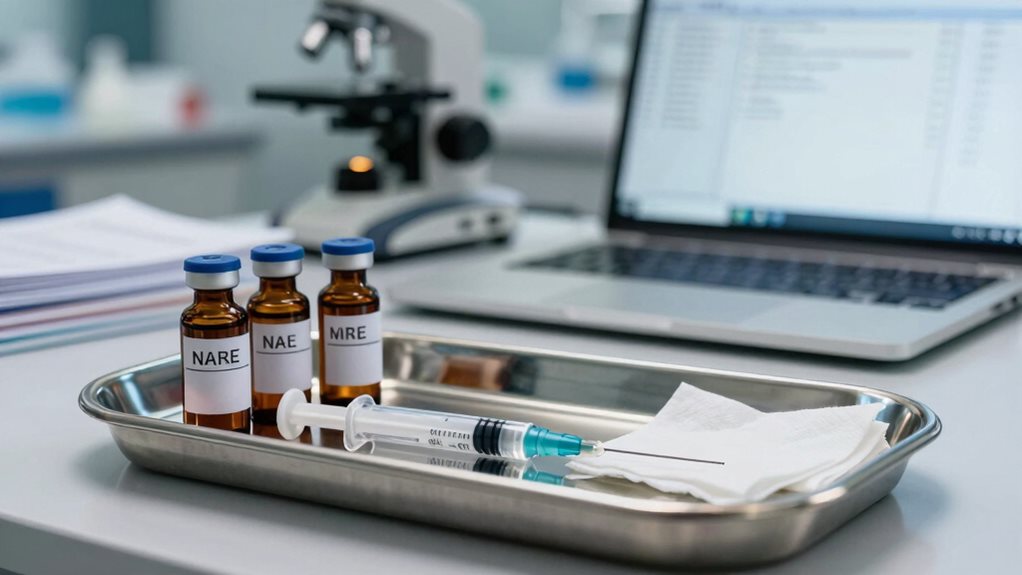
Given these quality control concerns, you’re probably wondering whether any legitimate clinical research on BPC-157 is actually moving forward, and the answer is yes—but with important limitations you need to understand. A Phase 2 randomized, double-blind, placebo-controlled trial for acute hamstring muscle strain repair is currently registered on ClinicalTrials.gov, testing whether BPC-157 speeds structural healing and functional recovery. However, published human evidence remains minimal, with only three small pilot studies existing as of early 2026, and no completed randomized efficacy trials have appeared in peer-reviewed literature.
Should You Consider BPC-157? A Decision Framework
How, then, should you actually think about using BPC-157 when the evidence remains so fragmented?
You should view it strictly as an investigational compound, not a proven therapy, and avoid self-administration since no sturdy human safety data exists.
If you’re considering participation, seek specialist-supervised research settings where monitoring can address the significant unknowns around dosing, interactions, and long-term effects.
Frequently Asked Questions
What’s the Best BPC-157 Injection Site for Injuries?
You should inject BPC-157 subcutaneously near the injury, typically 1–4 inches away, avoiding direct tendon or joint penetration. For knee issues, target tissue above or below the kneecap; for Achilles problems, inject slightly above or below the damaged area; shoulder injuries respond well to deltoid-region placement.
When the site is deep or awkward, you’ll use your abdomen, thigh, or upper outer glute for systemic absorption instead. Rotate locations to prevent irritation.
How Does BPC-157 Compare to TB-500 for Healing?
You should view BPC-157 and TB-500 as complementary rather than interchangeable tools for healing.
BPC-157 supports localized repair, particularly for tendons, ligaments, and gastrointestinal tissue, by promoting angiogenesis and reducing inflammation directly at injury sites.
TB-500 works systemically, enhancing cell migration and tissue remodeling across multiple areas, making it preferable for widespread soft tissue or muscle recovery.
Your specific injury type determines which peptide suits you better, though some practitioners suggest stacking both for all-encompassing results.
Can BPC-157 Be Taken Orally or Sublingually?
Yes, you can take BPC-157 orally or sublingually, though oral use is better supported.
Oral capsules work well for gut issues like ulcers or IBS because the peptide resists stomach acid, but you’ll need higher doses—typically 500 mcg to 1 mg daily—since less reaches your bloodstream.
Sublingual delivery is less established, with limited clinical validation and inconsistent dosing guidance.
For systemic healing, injections remain preferred, while oral forms excel for gastrointestinal targets.
Always consult a healthcare provider before starting.
What’s the Typical BPC-157 Dosage and Cycle Length?
You’ll typically start with 250 mcg once daily, though many protocols use 250 mcg twice daily for 500 mcg total.
Common cycles run 4–6 weeks, with some extending to 8–12 weeks for chronic issues.
Acute injuries may warrant 500–750 mcg initially, then reduced maintenance dosing.
You should consider breaks between cycles, such as 4 weeks on followed by 2 weeks off, since long-term human data remain limited.
Does BPC-157 Require Refrigeration for Storage?
Yes, you should refrigerate BPC-157, especially after reconstitution. Keep reconstituted solution at 2–8°C and use it within about 28 days.
Don’t freeze it again, as this damages the peptide.
For unopened lyophilized powder, refrigeration works for routine storage, but -20°C is better for long-term preservation. Avoid heat, light, and humidity to maintain stability.
And Finally
You’re now equipped with a clear, evidence-based understanding of BPC-157’s potential and its significant limitations. While the preclinical research on tissue repair, angiogenesis, and gastrointestinal protection appears promising, you must remember that human clinical trials remain scarce and incomplete. If you’re considering BPC-157, you’ll need to weigh the experimental nature of this peptide against your specific health goals, consult qualified medical professionals, and recognize that regulatory approval and long-term safety data are still years away.
References
- https://pmc.ncbi.nlm.nih.gov/articles/PMC12446177/
- https://pmc.ncbi.nlm.nih.gov/articles/PMC13026520/
- https://journals.lww.com/nrronline/fulltext/2022/03000/pentadecapeptide_bpc_157_and_the_central_nervous.3.aspx
- https://www.statnews.com/2026/02/03/bpc-157-peptide-science-safety-regulatory-questions/
- https://journals.physiology.org/doi/full/10.1152/japplphysiol.00945.2010
- https://www.frontiersin.org/journals/pharmacology/articles/10.3389/fphar.2021.627533/full