Sermorelin stimulates your pituitary gland to release growth hormone naturally by activating GHRH receptors, which preserves your body’s feedback loops rather than overriding them. You’ll typically start with 200–300 mcg injected subcutaneously at bedtime, and many people notice improved sleep within weeks while body composition changes emerge gradually over three to six months. Common side effects include minor injection-site reactions, headaches, or brief flushing, though serious problems remain rare. Originally FDA-approved as GEREF in 1997, the branded version left the market around 2008 due to pricing pressures, not safety concerns, so you’ll now access it through compounding pharmacies with proper medical oversight. Regular IGF-1 monitoring and baseline health checks help ensure safe, effective use over time, and understanding how sermorelin differs from alternatives like ipamorelin or CJC-1295 can guide your treatment decisions moving forward.
TLDR
- Sermorelin stimulates natural growth hormone release via pituitary GHRH receptors in pulsatile patterns.
- Clinical benefits include improved sleep quality, exercise recovery, and gradual body composition changes over months.
- Common side effects are injection-site reactions, headaches, and flushing; serious adverse events remain rare.
- FDA-approved as GEREF in 1997, it now exists primarily through compounding pharmacies.
- Long-term safety data is limited; IGF-1 monitoring every 6–12 months is recommended under medical supervision.
Sermorelin vs. HGH: What’s the Real Difference?
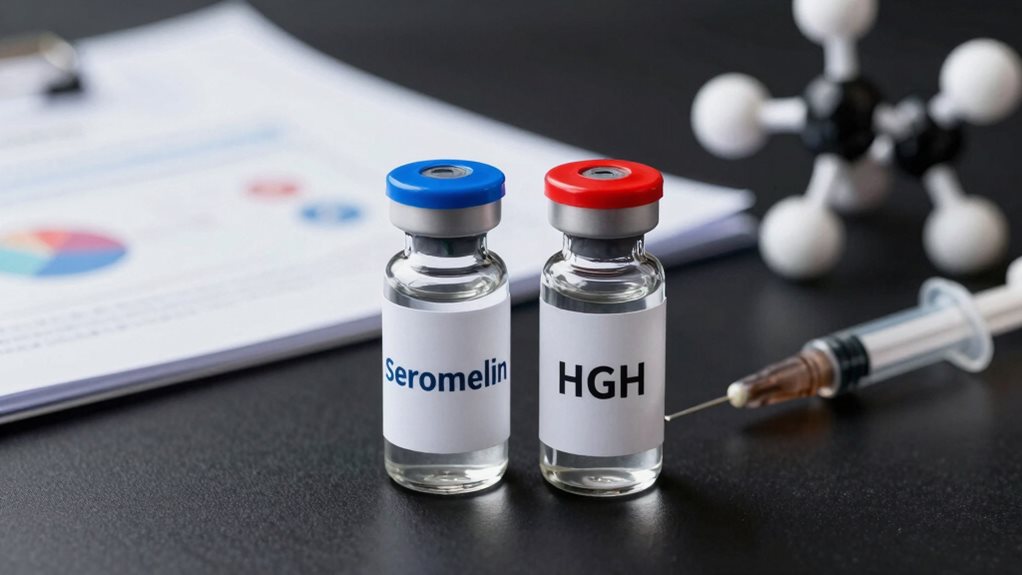
Sermorelin vs. HGH: What’s the Real Difference?
Why do two therapies that both aim to increase growth hormone levels work so differently in your body? Sermorelin acts as a signal, prompting your pituitary gland to release its own growth hormone in natural pulses, while HGH delivers synthetic hormone directly, bypassing your body’s regulatory feedback. This distinction matters because sermorelin preserves physiological control, reducing risks of excessive levels, whereas HGH suits cases where your pituitary can’t respond adequately. In addition, sermorelin’s dual action on signaling and natural pulsatility aligns with the brain’s regulation of hunger and energy balance, which can influence broader metabolic effects. GIP and GLP-1 receptor activation and the coordinated signaling in tirzepatide illustrate how dual receptor approaches can produce amplified metabolic outcomes beyond a single-path mechanism.
How Does Sermorelin Trigger Growth Hormone Release?
Although your pituitary gland already knows how to release growth hormone, it sometimes needs a clear signal to do so—especially as you age and natural stimulatory inputs fade. Sermorelin provides that signal by binding to GHRH receptors on your pituitary’s somatotroph cells, activating a Gs-protein cascade that raises cAMP within minutes. This triggers protein kinase A, releasing pre-stored GH in a natural, pulsatile pattern while also promoting new hormone synthesis through enhanced gene transcription—preserving your body’s own regulatory feedback rather than overriding it. GHRH receptors
What Do Clinical Trials Actually Prove?
You’ll find that clinical trials offer the strongest support for sermorelin in children with growth hormone deficiency, where improved growth velocity has been clearly documented, while adult studies more consistently show rises in IGF-1 and modest body-composition changes rather than dramatic physical transformation.
When you examine the evidence, you see that mechanism validation studies confirm sermorelin’s ability to increase GH pulse amplitude, though these effects are most pronounced when baseline deficiency is present rather than in healthy individuals.
You should recognize that the trial data, while internally consistent, remains limited in scope and duration, meaning the benefits you read about apply most reliably to specific populations with documented hormone insufficiency. Regulatory status update
Pediatric Growth Evidence
The clinical evidence for sermorelin’s effects on pediatric growth comes primarily from children diagnosed with growth hormone deficiency, rather than from healthy children or those seeking general height enhancement.
In a key multicenter trial of 110 children with GHD, daily sermorelin at 30 mcg/kg increased growth velocity from 4.1 to 8.0 cm/year after six months, with 74% showing good response.
Research supports sustained improvement over 12 months, though long-term final height data remain limited, and efficacy isn’t established for healthy children or nonmedical enhancement.
Adult IGF-1 Findings
Moving from pediatric applications to adult use, you’ll find that the clinical portrait for sermorelin and IGF-1 modulation becomes considerably more subtle, with evidence pointing toward biochemical changes rather than the dramatic functional improvements many hope to achieve.
Adult trials consistently show IGF-1 levels rise into target ranges, yet broad symptom relief remains elusive.
You may see modest body-composition benefits at higher-normal targets, but these come with tradeoffs: increased insulin resistance, myalgia, and dose-dependent fatigue signal that tolerability varies considerably with exposure level.
Mechanism Validation Studies
How does clinical evidence actually validate sermorelin’s mechanism, and what limits should you recognize when interpreting that proof?
Trials confirm sermorelin activates pituitary GHRH receptors, stimulating pulsatile GH release and raising IGF-1 by 35–50% in deficient patients, though effects remain modest in healthy adults. You should understand this validates physiology, not broad anti-aging claims, as long-term benefits lack definitive proof.
Why Did the FDA-Approved Version Disappear?
You might wonder why an FDA-approved sermorelin product existed in 1997 yet vanished from commercial pharmacies roughly a decade later, leaving only compounded alternatives behind. The withdrawal created a vacuum that compounding pharmacies eventually filled, though you should understand that these compounded preparations lack the formal FDA approval once held by the original commercial version. The episode underscores how regulatory and market dynamics, not safety concerns, can shape access to peptide therapies and influence reliance on compounded formulations FDA-approved version.
Commercial Market Withdrawal
Although sermorelin has remained available through compounding pharmacies, the FDA-approved branded version—known as GEREF—quietly disappeared from the U.S. commercial market in 2008, leaving many patients and practitioners to wonder what actually happened to this formally sanctioned therapy.
The manufacturer stopped production due to supply-chain and business considerations, not safety or efficacy failures, and the FDA later confirmed GEREF wasn’t withdrawn for reasons of safety or effectiveness.
Generic Competition Impact
Why did an FDA-approved therapy simply vanish from the market without a safety recall or efficacy failure? You can understand this through market economics, not clinical problems.
When generic competitors enter, prices often drop 20% with three competitors or 70-80% with ten or more, making small-market branded products financially unsustainable.
For sermorelin, competition from other growth hormone products eroded commercial viability, so the manufacturer exited.
Compounding Pharmacy Shift
How does a medication remain available when its FDA-approved version has vanished from pharmacy shelves? You’ll find sermorelin through licensed compounding pharmacies, which prepare it under federal 503A and 503B frameworks after the branded product Geref was withdrawn in 2008 for commercial reasons, not safety concerns. This shift moved sermorelin from manufactured drug to individualized pharmacy preparation, preserving access without requiring new FDA approval.
Is Sermorelin Safe? Common and Serious Side Effects
When you’re considering any therapy that alters your body’s hormone signaling, you’ll naturally want to understand what risks you might encounter, and sermorelin—despite being widely described as well tolerated—does carry a profile of potential effects you’ll need to monitor. HPA axis effects Although most people experience injection-site reactions, headaches, dizziness, or flushing, though these typically resolve quickly given sermorelin’s brief 8–12 minute half-life. Less frequently, you might notice mood changes, sleep disturbances, or fluid retention causing swelling in your extremities. Serious risks remain rare, with severe allergic reactions occurring in fewer than 1% of patients, though you’ll want to watch for warning signs like throat swelling, breathing difficulty, or spreading injection-site infection requiring urgent attention.
Who Should (and Shouldn’t) Consider Sermorelin?
Where exactly you fall on the range of candidacy for sermorelin depends on a constellation of clinical factors, and understanding these boundaries will help you navigate conversations with your healthcare provider more productively. You’re a strong candidate if you have confirmed adult growth hormone deficiency, low IGF-1, and abnormal stimulation testing. Children with growth delays may also qualify. Consideration of cancer history and pregnancy status is important, as with other endocrine therapies, to weigh risks and benefits and ensure appropriate monitoring by an endocrinologist. cardiovascular protection
How Is Sermorelin Dosed and Injected?
Whether you’re preparing to begin therapy or simply seeking clarity before speaking with your clinician, understanding the precise mechanics of sermorelin administration will help you approach treatment with confidence and competence.
You’ll typically start with 200–300 mcg injected subcutaneously at bedtime, rotating sites like your abdomen or thigh, while reconstituting powder with bacteriostatic water and storing it refrigerated. Safety and regulatory context
Is Sermorelin Safe for Long-Term Use?
How long can you reasonably continue sermorelin therapy without encountering unforeseen risks? Most clinical trials lasted only 6–16 weeks, so evidence beyond one year remains sparse. You may tolerate extended use up to 12–24 months when medically supervised, with IGF-1 monitored every 6–12 months. However, long-term safety data are incomplete, making indefinite use uncertain. In practice, regulatory and safety considerations emphasize the need for medical oversight and baseline labs to monitor metabolic and hormonal health over time, given the limited long-term data. Regulatory oversight and regular monitoring help manage potential risks associated with extended use.
How Does Sermorelin Compare to Ipamorelin and CJC-1295?
When you’re weighing your options for growth hormone optimization, you’ll find that sermorelin, ipamorelin, and CJC-1295 each bring distinct mechanisms, efficacy profiles, and safety considerations to the table—differences that matter considerably depending on whether you prioritize physiologic pulsatility, potency, or tolerability.
Sermorelin works through the GHRH pathway to stimulate your pituitary in a shorter, more natural pattern, while ipamorelin targets the ghrelin receptor as a selective secretagogue, and CJC-1295 offers a longer-acting GHRH analog that sustains elevation for days rather than hours.
Understanding how these compounds diverge in their strength of GH release, side-effect potential, and dosing convenience will help you make an informed, individualized choice alongside qualified medical guidance. GHRH pathway
Mechanism Differences
If you’re trying to understand how sermorelin stacks up against ipamorelin and CJC-1295, you’ll need to look closely at where each compound sits in the growth hormone signaling cascade and how that positioning shapes their effects.
Sermorelin binds the GHRH receptor directly, activating cAMP signaling for pulsatile GH release through your body’s natural feedback loops.
Ipamorelin, however, targets the ghrelin receptor—an entirely separate secretagogue pathway—while CJC-1295 shares sermorelin’s GHRH receptor target but delivers prolonged stimulation through structural modifications.
You’ll notice sermorelin’s brief half-life preserves physiological pulse patterns, whereas these alternatives diverge in duration, receptor selectivity, and regulatory mechanisms.
Efficacy Comparison
Understanding these mechanistic differences sets the stage for evaluating how sermorelin actually performs relative to its alternatives in real-world outcomes, a question that hinges on potency, physiological appropriateness, and the quality of supporting evidence.
You’ll find sermorelin offers the strongest published clinical record with FDA-approved history, producing gradual, pulsatile growth hormone patterns ideal for long-term restoration.
Ipamorelin delivers cleaner, more selective secretion, while CJC-1295 drives the most potent elevations—yet lacks sermorelin’s established human trial documentation.
Safety Profiles
The safety panorama of growth hormone secretagogues reveals meaningful distinctions that’ll guide your treatment decisions, particularly when weighing short-term tolerability against long-term evidence.
Sermorelin offers you the most established safety record, having been FDA-approved with extensive clinical data, though you’ll encounter injection-site reactions in 15–20% of cases, headaches in 5–10%, and occasional facial flushing.
You’ll find ipamorelin described as best-tolerated with milder, less frequent effects, while CJC-1295 presents greater uncertainty for prolonged use, carrying potential metabolic and cardiovascular considerations that remain incompletely characterized in available research.
What Health Checks Do You Need Before Starting?

Before you begin sermorelin therapy, you’ll need thorough medical screening to ensure the treatment is both safe and appropriate for your individual health profile, since this peptide stimulates your body’s natural growth hormone axis and can interact with several underlying conditions that might otherwise go unnoticed.
In addition, clinicians may evaluate your sleep-related breathing disorders, as growth hormone therapies can influence respiration during sleep and overall metabolic demands, to help identify any conditions that could be worsened by treatment. growth hormone signaling
Can Sermorelin Help With Sleep, Recovery, and Body Composition?
Once your baseline health screening confirms you’re a suitable candidate, you’re likely wondering what tangible changes you might actually experience with sermorelin therapy, particularly in areas where growth hormone’s influence is most noticeable: your sleep quality, physical recovery capacity, and body composition.
You’ll probably notice sleep improvements first—deeper, more restorative rest often appears within weeks as sermorelin stimulates your natural GH pulses during nighttime.
Recovery from exercise typically follows, with reduced soreness and faster tissue repair when you combine therapy with proper training and nutrition.
Body composition changes develop more gradually; modest fat reduction and lean mass gains usually require three to six months of consistent use alongside resistance exercise.
These benefits aren’t dramatic transformations, but rather incremental, sustainable improvements that align with your body’s natural mechanisms.
Where to Source Quality Sermorelin (and Red Flags to Avoid)
How do you separate legitimate sermorelin sources from the flood of questionable options flooding online marketplaces? You start by demanding prescription-based care from licensed providers who partner with FDA-registered or state-licensed compounding pharmacies, and you verify that batch-specific Certificates of Analysis are available.
Avoid “no-Rx needed” sellers, unusually low prices, and fixed-dose models lacking medical supervision, since these signal regulatory violations and quality risks.
Frequently Asked Questions
Does Sermorelin Affect Fertility or Testosterone Levels?
Sermorelin affects your fertility and testosterone only indirectly, since it stimulates growth hormone release rather than acting on sex hormones directly. You may see some support for natural testosterone production because sermorelin doesn’t suppress your body’s own hormonal signaling like testosterone replacement therapy does, which means your sperm production typically remains unaffected.
However, you shouldn’t expect sermorelin to reliably raise your testosterone levels or improve fertility in clinically proven ways, as human evidence for these outcomes remains limited and largely theoretical.
Can Sermorelin Worsen Existing Thyroid Conditions?
Sermorelin won’t directly damage your thyroid, but it can unmask or worsen existing hypothyroidism by increasing your metabolic demand and altering how your body uses thyroid hormone. If you have Hashimoto’s disease, subclinical hypothyroidism, or take levothyroxine, you’ll need careful monitoring because growth hormone effects may raise your hormone requirements. Check your TSH and free T4 before starting, ensure your thyroid is well-controlled, and retest if symptoms like fatigue or cold intolerance emerge during treatment.
Is Sermorelin Detectable in Standard Drug Tests?
You won’t find sermorelin on standard workplace drug tests, since these panels screen for recreational drugs like opioids and cannabinoids, not peptide hormones. However, specialized anti-doping laboratories can detect it using advanced mass spectrometry, with reported sensitivity down to 1 ng/mL in blood or urine. For competitive athletes, this creates genuine detection risk, while routine employment screening poses virtually none.
Does Alcohol Consumption Interfere With Sermorelin Effectiveness?
Yes, alcohol can interfere with sermorelin effectiveness, primarily by suppressing your body’s natural growth hormone response rather than through direct chemical interaction. You’ll want to avoid drinking within about four hours before your bedtime injection and for two hours afterward, since alcohol disrupts the pulsatile GH release sermorelin aims to trigger and degrades sleep quality, which further blunts hormonal output. Moderate, occasional use carries less risk than chronic or heavy drinking patterns.
Can Sermorelin Be Used Alongside Testosterone Replacement Therapy?
Yes, you can use sermorelin alongside testosterone replacement therapy, though this requires medical supervision. These treatments work through different pathways—sermorelin stimulates your pituitary to release growth hormone, while TRT supplies exogenous testosterone directly. When combined, they may offer synergistic benefits for body composition, recovery, and energy, but you’ll need careful monitoring for fluid retention and cardiovascular risks. Don’t start this combination without your clinician’s guidance, especially if you have any history of tumors.
And Finally
You’ve explored sermorelin’s mechanisms, evidence, and practical considerations, and now you’re equipped to make an informed decision with your qualified healthcare provider. While research supports its potential for improving sleep, recovery, and body composition when growth hormone deficiency exists, individual results vary considerably based on age, baseline hormone levels, and adherence to proper protocols. Remember that sourcing from legitimate compounding pharmacies, completing necessary pre-treatment screenings, and maintaining realistic expectations remain essential steps toward safe, effective use.
References
- https://peptidings.com/peptides/sermorelin/
- https://ironpeakpeptides.com/sermorelin-research-guide/
- https://pubmed.ncbi.nlm.nih.gov/18031173/
- https://peptideassociation.org/sermorelin-peptide-therapy
- https://www.mayoclinic.org/drugs-supplements/sermorelin-injection-route/description/drg-20065923
- https://www.peptidejournal.org/peptides/sermorelin-ghrh-analog-research-profile
- https://www.usada.org/spirit-of-sport/athletes-know-sermorelin/
- https://medicalantiaging.com/wp-content/uploads/2024/10/MAA-Sermorelin-Medical-Evidence.docx.pdf
- https://peptidetreatments.com/peptides/sermorelin
- https://pmc.ncbi.nlm.nih.gov/articles/PMC7108996/