
GHRP-6 is a synthetic six-amino-acid peptide that mimics ghrelin, binding to your GHS-R1a receptors in the hypothalamus and pituitary to trigger growth hormone release through calcium-dependent signaling, while also activating appetite-regulating neurons that cause intense hunger within 15–30 minutes. You’ll experience transient cortisol and prolactin spikes alongside GH pulses, and though animal studies show promising cardioprotective and wound-healing effects, human clinical evidence remains limited because the FDA has not approved GHRP-6 for therapeutic use—it remains classified solely for legitimate laboratory research. Understanding how this compound interacts with your endocrine system, what risks accompany its hormonal fluctuations, and where the science actually stands will help you make informed decisions about its relevance to your interests.
TLDR
- GHRP-6 is a synthetic ghrelin mimetic that stimulates pulsatile growth hormone release via GHS-R1a receptor activation.
- FDA classifies GHRP-6 as a research chemical only, banning human use and WADA prohibits it for athletes year-round.
- Common effects include intense hunger within 15–30 minutes, transient cortisol spikes, and temporary prolactin elevations post-dose.
- Animal studies demonstrate cardioprotective benefits and enhanced wound healing, though human clinical evidence remains limited.
- Unlike exogenous GH, GHRP-6 triggers natural secretion patterns but carries endocrine risks without approved safety labeling.
What Is GHRP-6 and How Does It Work?

How exactly does a synthetic six-amino-acid chain manage to influence your body’s growth hormone system? GHRP-6, or growth hormone-releasing hexapeptide, acts as a ghrelin mimetic by binding to the GHS-R1a receptor in your anterior pituitary, triggering IP3/DAG/PKC signaling that stimulates somatotroph cells to release growth hormone in pulses within 20-30 minutes, distinct from GHRH’s cAMP pathway. The broader context of peptide signaling in cognition highlights how such hormonal cascades intersect with neuroendocrine regulation and metabolic signaling that can influence brain function over time stress buffering and neurochemical balance.
Is GHRP-6 Legal? Why It’s Still a Research Chemical
You need to understand that GHRP-6 occupies a complex legal position: it remains unapproved by the FDA for any human therapeutic use, which means you can’t legally obtain it through prescription or purchase it as a supplement, yet it’s simultaneously classified as a research chemical that licensed laboratories and academic institutions may acquire for legitimate scientific investigation.
This distinction between prescription drug status and research chemical classification creates significant confusion, so you must recognize that while possession for bona fide laboratory research is permitted under FDA guidelines, any marketing or administration to humans constitutes a federal violation under 21 USC 355(a).
Looking ahead, you should know that no Phase III clinical trials are currently active and the peptide lacks USP or NF monograph recognition, making future therapeutic approval unlikely in the near term despite ongoing scientific interest in its mechanisms. Regulatory status
Regulatory Status Overview
Whether you’re a researcher evaluating compounds for your next study or simply trying to understand what you’re seeing on a supplier’s website, you’ll quickly notice that GHRP-6 occupies an unusual position in the regulatory terrain: it’s widely available for purchase, yet it carries no formal approval for human medical use from the U.S. FDA. You can legally possess this peptide, since it isn’t a DEA-controlled substance, but you’ll find it’s explicitly labeled “Research Use Only” and “Not for Human Use” by reputable vendors.
If you’re an athlete, you should recognize that WADA bans GHRP-6 year-round, making it unsuitable for competitive sports regardless of its research availability.
Prescription vs Research
Why does a compound that’s relatively easy to purchase online remain locked out of conventional medicine? You can buy GHRP-6 labeled for research, yet no doctor can legally prescribe it for your treatment because the FDA hasn’t approved it for any human indication.
Without that approval, compounding pharmacies face warning letters, and clinical use requires special investigational protocols that most patients can’t access.
Future Approval Possibilities
Although GHRP-6 has circulated in research circles for decades, it remains anchored in regulatory limbo—neither approved for human therapy nor classified as a controlled substance, which creates a landscape you’ll need to navigate carefully if you’re considering its use.
You won’t find Phase III trials or an FDA-approved indication, meaning no pharmaceutical sponsor is actively pursuing approval.
The absence of long-term safety data, combined with concerns about weight gain, glucose effects, and theoretical cancer risks linked to GH/IGF-1 pathways, makes standard approval unlikely soon.
However, you can legally possess it as a research chemical, though marketing it for human consumption violates FDA regulations, and clinical use outside approved protocols carries significant risk.
GHRP-6 vs. Your Body’s Natural Growth Hormone
How does a synthetic peptide like GHRP-6 compare to the growth hormone your body already produces? Unlike injected HGH, which replaces your natural hormone with a steady external supply, GHRP-6 stimulates your pituitary to release more of your own GH in pulses, preserving your body’s rhythm. You’ll experience a sharp rise in GH within 15–30 minutes, peaking around one hour, much like natural secretion. However, GHRP-6 also triggers hunger through ghrelin receptor activation, an effect absent in normal GH release. Ghrelin receptor activation can also influence appetite modulation and metabolic effects, aligning with how GHRPs function as potent secretagogues.
How GHRP-6 Binds Two Receptors (and Why It Matters)

When you understand how GHRP-6 operates at the molecular level, you’ll grasp why this peptide stands apart from simpler growth hormone stimulants. You activate two distinct receptors simultaneously: GHS-R1a triggers potent GH pulses through calcium signaling, while CD36 delivers cytoprotective benefits via PI-3K and AKT1 pathways. This dual mechanism ensures redundant, thorough effects—growth hormone release plus tissue protection—that single-target compounds simply can’t match. Receptor targets
Does GHRP-6 Actually Build Muscle?
You might wonder whether GHRP-6 delivers the muscle growth you’re hoping for, or if its effects are more indirect than the marketing suggests.
The GH-IGF-1 axis involvement suggests potential anabolic signaling, but human data remain limited for direct hypertrophy or strength gains in healthy individuals, making any muscle-building impact likely to be a combination of factors such as GH-IGF-1 axis and appetite modulation.
GH-IGF-1 Axis
Whether you’re researching GHRP-6 for therapeutic applications or athletic performance, you’ll want to understand exactly how this peptide translates into measurable tissue growth rather than relying on assumptions about growth hormone elevation alone.
GHRP-6 binds GHSR-1a receptors on somatotroph cells, triggering calcium influx that releases growth hormone pulses peaking at 200–800 ng/mL within 30 minutes.
This stimulates hepatic IGF-1 synthesis, which activates the mTORC1 pathway driving protein synthesis, satellite cell activation, and myofiber hypertrophy while inhibiting protein breakdown.
Direct Anabolic Effects
The question of whether GHRP-6 directly builds muscle in humans demands more context than simple yes-or-no framing, as the evidence reveals a compound with genuine anabolic potential that doesn’t quite translate into robust proof of hypertrophy in clinical populations. You’ll find stronger support for anti-catabolic and muscle-preservation effects than for dramatic size gains, with mechanistic studies showing myogenic signaling through Ca²⁺-CaMKII-ERK-MyoD pathways and IGF-1-mediated differentiation in vitro. While preclinical work demonstrates reduced atrophy signaling and enhanced survival pathways, human data remain limited for bodybuilding-style outcomes; GHRP-6’s anabolic contribution appears largely indirect, driven by growth hormone secretion rather than purely local muscle action, making it more suitable for recovery and preservation contexts than rapid hypertrophy.
Clinical Evidence Gap
How, then, does the research actually stand when you look for proof that GHRP-6 builds muscle in humans? You’ll find a striking absence: no rigorous randomized controlled trials demonstrate lean mass gain, quantify muscle protein synthesis, or show statistically significant strength increases.
Despite substantial IGF-1 elevation, controlled human data remains unavailable, leaving only anecdotal reports and mechanistic speculation without verified clinical outcomes.
GHRP-6 and Fat Loss: What Animal Studies Actually Show
Although you’ll often see GHRP-6 marketed as a fat-loss compound, the animal research tells a more complicated story that you should understand before drawing any conclusions about its effects on body composition.
You’ll also want to consider that receptor signaling and context-dependent modulation play a role in any metabolic outcomes, not simple direct stimulation of fat loss receptor signaling.
Why GHRP-6 Triggers Intense Hunger

You’ll notice intense hunger shortly after taking GHRP-6 because this peptide functions as a direct ghrelin mimetic, binding to and activating GHS-R1a receptors in your hypothalamus—the same receptors your body’s natural hunger hormone targets. This activation occurs in the arcuate nucleus, a brain region that governs appetite signals, which explains why the effect emerges within 15 to 30 minutes and can persist for up to two hours. GHRP-6 uniquely stimulates growth hormone release while also triggering a strong orexigenic response, setting it apart from some newer secretagogues that may spare appetite GHS-R1a activation.
Ghrelin Receptor Activation
The hunger you’ll experience after taking GHRP-6 isn’t a secondary side effect—it’s a direct, receptor-driven response that begins within minutes of administration. GHRP-6 binds GHS-R1a, the ghrelin receptor, activating NPY/AgRP neurons that release hunger-promoting signals while suppressing satiety neurons. This neurologically mimics a fasted state regardless of your actual energy status, producing rapid, intense appetite through central pathways rather than blood glucose changes.
Hypothalamic Hunger Pathways
Why does GHRP-6 produce hunger that feels almost impossible to ignore?
You experience this because the compound activates your hypothalamus, specifically the arcuate nucleus, where NPY and AgRP neurons drive intense, immediate feeding motivation.
Acting as a ghrelin mimetic, GHRP-6 overrides normal satiety signals from leptin and insulin, creating a pharmacologic fasted state within 20–30 minutes that persists 90–120 minutes, compelling food-seeking regardless of actual energy status.
Can GHRP-6 Protect Your Heart? (Animal Study Results)
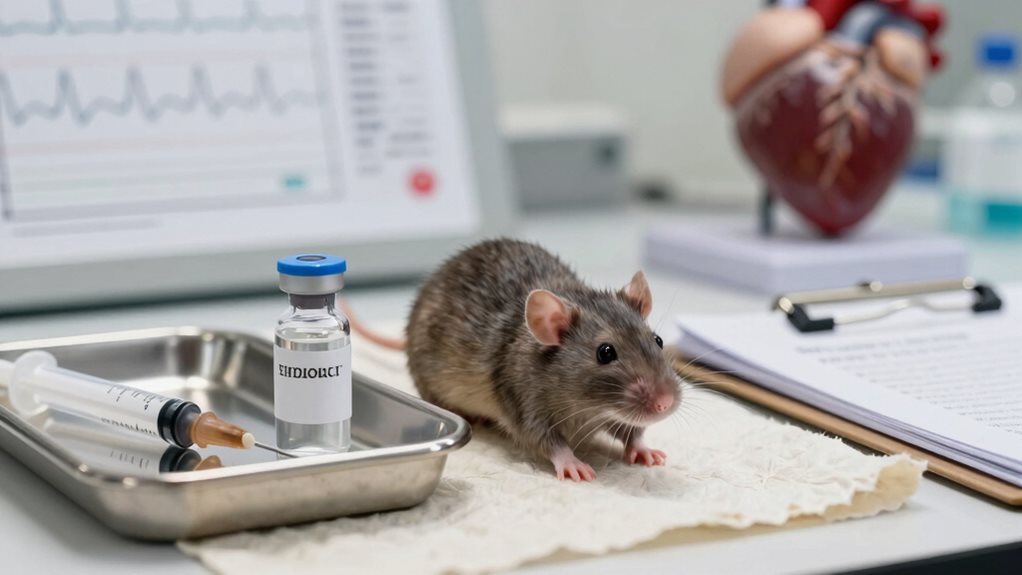
How might a synthetic peptide reshape our understanding of cardiac protection? Animal studies suggest GHRP-6 offers substantial cardioprotective effects across multiple damage models, including dilated cardiomyopathy, acute ischemia, and doxorubicin-induced toxicity. In rats, concomitant GHRP-6 improved survival from 42% to 84%, while pigs showed 78% reduced infarct mass and 50% thinner infarcts versus saline controls. Dogs receiving chronic therapy avoided sudden death entirely. These preclinical findings demonstrate improved left ventricular function, reduced myocardial damage, preserved muscle architecture, and attenuated adverse remodeling through anti-apoptotic, antioxidant, and metabolic mechanisms—though human outcome trials remain unconfirmed. New preclinical findings indicate that GHRP-6 may engage multiple pathways to support cardiac tissue under stress, reinforcing the potential for translational research into human therapies.
GHRP-6 for Injury Recovery Beyond Muscle
Beyond its promise for cardiac tissue, GHRP-6 shows intriguing potential for broader injury recovery, spanning soft tissue wounds, connective tissue repair, bone healing, and even nervous system protection. Delivery systems and formulation quality influence how peptides exert their effects in wounded or healing skin and tissues, shaping outcomes alongside dose and duration. You may find GHRP-6 accelerates wound closure and reduces scarring through growth hormone and IGF-1 release, which supports collagen synthesis, bone remodeling, and neuroprotection.
However, human clinical evidence remains limited, so you should view these applications as investigational rather than established therapies.
GHRP-6 Side Effects: Cortisol and Prolactin Spikes
While GHRP-6 offers notable benefits for growth hormone release and tissue recovery, you’ll want to understand its hormonal side effects before incorporating it into any regimen, particularly the transient spikes in cortisol and prolactin that accompany each dose.
Each injection typically elevates cortisol within thirty minutes, peaking briefly before resolving in two to three hours through ACTH stimulation, while prolactin rises via direct action on pituitary lactotrophs. The hormone fluctuations are influenced by dose and dosing frequency, with higher or more frequent dosing increasing cumulative exposure and potentially impacting sleep, mood, or recovery. These effects are dose-dependent, meaning lower amounts around 100 mcg often produce minimal changes, whereas higher or more frequent dosing increases cumulative exposure and may disrupt sleep, mood, or recovery.
You’ll find these hormonal fluctuations generally self-limiting, normalizing within hours, though sustained high-dose protocols beyond twelve to sixteen weeks raise concerns for persistent endocrine shifts, including potential gynecomastia in men or menstrual irregularities in women. Endocrine impact
What Changes How Well GHRP-6 Works
Several factors determine whether you’ll get a sturdy growth hormone response from GHRP-6 or a more modest effect, and understanding these variables helps you interpret research findings and optimize protocols. Your dose matters: responses grow until saturation near 1 mcg/kg, where diminishing GH gains meet rising cortisol and prolactin.
Timing, subcutaneous delivery, and intact hypothalamic GHRH signaling shape your outcome, while baseline hormone states and diurnal rhythms further modulate pulse magnitude.
Who Should Avoid GHRP-6 (and Why)
Who should steer clear of GHRP-6, and what makes these exclusions medically necessary? If you have active cancer, pituitary disorders, or uncontrolled diabetes, you should avoid this peptide entirely. GHRP-6 stimulates growth hormone release, which can fuel tumor growth, disrupt already compromised endocrine function, or worsen insulin resistance and blood glucose control.
Cushing’s syndrome and prolactinoma also warrant avoidance, since GHRP-6 elevates cortisol and prolactin—hormones already excessive in these conditions. Without FDA approval or formal safety labeling, you face uncertain risks in these vulnerable states.
Always consult an endocrinologist before considering any growth hormone secretagogue.
Frequently Asked Questions
Does GHRP-6 Cause Cancer Growth?
No direct evidence shows GHRP-6 causes cancer in humans, though theoretical concerns exist. GHRP-6 stimulates growth hormone release through the GHS-R1a receptor, activating pathways linked to cellular proliferation, which raises questions about promoting existing tumors rather than initiating cancer. Preclinical studies show mixed effects—some demonstrate signaling changes in tumor cells without proven growth stimulation, while others suggest transient impacts on established tumors in mice. Current research doesn’t establish carcinogenicity, but caution is warranted if you have active cancer or high genetic risk.
How Long Do GHRP-6 Effects Last?
GHRP-6’s growth hormone surge peaks within 15–30 minutes of your injection and tapers over 60–90 minutes, though measurable effects may persist 2–4 hours depending on your dose and metabolism.
You’ll notice appetite stimulation starting around the same 15–30 minute window, and this hunger effect typically lasts for several hours.
Most acute hormonal changes, including transient cortisol and prolactin elevations, resolve within 2–4 hours without lingering into the next day.
Can GHRP-6 Improve Sleep Quality?
GHRP-6 can alter your sleep architecture, but it won’t reliably improve your overall sleep quality. You’ll likely experience increased stage 2 sleep, which is lighter rest, rather than enhanced deep or REM sleep.
Your results depend heavily on dose, timing, and administration method, and the peptide’s cortisol-raising effects may actually counteract sleep benefits.
Current evidence doesn’t support using GHRP-6 as a dedicated sleep aid.
Is GHRP-6 Detectable in Drug Tests?
You won’t see GHRP-6 on standard workplace drug screens, as these panels target common substances like THC and opioids, not peptides.
However, specialized anti-doping laboratories using LC-MS/MS can detect it, with urine detection windows around 23 hours for the parent compound and roughly 12 hours for metabolites.
Athletes and military personnel face higher detection risks, since their testing protocols specifically include peptide analysis that routine employer screenings simply don’t cover.
What’s the Difference Between GHRP-6 and GHRP-2?
GHRP-2 and GHRP-6 both stimulate growth hormone through the ghrelin receptor, yet they differ in potency and side effects.
You’ll find GHRP-2 produces roughly 25–50% higher GH peaks, making it the stronger secretagogue, while GHRP-6 triggers markedly stronger appetite stimulation through hypothalamic pathways like NPY.
Additionally, GHRP-2 elevates ACTH, cortisol, and prolactin more substantially, whereas GHRP-6 offers a milder metabolic profile with minimal hunger suppression concerns.
And Finally
You’ve now investigated how GHRP-6 functions as a growth hormone secretagogue, stimulating your pituitary through dual receptor binding while remaining restricted to research settings. You understand its potential applications, from muscle support to injury recovery, alongside the hormonal trade-offs involving cortisol and prolactin. Ultimately, your decision to pursue this compound demands careful consultation with qualified medical professionals, thorough evaluation of your individual health profile, and strict adherence to legal and safety frameworks governing peptide research.
References
- https://www.frontiersin.org/journals/pharmacology/articles/10.3389/fphar.2024.1402138/full
- https://pmc.ncbi.nlm.nih.gov/articles/PMC13029777/
- https://pmc.ncbi.nlm.nih.gov/articles/PMC4854984/
- https://pmc.ncbi.nlm.nih.gov/articles/PMC12777158/
- https://pmc.ncbi.nlm.nih.gov/articles/PMC5392015/
- https://pubmed.ncbi.nlm.nih.gov/7772238/
- https://academic.oup.com/endo/article-abstract/151/5/2008/2456511

Pingback: Ipamorelin vs Hexarelin - PeptAtlas