
You need to understand that linear peptides are simple, straight chains of amino acids with open ends, offering flexibility but often limited stability. In contrast, branched peptides feature multiple chains attached to a central core, creating complex, multivalent structures that enhance stability, protease resistance, and biological activity. These differences influence their applications, with branched peptides excelling in targeting and durability, while linear ones are easier to synthesize. Exploring further reveals how their structures determine their functional advantages in various fields.
TLDR
- Linear peptides are open-chain with free N- and C-termini, offering flexibility, while branched peptides have multiple chains attached to a central core.
- Branched peptides feature complex, multivalent structures that enhance stability, receptor binding, and resistance to enzymatic degradation.
- Linear peptides are simpler and more cost-effective to synthesize but are generally more susceptible to proteolytic breakdown.
- Branched peptides provide multivalent interactions, improving potency, specificity, and bioavailability in therapeutic applications.
- Structural differences influence biological activity, stability, delivery methods, and the potential for advanced functionalities.
What Are Linear and Branched Peptides, and Why Do They Matter?
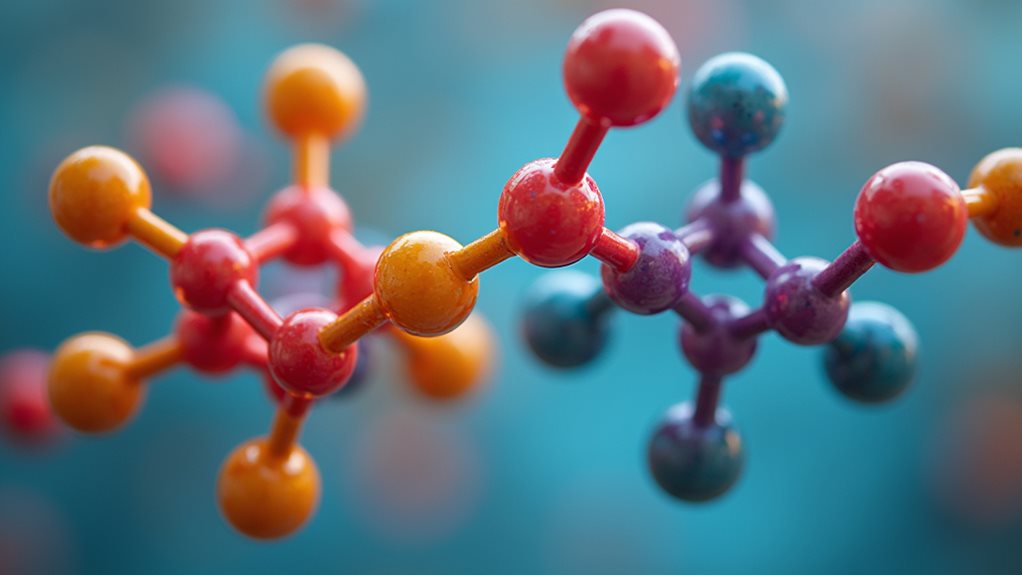
Have you ever wondered how the structure of a peptide influences its function and potential applications? Linear peptides are open-chain sequences with free N- and C-termini, offering flexibility and ease of synthesis, making them common in nature and research. In contrast, branched peptides have multiple chains attached to a core, creating complex, multivalent architectures that can enhance stability and biological activity. Multivalency and structural diversity can influence receptor binding and proteolytic resistance, making peptide topology a crucial factor in design and optimization.
How Are Peptides Synthesized and Designed?
Peptides are typically synthesized through well-established, reliable methods that enable precise control over their sequence and structure.
Solid-phase peptide synthesis (SPPS) is the most dominant and widely used technique for constructing both linear and branched peptides. This method involves attaching the initial amino acid to a resin, then sequentially adding protected amino acids through cycles of coupling and deprotection.
This process allows for accurate design and complex architectures.
In addition, SPPS can accommodate advanced strategies such as orthogonal protection schemes and branching motifs to create diverse peptide topologies. amylin analog and complementary approaches enable the exploration of multi-functional peptide constructs.
What Are the Structural Differences Between Linear and Branched Peptides?
Understanding the structural differences between linear and branched peptides is essential for appreciating their unique properties and potential applications. Branched peptides have multiple chains attached at a core, creating a multi-arm, three-dimensional structure. This complexity influences their functionality and interaction potential. Amino acid sequence governs not only the linear order but also how branching points affect overall stability and binding behavior.
Why Do Branched Peptides Offer Better Stability and Protease Resistance?
Branched peptides offer enhanced stability and resistance to proteases primarily because their increased structural complexity creates steric hindrance around vulnerable sites, making it more difficult for enzymes to access and cleave the peptide bonds.
This design also limits the conformational flexibility of the peptides, reducing the ways in which proteases can recognize and bind to them effectively.
Additionally, the multivalent and rigid nature of branched structures often impedes enzymatic attack, resulting in longer persistence in biological environments.
A notable regulatory shift highlights how design choices in therapeutic peptides can influence manufacturing and accessibility within clinical settings, underscoring the broader impact on drug development and supply chains regulatory landscape.
Increased Structural Complexity
The increased structural complexity of branched peptides plays a crucial role in enhancing their stability and resistance to proteolytic degradation.
Reduced Enzyme Accessibility
The three-dimensional structure of branched peptides plays a significant role in reducing their accessibility to enzymes that typically cleave peptide bonds, thereby enhancing their stability in biological environments.
Enhanced Conformational Rigidity
Conformational rigidity plays a crucial role in enhancing the stability and protease resistance of peptides.
Branching structures inherently contribute to this increased rigidity. The steric crowding from branching limits accessible conformations, making peptides less flexible and more ordered.
This reduced flexibility decreases their likelihood of unfolding or adopting protease-favorable shapes.
Ultimately, this structural constraint improves their resistance to enzymatic degradation.
How Do Peptide Architectures Affect Biological Activity and Delivery?
Peptide structures substantially influence both their biological activity and their effectiveness as delivery systems, as the structural design determines how these molecules interact with cellular targets and steer biological environments.
Branched frameworks offer greater control over bioactive motifs, enhancing receptor binding and stability, while linear peptides tend to be more flexible but often face challenges like rapid degradation and limited permeability, affecting their therapeutic potential.
New insights from follistatin-344 research highlight how specific signaling interactions can modulate muscle-related pathways, providing additional context for how architecture may influence efficacy in signaling-rich environments. Follistatin-344 signaling can modulate multiple pathways involved in muscle growth and regulation, underscoring the importance of stability and receptor engagement in peptide design.
What Are Common Applications of Linear and Branched Peptides?
Linear and branched peptides serve a variety of essential roles across multiple scientific and medical fields, with applications that include therapeutic development, targeted drug delivery, and imaging techniques.
Branched and linear peptide designs also influence stability and bioavailability, with branched structures often enhancing binding strength and multivalency stability profiles and linear sequences offering straightforward synthesis for broad drug-development efforts.
Therapeutic Development Uses
Understanding the diverse applications of peptide therapeutics reveals how their structural variations influence their use across different medical fields.
Linear peptides are primarily used for hormone replacement, metabolic regulation, and antimicrobial therapies.
Meanwhile, branched peptides excel in tumor targeting and vaccine development through multivalent binding.
Both structures serve critical roles in advancing disease treatment and management strategies.
Targeted Drug Delivery
Have you ever wondered how targeted drug delivery systems achieve such precision in directing therapeutic agents to specific cells or tissues? Branched peptides serve as multivalent ligands, improving binding to tumor markers and reducing off-target effects, especially in cancer therapy.
Linear peptides guide payloads into tissues and cells, enhancing specificity and intracellular delivery of proteins, nucleic acids, or small molecules.
Biomaterials and Imaging
In biomaterials and imaging applications, peptides serve as versatile tools due to their ability to form structured assemblies and interact specifically with biological targets.
Linear peptides are often used to create nanofibers and hydrogels supporting cell growth, while branched peptides enhance functional density and control, improving imaging signals, receptor targeting, and biomineralization.
Both types contribute markedly to advanced tissue engineering and diagnostic technologies.
How to Choose the Right Peptide Architecture for Your Goals
Choosing the appropriate peptide design depends on your specific goals and the biological environment in which the peptide will be used. Different structures offer distinct advantages and limitations.
Branched peptides provide multivalent interactions, improved stability, and higher binding strength. They are making them ideal for complex or therapeutically demanding scenarios.
GHRP-6 and GHRP-2 differ in appetite stimulation and potency profiles, influenced by their receptor interactions and peptide architecture. GHRP-6 vs GHRP-2 can inform how peptide design shapes biological outcomes.
Frequently Asked Questions
How Does Branching Influence Peptide Folding and Overall Three-Dimensional Structure?
Branching influences peptide folding by reducing conformational freedom, stabilizing certain structures, and promoting complex three-dimensional shapes like multi-arm or dendrimer-like frameworks. It enhances self-assembly, stability, and functional diversity, shaping the peptide’s overall spatial organization.
What Are the Main Challenges in Synthesizing Complex Branched Peptides?
You face challenges like steric hindrance, poor coupling efficiency, and complex protecting-group control. Purification is tough, workflows are labor-intensive, and achieving reproducibility and scalability remains difficult due to multiple steps, side reactions, and product heterogeneity.
Can Branched Peptides Be Modified Post-Synthesis for Enhanced Function?
Yes, you can modify branched peptides after synthesis using chemoselective reactions like click chemistry or reductive amination. These modifications allow you to add functional groups, labels, or targeting modules efficiently, enhancing their biological and functional properties.
How Do Different Branch Points Impact Peptide Stability and Biological Activity?
You’ll find that branch points near vulnerable ends enhance stability by blocking enzymes, while internal branches improve structural rigidity and target binding. Positioning branches strategically influences both peptide resistance to degradation and its biological activity.
Are There Specific Analytical Techniques Best Suited for Characterizing Branched Peptides?
You should use a combination of analytical techniques like LC-MS or MALDI-TOF MS for mass confirmation, NMR for structure, and HPLC or UPLC for purity. Combining methods guarantees precise, thorough characterization of branched peptides’ complex structures.
Final Note
Choosing between linear and branched peptides depends on your specific goals, such as stability, biological activity, or delivery. Understanding their structural differences and synthesis methods allows you to make informed decisions, optimizing performance for your applications. While branched peptides generally offer enhanced stability and resistance to proteases, linear peptides may suit simpler, cost-effective needs. Carefully evaluate your requirements, considering factors like functionality and target environment, to select the framework that best aligns with your scientific or therapeutic objectives.
References
- https://pubs.rsc.org/en/content/articlehtml/2025/tb/d4tb01897d
- https://www.lkouniv.ac.in/site/writereaddata/siteContent/202004091956360737nalini_pandey_Amino_acids_proteins.pdf
- https://peptidenexus.com/article/branched-peptides-2016-04-18
- https://semaxpolska.com/en_gb/structure-and-types-of-peptides/
- https://www.turito.com/blog/chemistry/peptides
- https://pubs.rsc.org/en/content/articlepdf/2025/tb/d4tb01897d
- https://onlinelibrary.wiley.com/doi/full/10.1002/psc.3335
- https://peptides.com/blog/peptide-bond-architecture/
- https://tspace.library.utoronto.ca/bitstream/1807/70033/1/Yu_Chiayun_201311_MSc_thesis.pdf
- https://pmc.ncbi.nlm.nih.gov/articles/PMC6369414/