You’ll study peptides through a pipeline that begins with sourcing natural molecules from venom, marine byproducts, or plant proteins, then builds them using solid-phase synthesis where amino acids are assembled step-by-step on resin supports. You’ll verify identity with mass spectrometry and HPLC purity checks, test function in cell lines to map intracellular activity, and validate findings in animal models that account for species differences in receptor structure and clearance rates before any human safety trials can proceed.
TLDR
- Peptides are synthesized step-by-step on solid-phase resins using automated chemistry cycles.
- Identity and purity are verified through mass spectrometry and high-performance liquid chromatography.
- Binding affinity and kinetics are measured using surface plasmon resonance and isothermal titration calorimetry.
- Cellular effects are observed through peptidomics, signal tracing, and phenotypic response studies.
- Animal models translate findings to living systems for safety, dosing, and regulatory validation.
From Venom to Vial: Where Research Peptides Originate

Whether you’re new to peptide research or simply looking to understand where these molecules come from, you’ll find that research peptides originate from a remarkably diverse array of natural sources, each offering unique advantages for scientific investigation. You can extract bioactive peptides from animal proteins like milk, eggs, and meat, or investigate plant sources including soybean and wheat germ for antioxidant properties. Marine byproducts—fish heads, skin, and fins—offer abundant, underutilized reservoirs, while venom peptidomics reveals highly bioactive molecules evolved for precise physiological targeting, guiding your selection based on availability, sequence motifs, and desired biological activity. LL-37 is one example of how antimicrobial peptides illuminate immune mechanisms and potential therapeutic pathways immune function as well as their broader roles in host defense and inflammation.
How Labs Build Synthetic Peptides From Amino Acids
You’ll start by learning how solid-phase peptide synthesis anchors your first amino acid to a resin support, a method that lets you build the chain step-by-step while keeping reactions simple and controlled.
In this context, researchers must carefully consider mitochondrial-targeting mechanisms and the role of peptide conformation to ensure correct assembly and function mitochondrial targeting as they design and optimize synthesis routes.
Solid-Phase Synthesis Basics
The foundation of modern peptide synthesis rests on a technique that lets you build chains one amino acid at a time while keeping everything anchored to a solid surface. You begin by attaching the first amino acid to an insoluble resin through its carboxyl group, then extend the chain from C-terminus toward N-terminus using protected amino acids. Each cycle involves deprotection, coupling, and washing, with Fmoc or Boc chemistry shielding reactive groups until needed. Automation becomes possible because you’re repeating identical steps. Once assembly finishes, you’ll cleave the peptide with acid, remove side-chain protections, and recover your product through precipitation and lyophilization.
Amino Acid Selection
How do you decide which building blocks to use when assembling a peptide from scratch? You begin with sequence-driven selection, choosing each amino acid’s order carefully because this determines structure, folding, and purification. You’ll use protected forms to prevent side reactions, selecting natural or non-natural residues based on your research goals. Reactivity and coupling efficiency guide your choices, ensuring high yields and precise control over the final peptide’s function.
Quality Verification Methods
Once you’ve assembled your peptide chain through careful amino acid selection and coupling chemistry, you face the next phase: proving that what you’ve built matches what you intended. You’ll use reverse-phase HPLC to assess purity by separating species based on hydrophobicity, monitoring at 214 or 220 nm, though a single peak doesn’t guarantee identity since co-eluting impurities may hide within it. Mass spectrometry provides orthogonal confirmation, with MALDI-TOF-MS or ESI-MS comparing measured mass against theoretical values to catch oxidation, dehydration, or cleavage products. For regulatory work, you’ll add peptide mapping, amino acid analysis, and even NMR to build unambiguous evidence that your sequence, composition, and content meet the required specifications.
How Scientists Verify What a Peptide Actually Is
Once you’ve synthesized a peptide, you’ll need to confirm both its chemical identity and its purity before you can trust it for experiments. Mass spectrometry provides high-resolution molecular weight confirmation that supports the expected sequence, while tandem MS fragmentation patterns reveal specific amino acid arrangements through characteristic ion series. High-performance liquid chromatography serves as your complementary tool for purity assessment, separating your target peptide from impurities, truncated forms, or modifications that might otherwise compromise your results.
Chemical Identity Confirmation
Identity confirmation stands as the cornerstone of peptide research, ensuring that the molecule in your vial matches the sequence you designed before you invest time, money, and biological samples in downstream experiments. You’ll rely on mass spectrometry as your primary tool, where you compare your peptide’s observed molecular mass against its theoretical mass, looking for matches within 0.5–1.0 Da tolerance. You should also use tandem MS/MS, which fragments your peptide and measures b-ions and y-ions to verify the actual sequence order through mass differences between adjacent fragments. For additional confidence, you’ll often combine these methods with peptide mapping, where selective enzymatic cleavage generates predictable fragments for chromatographic comparison against reference standards. When characterizing critical reference materials, you may incorporate NMR to confirm structural features beyond mass alone, recognizing that correct molecular weight doesn’t guarantee correct sequence arrangement. Ultimately, you’ll adopt an orthogonal approach—pairing MS with chromatography or other independent methods—because single-technique verification, however precise, rarely provides sufficient certainty for rigorous research applications.
Purity Assessment Methods
After confirming that your peptide possesses the correct chemical identity, you’ll turn your attention toward determining how much of that correct material is actually present in your sample, alongside what else might be sharing the same vial. You’ll primarily rely on reversed-phase HPLC, where your peptide separates from impurities based on chemical interactions with the stationary phase, producing distinct peaks you can quantify by UV absorbance at 210–220 nanometers. This percentage-based area calculation reveals truncated sequences, oxidation products, and synthesis byproducts, though you’ll want LC-MS confirmation when overlapping peaks or non-UV-absorbing contaminants complicate interpretation.
What Cell Studies Reveal About Peptide Function
How, then, do researchers uncover what peptides actually do once they’re inside a cell? You’ll find that cell-line peptidomics reveals thousands of intracellular peptides generated by proteasomes and processed by enzymes like thimet oligopeptidase, forming dynamic pools across the cytosol, nucleus, and mitochondria. These studies show you conserved peptide profiles across species, suggesting fundamental cellular roles rather than random byproducts. You can observe peptides modulating signal transduction, protein-protein interactions, and mitochondrial stress responses, acting as local regulators that fine-tune pathways without requiring classical hormone-like secretion. conserved profiles
Why Animal Models Still Matter for Peptide Research
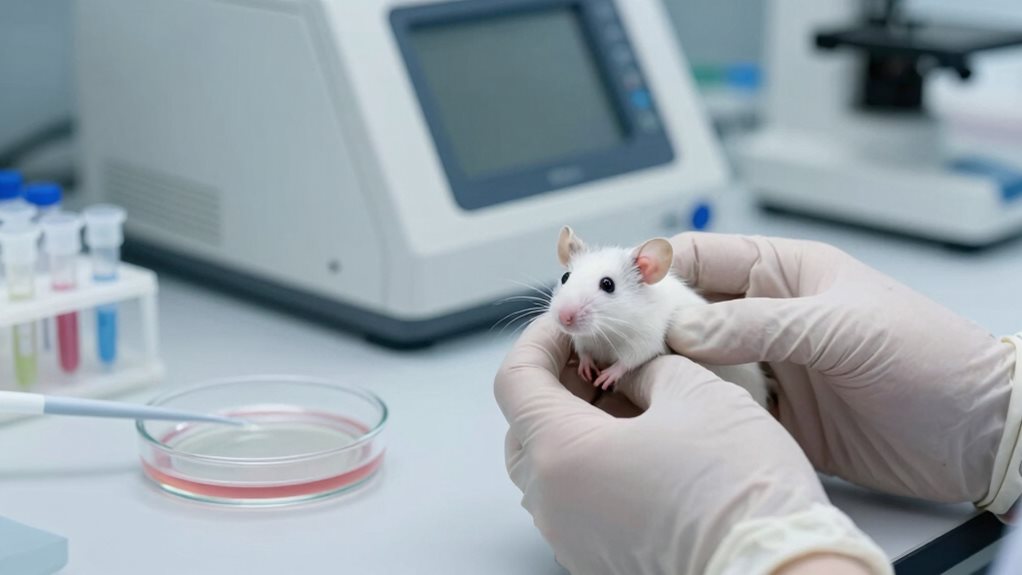
Where do researchers turn when cell studies, however illuminating, can’t predict how a peptide will behave in a living, breathing organism? You look to animal models, which remain essential for bridging laboratory findings and human trials. Through in vivo testing, you’ll observe how peptides distribute, bind receptors, and alter pathways within complete biological systems. These studies generate critical safety data, establish dose frameworks, and satisfy regulatory requirements—particularly for investigational drugs seeking first-in-human approval. The choice of species is guided by receptor homology and metabolic similarity to ensure relevant translational insights, and strict interpretation is applied to cross-species differences to account for potential variability. ethical guidelines
How Researchers Decode a Peptide’s Mechanism of Action
Once you’ve observed a peptide’s effects in living systems, you’ll need to determine precisely how it produces those outcomes—whether by locking onto a cell-surface receptor, disrupting a protein partnership, or some other molecular strategy. You’ll identify your target through structural mapping and rational design, then define the minimal active motif using truncation studies and alanine scanning.
Quantitative binding assays like SPR and ITC measure your peptide’s affinity and kinetics, distinguishing direct engagement from indirect effects.
Finally, you’ll trace signal transduction through second messenger pathways and phenotypic responses, validating specificity through computational docking and comparative studies that link molecular events to cellular outcomes.
Why Most Research Peptides Die Before Human Testing
Research peptides rarely survive the journey from laboratory bench to human clinical trials, and you’ll find that the attrition isn’t random—it’s driven by predictable, well-documented barriers that claim roughly 90% of promising candidates before they ever reach Phase 1.
You’ll encounter translational mismatches, where rodent receptors differ from human ones by 10–25%, and animals clear peptides 7–10 times faster, distorting your dose predictions. translational mismatches
You’ll struggle with pharmacokinetic instability, as rapid enzymatic breakdown prevents therapeutic concentrations from persisting.
You’ll face immunogenicity risks, where foreign sequences trigger antibody formation that complicates safety evaluation.
You’ll discover that only 18–25% of peptides entering Phase 2 ever advance, meaning most candidates fail when human efficacy is finally tested.
What Phase I Trials Reveal About Peptide Safety
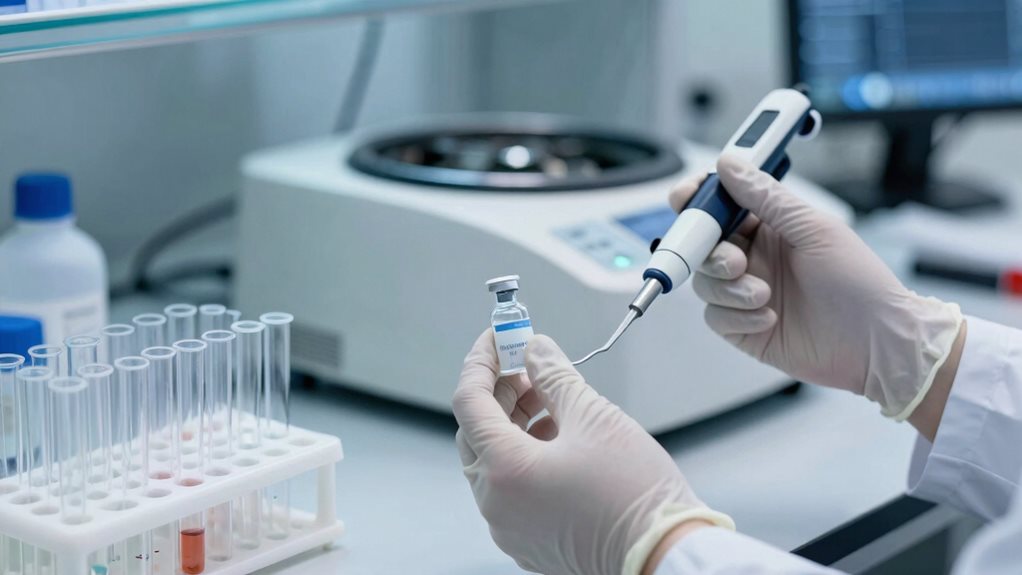
How do researchers finally bridge the gap between animal data and human biology? They conduct Phase I trials, where you’ll see scientists test peptide safety, tolerability, and how your body absorbs and clears the compound. These studies use careful dose escalation to find maximum tolerated doses and watch for adverse reactions. You’ll learn that many peptides prove well tolerated, with only mild effects like injection-site pain, reassuring you that development can advance. In Follistatin-344 research, early human testing often focuses on safety signals and pharmacokinetics to guide further study pharmacokinetics and determine how the peptide behaves in the body.
Where Peptide Research Goes Next: AI, Delivery, and New Diseases
Although you’ve seen how researchers establish peptide safety in early human trials, the field is now advancing far beyond traditional methods, and you’re witnessing a transformation driven by artificial intelligence, innovative delivery systems, and expansion into new therapeutic areas. BDNF upregulation may emerge as a guiding benchmark for neuropeptide research as AI-driven design increasingly targets multi-pathway brain modulation.
And Finally
You’ve now traced the complete journey of research peptides, from natural discovery through rigorous validation to clinical evaluation, and you understand why this process demands years of meticulous work before any therapeutic potential can be realized. As you look toward the future, you’ll see artificial intelligence accelerating peptide design, novel delivery systems solving bioavailability challenges, and expanded applications addressing previously untreatable conditions, ensuring that this field remains essential to biomedical progress for decades to come.
References
- https://chameleonpeptides.com/how-peptides-work/
- https://www.peptideprotocolwiki.com/learn/research-methods
- https://pr.wvcjournal.com/article/Peptide-Science-Mechanisms-and-Research-Applications?storyId=6916f3fbccaac100022e4a08
- https://pmc.ncbi.nlm.nih.gov/articles/PMC8844085/
- https://www.mexc.com/news/1013741
- https://peptideware.com/research-peptides-guide/
- https://www.ncbi.nlm.nih.gov/books/NBK562260/
- https://www.nature.com/articles/s41392-022-00904-4
- https://www.nature.com/articles/s41392-024-02107-5
- https://www.mcgill.ca/oss/article/medical-did-you-know/there-much-pep-peptide-research