You’ll choose GHK-Cu for skin, hair, and surface tissue concerns, since this copper-binding peptide activates dermal fibroblasts and boosts collagen production by 30-70% at nanomolar concentrations through topical application. For deeper injuries involving tendons, ligaments, muscles, or nerves, BPC-157 offers stronger preclinical support through angiogenesis and cytoprotective pathways, though you’ll need oral or injectable delivery rather than topical use. Both remain unapproved drugs with limited human trial data, so your specific tissue target—surface versus deep structure—drives the appropriate selection, and the sections ahead break down mechanisms, delivery methods, and safety considerations to guide your decision.
TLDR
- GHK-Cu targets skin and surface tissues, while BPC-157 excels in deeper musculoskeletal repair.
- GHK-Cu boosts collagen production 30-70% via copper-dependent dermal fibroblast activation.
- BPC-157 demonstrates stronger preclinical support for tendon, ligament, and muscle healing.
- Topical GHK-Cu penetrates locally; BPC-157 requires injection for reliable systemic exposure.
- Both peptides remain unapproved drugs with limited controlled human trial data available.
GHK-Cu vs. BPC-157: Which Matches Your Injury Type?
When you’re weighing GHK-Cu against BPC-157, your specific injury type—not just your general wellness goals—ought to guide your decision, since these peptides operate through distinctly different biological pathways and tissue affinities. For deep musculoskeletal damage, gut injury, or nerve trauma, BPC-157 offers stronger preclinical support through angiogenesis and cytoprotection. GHK-Cu suits surface collagen repair and matrix quality instead. Angiogenesis
Skin and Hair: Why GHK-Cu Outperforms BPC-157 Here
When you look at how GHK-Cu actually works in your skin, you’ll find it directly activates fibroblasts—the cells that manufacture collagen—while also supplying copper as an essential cofactor for antioxidant enzymes that protect your dermal matrix from oxidative damage, a dual mechanism that BPC-157 simply doesn’t replicate with the same specificity for cosmetic tissue. GHK-Cu’s signaling also engages pathways that influence skin thickness and elasticity, supporting lasting improvements in visible texture and resilience. Your hair follicles also respond to GHK-Cu’s signaling, which helps regulate the growth cycle and can reduce shedding while encouraging the emergence of new, finer hairs that gradually thicken over time. These copper-dependent repair pathways, combined with GHK-Cu’s documented effects on skin thickness, elasticity, and wrinkle depth in human trials, make it the clearly targeted choice when your goal is visible, lasting improvement in skin quality and hair density rather than the deeper tissue repair where BPC-157 shows its strengths. copper-dependent repair pathways
Collagen Production Mechanisms
How exactly does your skin rebuild its structural foundation after damage, sun exposure, or the natural collagen loss that accelerates with age? GHK-Cu activates your dermal fibroblasts directly, enhancing type I and III collagen production by 30-70% at nanomolar concentrations through TGF-beta signaling and gene upregulation, while BPC-157 lacks comparable fibroblast-specific, collagen-focused mechanistic documentation in skin models.
Copper-Dependent Skin Repair
Why does copper matter so much for your skin’s ability to repair itself, and what makes GHK-Cu uniquely positioned to deliver it? Copper serves as an essential cofactor for lysyl oxidase, which crosslinks collagen for structural integrity, and superoxide dismutase, your skin’s antioxidant defense. GHK-Cu acts as a precise copper carrier, delivering these ions directly to dermal tissue where they enable extracellular matrix remodeling, gene regulation affecting over 4,000 genes, and melanin production—mechanisms BPC-157 simply doesn’t possess.
Hair Follicle Stimulation
Where does meaningful hair regrowth actually begin—at the level of blood vessels supplying the scalp, or within the follicle itself? You’ll find GHK-Cu operates directly inside follicles, extending anagen phase and enlarging follicles up to 46%, while BPC-157 supports scalp repair through angiogenesis without comparable cycle control. For targeted stimulation, you should prioritize GHK-Cu.
Tendons, Gut, and Muscle: Where BPC-157 Beats GHK-Cu
When you’re dealing with injuries beneath the surface—whether that’s a strained tendon, damaged gut lining, or recovering muscle tissue—you’ll find that BPC-157 offers something GHK-Cu simply doesn’t match in the current research landscape. In preclinical studies, BPC-157 has shown targeted tissue repair effects through pathways like VEGFR2-driven angiogenesis and FAK-paxillin signaling, which supports localized healing at injury sites regulatory status and safety considerations remain unproven in long-term human use.
Deep Tissue Repair
Deep tissue repair demands more than surface-level remodeling, and this is where BPC-157 distinguishes itself from GHK-Cu in meaningful, evidence-backed ways. You’ll find BPC-157’s preclinical evidence substantially stronger for tendons, ligaments, and muscle, where it promotes angiogenesis, fibroblast activity, and biomechanical recovery within 7–28 days.
GHK-Cu excels in skin and surface tissues but lacks comparable depth for internal connective structures.
Gastrointestinal Protection Benefits
How does internal tissue recovery differ when you’re dealing with the delicate mucosal linings of your gastrointestinal tract rather than surface-level wounds?
For gut-specific healing, you’ll find BPC-157 carries the stronger research record, with studies highlighting its protection against ulcers and drug-induced damage, whereas GHK-Cu remains more relevant to collagen and skin repair than intestinal barrier support.
Delivery Methods: Topical GHK-Cu, Oral or Injectable BPC-157
Where topical GHK-Cu and systemic BPC-157 diverge most clearly is in how you’re actually getting these peptides into your body, and this distinction shapes everything from what you can realistically treat to how quickly you might notice results.
You’ll apply GHK-Cu directly to skin, where it penetrates through hair follicles and works locally on texture, firmness, and healing without entering your bloodstream meaningfully.
You’re choosing concentrations between 0.1% and 2%, knowing that exceeding this range risks irritation without added benefit.
With BPC-157, you’re weighing oral convenience against injectable efficiency: swallowing means facing digestive degradation for possible gut or systemic support, while injecting bypasses this obstacle for more direct exposure.
Your decision hinges on whether you need targeted surface repair or deeper physiological engagement. Delivery context
Human Trials vs. Animal Studies: What Each Peptide Actually Has
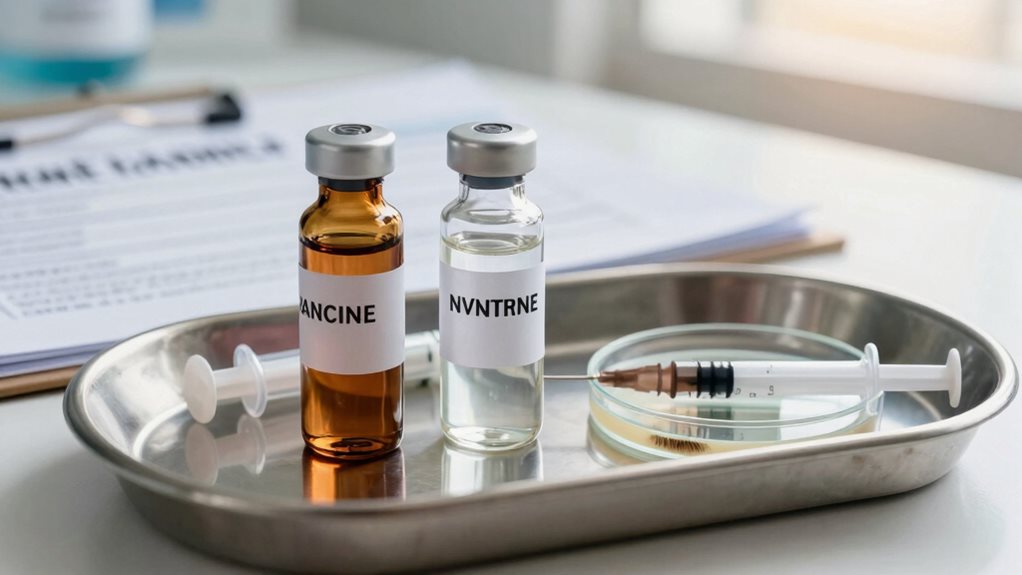
When you’re weighing these peptides against each other, you’ll quickly notice that neither one rests on a foundation of robust, large-scale human trials—yet the nature and extent of their evidence gaps differ substantially, and understanding these distinctions matters enormously for setting realistic expectations about what each compound can actually deliver.
GHK-Cu offers you controlled human data, but only for topical skin applications like collagen remodeling and wrinkle reduction, with over 250 lab studies and promising animal wound-healing research that simply hasn’t translated to human trials for systemic or injectable uses.
BPC-157 presents you with a starker contrast: genuinely strong animal evidence for tendon, gut, and ligament repair, yet merely three small uncontrolled human studies totaling under thirty patients, leaving its clinical efficacy entirely unconfirmed in rigorous human settings.
Safety, Side Effects, and Legal Status for Both Peptides
Why should you care about safety profiles when both peptides carry substantial unknowns? You face different risks with each compound. GHK-Cu offers you decades of topical safety, though injectable forms raise copper toxicity concerns. BPC-157 lacks human trial data, leaving you with only animal studies for reassurance. Both remain unapproved drugs, legal as research chemicals but barred from therapeutic marketing, and you must weigh infection risks from unregulated products against uncertain long-term effects. regulatory status
Quick Reference: Match Your Condition to the Right Peptide
You’ve weighed the uncertainties, and now you’re ready to match a peptide to your specific situation—this requires looking at what each compound actually does rather than what you hope it might do.
Thymosin Alpha-1 can influence innate and adaptive immune responses, which may have implications for tissue repair processes in certain contexts and can modulate responses to infections or immune challenges. immune modulation Think about how immune signaling intersects with healing when considering peptide options.
Frequently Asked Questions
Can I Use Both Peptides Together Safely?
You can use GHK-Cu and BPC-157 together, as their mechanisms complement rather than compete, though no controlled studies have tested this combination directly. Administer them separately—different injection sites or time gaps—to avoid potential pH or stability concerns, since guidance on mixing remains disputed. Follow typical 4–8 week cycles with breaks, and consult a clinician if you have active cancer history, as angiogenesis-related theoretical risks exist.
What’s the Typical Cost Difference Between Them?
You’ll typically spend less on GHK-Cu, especially with topical formulations running $30-$80 monthly, while BPC-157 usually costs $150-$300 per month through compounding pharmacies.
Injectable GHK-Cu narrows this gap, landing around $100-$250 monthly, which overlaps with BPC-157’s standard range.
Your final cost depends heavily on formulation choice, pharmacy sourcing, and whether you’re using cosmetic-grade products versus clinical protocols with professional oversight.
How Long Until I See Results With Each?
With GHK-Cu, you’ll typically notice improved hydration and reduced redness within one to four weeks, while visible texture changes and fine-line reduction emerge around eight to twelve weeks, with peak results at three to four months.
For BPC-157, human timeline data remains limited, though some users report early effects within days to weeks for recovery-related goals; however, no strong clinical evidence establishes consistent cosmetic timelines comparable to GHK-Cu.
Are These Peptides Banned in Sports Testing?
Yes, BPC-157 is banned under WADA’s S0 category with no therapeutic use exemption available, meaning you’ll face sanctions if detected, while GHK-Cu occupies a grayer zone—it isn’t explicitly named but is often treated as prohibited by function, especially when injected, so you should assume significant risk with both compounds if you’re subject to sports testing.
Can I Buy These Peptides Without a Prescription?
You can buy GHK-Cu without a prescription as a cosmetic ingredient—look for “copper tripeptide-1” in serums and creams—but injectable forms require medical oversight and aren’t legally available over-the-counter.
BPC-157, however, isn’t sold legally for human use without a prescription; it’s marketed as a research chemical, meaning commercial availability doesn’t equal compliant consumer access.
For both peptides, formulation and intended use determine what’s permissible, so verify local regulations before purchasing.
And Finally
You now understand that GHK-Cu serves your skin, hair, and surface-level needs through topical application, while BPC-157 addresses deeper structural injuries involving tendons, muscles, and gastrointestinal tissues via oral or injectable routes. Your specific condition, not general popularity, determines your optimal choice. Both peptides demonstrate favorable safety profiles in available research, though you should verify current legal status in your jurisdiction and consult a qualified healthcare provider before initiating any peptide-based protocol.