Amino acid sequences in peptides are the specific order of amino acids linked by peptide bonds, which determines the peptide’s structure, function, and interactions. They are written from the N-terminus to the C-terminus, ensuring clarity and consistency in notation, often using one-letter or three-letter codes. Variations in sequence can substantially influence folding, stability, and biological activity. Understanding these details can enhance your grasp of how peptides behave, with further understanding available as you investigate more.
TLDR
- Amino acid sequences are the specific order of amino acids in a peptide, crucial for its structure and function.
- Sequences are written from the N-terminus to the C-terminus, reflecting peptide synthesis direction.
- Small sequence variations can significantly impact peptide folding, stability, and biological activity.
- The primary structure determines how peptides fold into functional three-dimensional shapes.
- Accurate sequence notation, including terminal groups, is essential for understanding peptide behavior and designing therapeutics.
What Are Amino Acid Sequences and Why Do They Matter?
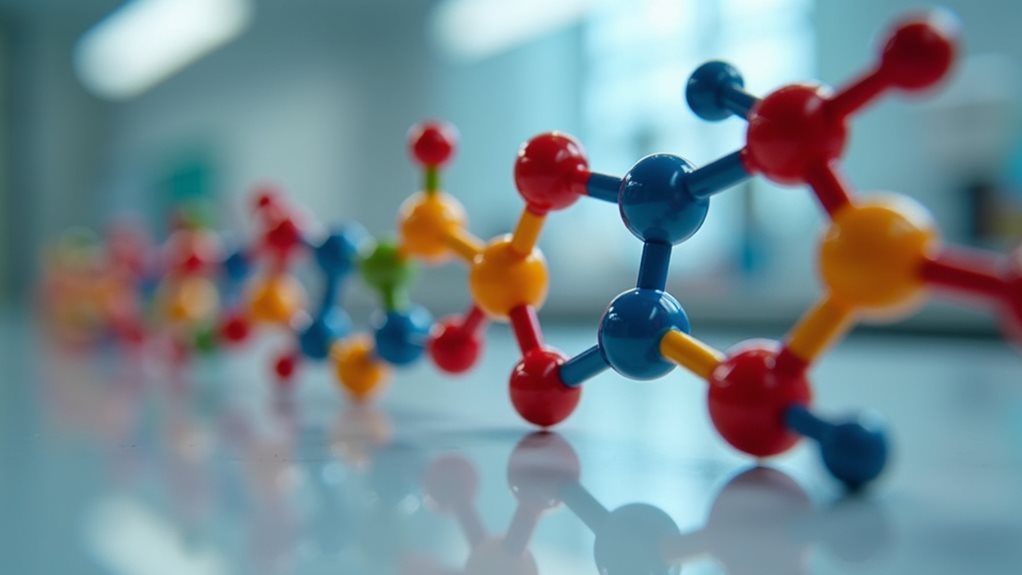
Have you ever wondered what makes one peptide or protein different from another, even if they contain the same types of amino acids? It’s the amino acid sequence, which is the specific order of these building blocks in a chain, known as the primary structure. This order encodes essential information, influencing how the molecule folds, functions, and interacts within biological systems. Peptide chains determine the precise three-dimensional shape that drives activity.
How Are Peptides Built From Amino Acids?
Peptides are constructed through a highly controlled series of chemical reactions that link amino acids together in a specific sequence. During synthesis, amino acids are oriented so that the carboxyl group of one amino acid forms a covalent peptide bond with the amino group of the next amino acid, releasing water in a dehydration reaction. Repeating these bonds creates a backbone, gradually building short peptides into longer chains. peptide bonds form specifically through condensation reactions that release a water molecule, linking amino acids in a defined order.
What Is the Direction of a Peptide Sequence (N-Terminus to C-Terminus)?
Understanding the direction of a peptide sequence is essential for accurate interpretation, as it’s conventionally written from the N-terminus, which has a free amino group, to the C-terminus, with a free carboxyl group.
This left-to-right notation reflects both the chemical structure and the biological synthesis process, ensuring consistency across scientific communication.
Recognizing this orientation helps prevent errors when comparing sequences, analyzing modifications, or designing peptides for research and therapeutic applications.
Thymosin Alpha-1 is a peptide with immune-modulating properties that exemplify how peptide sequences are studied and described in scientific literature.
Sequence Notation Direction
The standard notation for peptide sequences follows a specific direction from the amino terminus (N-terminus) to the carboxyl terminus (C-terminus), which guarantees consistency and clarity across scientific communication.
You read sequences from left to right, starting at the N-terminal end, ensuring that each residue’s position is correctly identified and that the peptide’s primary structure remains unambiguous.
N-Terminus and C-Terminus Roles
The directionality of a peptide sequence, which runs from the amino terminus (N-terminus) to the carboxyl terminus (C-terminus), provides a standardized structure for describing and analyzing protein structures.
This orientation influences how proteins are synthesized, with the N-terminus involved in targeting and signaling, while the C-terminus contributes to stability and interactions essential for proper protein function.
Why Does the Sequence of Amino Acids Affect Peptide Structure and Function?
The sequence of amino acids in a peptide directly determines how it folds into specific three-dimensional structures, as the order influences interactions between side chains, hydrogen bonds, and other stabilizing forces. This folding process not only defines the peptide’s shape but also affects its biological function, since active sites and binding surfaces depend on the precise arrangement of residues. As a result, even small changes in sequence can lead to significant differences in structure and activity, highlighting the importance of amino acid order in peptide behavior. peptide folding
Sequence Determines Folding
Amino acid sequences serve as the fundamental blueprint that determines how peptides fold into their specific three-dimensional structures. Your sequence encodes the interactions between side chains, influences backbone angles, and guides secondary structure formation.
Small changes in the sequence can shift the lowest-energy fold, affecting the overall shape and stability, which ultimately impacts the peptide’s function.
Function Depends on Order
Understanding how amino acid sequences influence the structure and function of peptides depends on recognizing that the specific order of residues determines the exposure and arrangement of chemical groups critical for biological activity.
The sequence controls recognition, shapes functional sites, and even single-residue changes can considerably alter activity, making the order essential for proper peptide function and interaction within biological systems.
How Are Peptide Sequences Represented: One-Letter vs. Three-Letter Codes?
Peptide sequences can be depicted using two main formats: the one-letter code and the three-letter code, each serving different purposes and audiences.
In research on stability and bioactivity, N-Acetyl Semax and Semax illustrate how small chemical modifications can influence peptide performance and interpretation of results. N-Acetyl Semax and Semax offer comparative insights into stability profiles and functional outcomes across studies.
What Is the Primary Structure of a Peptide?
The primary structure of a peptide refers to the specific sequence of amino acids linked together in a straight chain through peptide bonds, which are covalent connections formed by a condensation reaction. This sequence, written from the amino (N) to the carboxyl (C) terminus, determines the peptide’s identity and serves as the foundation for higher levels of structure. Understanding this linear order is essential because even small changes in the sequence can markedly alter the molecule’s properties and biological function. Epitalon and Thymosin Alpha-1 are studied in longevity research, and their different targets illustrate how variations in peptide structure can influence biological effects peptide structure and targets.
Definition of Primary Structure
Have you ever wondered what makes each peptide unique at the most fundamental level? The primary structure is the exact, linear sequence of amino acids linked by peptide bonds, from the N-terminus to the C-terminus.
It defines the peptide’s identity, composition, and serves as the foundation for its three-dimensional folding and biological function.
Importance of Sequence Order
Understanding why the sequence of amino acids matters is fundamental to grasping how peptides function and interact in biological systems.
Your peptide’s identity, structure, and function depend on the precise order of residues, as small changes can alter folding, stability, and activity.
This sequence encodes biological instructions, directly influencing how the peptide behaves and interacts within complex cellular processes.
Representation of Sequences
The primary structure of a peptide refers to the specific linear sequence of amino acid residues arranged in a defined order along the chain.
This sequence, written from the amino-terminal to the carboxyl-terminal end using three-letter or single-letter codes, reflects the covalent peptide bonds linking residues.
It’s the fundamental blueprint upon which higher structural levels depend and is vital for understanding peptide function.
How Do Scientists Determine Amino Acid Sequences in Peptides?
Mass spectrometry, especially tandem MS/MS, ionizes peptides, measures their mass-to-charge ratios, and fragments them for sequence analysis using software.
Edman degradation offers complementary N-terminal sequencing, especially for shorter, purified peptides, ensuring accurate identification.
Purity testing, such as HPLC, helps confirm that the labeled peptide is the predominant component and that contaminants are minimized, supporting reliable sequence verification. Purity assessment
What Are Examples of Peptide Sequences From Short Chains to Bioactive Peptides?
Peptides with short amino acid sequences can still exhibit powerful biological activities, and numerous examples demonstrate how minimal chains can perform critical functions within organisms or in food-derived products.
For example, brief peptide motifs are often sufficient to modulate cellular signaling pathways and enzyme activity, illustrating that small sequence length does not preclude impactful biological roles peptide motifs.
How Does Changing the Sequence Alter Peptide Properties and Roles?
Changing the sequence of amino acids within a peptide can markedly influence its structure, stability, and biological function. Variations in order affect how the peptide folds, its physical and chemical properties, and its ability to bind or interact with other molecules. Even minor sequence modifications can alter activity, stability, and role, emphasizing the critical importance of precise amino acid arrangement in determining peptide behavior.
From a research perspective, studies on sleep-related peptides show that sequence differences can modify receptor binding and physiological effects, underscoring how small changes can lead to meaningful functional outcomes. POTENTIAL RECEPTOR INTERACTIONS
What Common Notation Mistakes Should You Avoid When Writing Peptide Sequences?
When writing peptide sequences, it’s vital to use a consistent and accurate notation system to avoid confusion and guarantee clear communication.
Be certain to write sequences from N- to C-terminus, maintain uniform one- or three-letter codes, and include terminal groups and modifications explicitly.
Avoid mixing formats, omitting boundaries, or introducing transcription errors to prevent misinterpretation and ensure precise, reliable information.
Animal studies provide foundational insights about peptide structures and biological effects, but human-specific validation is essential due to species differences that can alter peptide behavior and outcomes translational gaps.
Avoid mixing formats, omitting boundaries, or introducing transcription errors to prevent misinterpretation and ensure precise, reliable information.
How Does Sequence Analysis Support Peptide Research and Drug Development?
Sequence analysis plays a critical role in supporting peptide research and drug development by providing precise information about the amino acid composition and order within peptides.
It confirms peptide identity through database comparisons, identifies proteins with partial sequences, and supports structure–activity studies.
This detailed understanding guides candidate prioritization, reveals developability liabilities, and enhances design accuracy, ultimately improving therapeutic outcomes.
Key Takeaways: The Critical Role of Amino Acid Sequence in Peptides
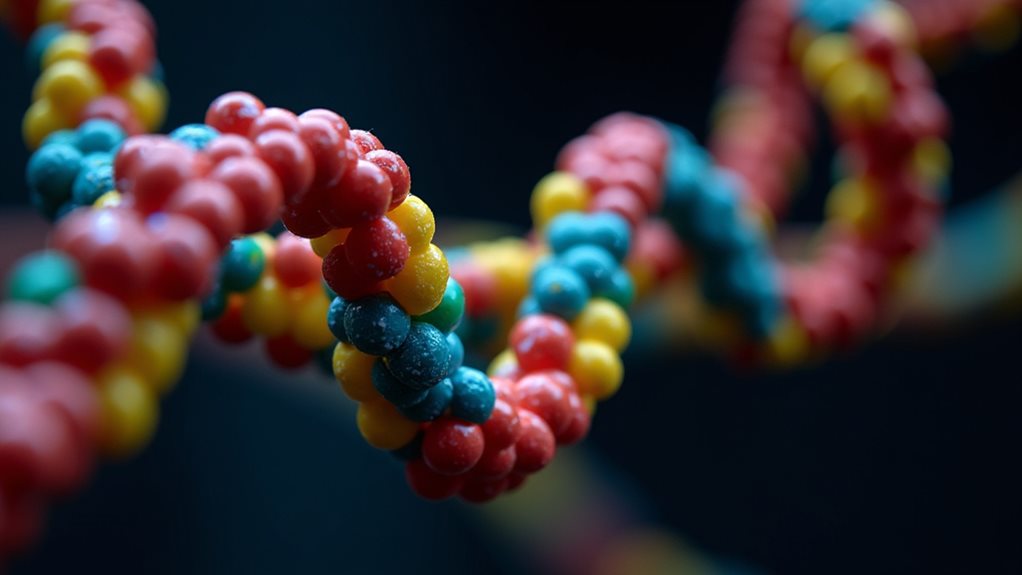
Amino acid sequences serve as the fundamental blueprint that determines a peptide’s identity, making them vital for understanding and manipulating peptide properties.
Your understanding of sequence helps predict how peptides fold into structures, interact with targets, and maintain stability.
Small changes can markedly impact function, stability, and specificity, highlighting the essential role of precise amino acid order in peptide behavior.
Frequently Asked Questions
How Does Amino Acid Sequence Influence Peptide Stability?
Your peptide’s amino acid sequence affects its stability by influencing oxidation susceptibility, proteolytic resistance, and folding patterns. Replacing reactive residues and balancing hydrophobic and hydrophilic amino acids can considerably enhance its chemical and serum stability.
Can Amino Acid Sequences Be Modified After Peptide Synthesis?
Yes, you can modify amino acid sequences after synthesis through techniques like cyclization, backbone changes, or incorporating special amino acids. These modifications enhance peptide properties but usually don’t change the original sequence directly, focusing instead on termini or side chains.
What Tools Are Used for Visualizing Peptide Sequences?
You use tools like Sequence logos to see conservation, PepMapViz for mapping peptides to proteins, and PepDraw for 3D visualizations. These tools help you analyze, compare, and understand peptide sequences effectively.
How Do Mutations Affect Peptide Amino Acid Sequences?
Mutations change peptide amino acid sequences by substituting, inserting, or deleting nucleotides, leading to silent, missense, nonsense, or frameshift effects. These can alter peptide length, structure, or function, sometimes truncating or modifying the protein considerably.
Are There Standard Formats for Submitting Peptide Sequences in Research?
Yes, you should use standard formats like FASTA, ProForma, or PEFF for submitting peptide sequences in research. These formats guarantee clarity, consistency, and proper annotation of modifications, making your data easily interpretable and compatible with databases and analysis tools.
Final Note
Understanding amino acid sequences is essential for grasping how peptides function and interact, informing research and drug development efforts. By recognizing how sequence variations influence structure and activity, you can better interpret peptide behavior and avoid common notation errors. This knowledge enables precise communication and effective analysis, supporting advancements in biomedical science. Carefully studying these sequences provides a solid foundation for exploring peptide applications, ensuring your work remains accurate, reliable, and scientifically sound.
References
- https://www.ebsco.com/research-starters/chemistry/peptide-sequence/
- https://chem.libretexts.org/Bookshelves/Introductory_Chemistry/Chemistry_for_Allied_Health_(Soult)/13:_Amino_Acids_and_Proteins/13.02:_Peptides
- https://www.ncbi.nlm.nih.gov/books/NBK562260/
- https://www.vanderbilt.edu/AnS/Chemistry/Rizzo/Chem220b/Ch27.pdf
- https://chem.libretexts.org/Courses/American_River_College/CHEM_309:_Applied_Chemistry_for_the_Health_Sciences/09:_Proteins_-_An_Introduction/9.03:_The_Peptide_Bond
- https://chem.libretexts.org/Courses/Brevard_College/CHE_301_Biochemistry/04:_Amino_Acids_and_Proteins/4.03:_Peptides
- https://chem.libretexts.org/Bookshelves/Introductory_Chemistry/Introduction_to_Organic_and_Biochemistry_(Malik)/07:_Proteins/7.03:_Primary_structure_of_proteins
- https://www.creative-biolabs.com/peptide-sequencing-comprehensive-guide.html
- https://chem.libretexts.org/Courses/Brevard_College/LNC_216_CHE/07:_Polymers/7.09:_Proteins-_Polymers_of_Amino_Acids
- https://openstax.org/books/organic-chemistry/pages/26-summary