Peptide purity testing relies on two main techniques: reverse-phase HPLC, which separates peptides based on hydrophobicity and provides a purity profile by analyzing chromatogram peaks, and mass spectrometry, which confirms the peptide’s molecular weight, sequence, and detects modifications or impurities. While HPLC indicates the main component’s dominance, it cannot verify identity alone. Combining both methods offers an extensive evaluation, ensuring samples meet quality standards. Continuing with this explanation will clarify how these techniques work together effectively.
TLDR
- HPLC separates peptides based on hydrophobicity, allowing purity assessment by analyzing chromatogram peaks.
- Mass spectrometry confirms peptide identity by measuring molecular weight and detecting modifications or truncations.
- Combining HPLC and MS provides comprehensive validation, ensuring purity, correct sequence, and absence of impurities.
- HPLC alone indicates purity percentage but cannot verify molecular structure or detect all impurities.
- Regular calibration of instruments ensures accurate and reliable results in peptide purity testing.
What Does Peptide Purity Testing Reveal About Your Sample?
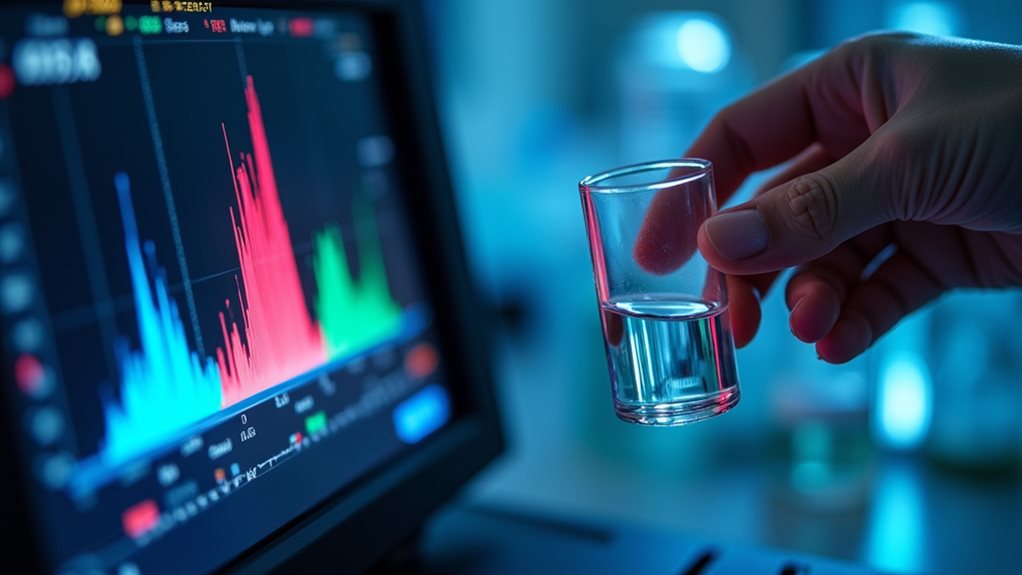
Peptide purity testing provides critical understanding into the composition and quality of your sample, allowing you to assess whether it meets the necessary standards for your intended application.
A careful consideration of peptide stacks and their interactions can illuminate how combinations of peptides may influence purity assessments, especially when mixed or considered for synergistic use peptide interactions and how such contexts may affect interpretation of analytical results.
How Does Reverse-Phase HPLC Separate Peptides?
Reverse-phase high-performance liquid chromatography (RP-HPLC) separates peptides based primarily on their hydrophobicity, not size or charge.
A nonpolar stationary phase interacts more strongly with hydrophobic regions, while a polar mobile phase carries the sample through.
Peptides with greater hydrophobic character interact longer and elute later, allowing precise separation based on their amino acid composition and overall hydrophobicity.
Hydrophobic interactions in RP-HPLC are influenced by the amino acid sequence, which determines the overall hydrophobic character of each peptide. Amino acid sequence
What Does a High HPLC Purity Percentage Really Mean?
A high HPLC purity percentage indicates that most of the UV absorbance in your chromatogram is concentrated in the main peak. However, it doesn’t necessarily mean the peptide is free of impurities or correctly sequenced. Additionally, stability differences between N-Acetyl Semax and Semax can influence how impurities behave during analysis peptide stability. This means that even with a high purity percentage, downstream functional assays may reveal activity or degradation products not apparent from UV-based purity alone.
UV Absorbance Correlation
Although a high HPLC purity percentage often suggests that a sample mainly contains the target peptide, it’s essential to recognize that this number reflects UV absorbance, not direct identity.
The measurement depends on how much of the UV signal is attributed to the main peak, which can be influenced by differences in chromophores, wavelength, and co-eluting impurities, not necessarily the actual chemical purity.
Peak Area Significance
Peak area ratio is a fundamental factor in determining reported HPLC purity, as it defines the proportion of the UV-detected chromatographic signal that originates from the main peptide peak relative to all detected peaks.
A high percentage indicates the main peak dominates the chromatogram, suggesting relative purity. However, it doesn’t confirm identity or account for co-eluting impurities or non-UV absorbing contaminants.
Total Material Considerations
While high HPLC purity percentages can suggest a chiefly single peptide species, they don’t automatically reflect the total amount of peptide present in a sample.
HPLC measures chromatographic signal dominance, not total mass, which can be affected by residual water, salts, or co-eluting impurities.
As a result, high purity doesn’t necessarily indicate a high peptide content by weight or overall quality.
What HPLC Can’t Tell You About Your Peptides?

Despite its widespread use in peptide quality assessment, High-Performance Liquid Chromatography (HPLC) has limitations that can lead to incomplete or misleading determinations about your peptide samples. HPLC can’t confirm peptide identity, detect all impurities, or assess biological activity. It reports chromatographic behavior, not molecular structure, so complementary tests are essential for a thorough quality evaluation. In the context of longevity peptides, understanding how HPLC interacts with complex samples is crucial for interpreting results accurately Peptide identity.
How Mass Spectrometry Confirms Peptide Identity
Mass spectrometry (MS) provides a powerful and reliable method for confirming peptide identity by analyzing both the intact molecular mass and the fragmentation patterns produced during the process.
You compare the measured mass to the theoretical, verify charge states, and examine fragment ions to guarantee sequence accuracy.
High mass precision and pattern consistency strengthen confidence in peptide identification, affirming its purity and correctness.
Additionally, MS-based verification often complements other purity assessments by detecting unexpected post-translational modifications or truncations that could alter identity or function. fragment ions
Why Use HPLC and MS Together for Peptide Analysis?
Using both High-Performance Liquid Chromatography (HPLC) and Mass Spectrometry (MS) together for peptide analysis employs their distinct strengths to provide a more complete assessment of sample quality. HPLC separates peptides based on hydrophobicity, revealing impurities. MS confirms molecular identity through mass-to-charge ratios, reducing ambiguity, verifying purity, and ensuring accurate identification when analyzing complex samples. Additionally, HPLC data can facilitate targeted MS analysis by guiding the selection of ions for confirmation and quantitation mass-to-charge performance to improve confidence in peptide characterization.
How to Assess Peptide Purity With HPLC and MS

To accurately assess peptide purity, you should understand how reverse-phase HPLC separates peptides based on their interactions with a C18 column and an acetonitrile/water gradient.
This separation results in distinct peaks for the target peptide and impurities. Interpreting the HPLC data involves examining the main peak’s area relative to the total, while recognizing that additional peaks may indicate various modifications or related species that affect purity.
Confirming the molecular identity of the main peak is achieved through mass spectrometry, which measures the peptide’s expected mass-to-charge ratio and detects modifications.
However, mass spectrometry doesn’t quantify purity alone, making combined analysis essential for thorough evaluation. Mass Spectrometry Verification
HPLC Separation Principles
Have you ever wondered how researchers determine peptide purity with high confidence? HPLC separates peptides based on hydrophobicity, using a C18 column and a water-acetonitrile gradient.
More hydrophobic peptides elute later, while polar ones come out earlier. Peak area normalization then estimates purity, with UV detection at 210–220 nm providing accurate peak identification amid impurities.
Mass Spectrometry Confirmation
Mass spectrometry (MS) plays an essential role in verifying peptide identity and ensuring purity by directly measuring the molecular mass of the sample components. You compare the observed mass with the theoretical mass derived from the sequence, confirming the peptide’s identity.
MS, especially coupled with chromatography, helps detect modifications and impurities, providing a critical confirmation step beyond HPLC’s purity estimation.
Common Mistakes in Peptide Purity Testing and How to Avoid Them

Many common mistakes in peptide purity testing can lead to inaccurate assessments, potentially obscuring true sample quality. These include co-elution of impurities with the main peak, misinterpreting HPLC purity as actual peptide content, and errors in detector readings or mass spectrometry interpretation. To ensure robust results, include orthogonal validation with complementary techniques such as peptide mass confirmation and carefully monitor calibration standards throughout the analysis.
Tips for Confirming Your Peptides Are Pure and Correctly Identified
Verifying that your peptides are both pure and correctly identified involves a systematic approach that combines multiple analytical techniques, with high-performance liquid chromatography (HPLC) serving as the initial step.
Use reversed-phase HPLC with UV detection to assess purity. Then confirm identity with mass spectrometry, ensuring the observed mass matches the expected.
For thorough validation, employ LC-MS and MS/MS to detect impurities, modifications, and sequence correctness.
Frequently Asked Questions
Can HPLC Detect All Types of Peptide Impurities?
HPLC can’t detect all peptide impurities because it mainly identifies UV-absorbing substances and misses non-UV contaminants, closely related variants, and low-level or non-chromophoric impurities, requiring additional methods like mass spectrometry for thorough detection.
How Does Oxidation Affect Peptide Mass Spectrometry Results?
Oxidation changes peptide mass by adding specific Da, creating distinct ion species. It alters fragmentation patterns, complicates residue identification, and can cause multiple forms, affecting accurate mass interpretation and purity assessment in your mass spectrometry analyses.
Is a High HPLC Purity Sufficient for Therapeutic Use?
A high HPLC purity alone isn’t enough for therapeutic use. You need additional confirmation of identity, impurity profile, and structural integrity through orthogonal methods like mass spectrometry, ensuring the peptide’s safety, efficacy, and regulatory compliance.
What Are Common Signs of Peptide Degradation in Analysis?
You’ll notice peptide degradation through decreased main peak area, new or shifted peaks, broadening, or tailing in HPLC. Mass spectrometry may reveal oxidation (+16 Da), deamidation (+1 Da), or multiple shifts, indicating structural changes and instability.
How Do I Interpret Ambiguous Ms/Ms Fragmentation Patterns?
When interpreting ambiguous MS/MS patterns, you should consider incomplete ion coverage, isobaric amino acids, and fragmentation behavior. Use high-resolution data, orthogonal methods, and spectral databases to clarify uncertainties and support accurate sequence assignments.
Final Note
By understanding how HPLC and mass spectrometry work together, you can accurately assess peptide purity and confirm their identity with confidence. While HPLC provides detailed purity profiles, mass spectrometry offers precise molecular identification, making their combined use vital for reliable analysis. Carefully avoiding common mistakes and following best practices guarantees your results are accurate and reproducible. This thorough approach helps you make informed decisions in peptide synthesis, quality control, and research, ultimately supporting your scientific objectives.
References
- https://www.peptidejournal.org/reference/understanding-peptide-purity-hplc-mass-spec
- https://www.peptidejournal.org/how-to/how-to-verify-peptide-purity-third-party-testing
- https://pmc.ncbi.nlm.nih.gov/articles/PMC7119934/
- https://certapeptides.com/blog/hplc-vs-mass-spectrometry-peptide-purity-testing
- https://www.creative-proteomics.com/resource/peptide-purity-analysis-hplc-lcms-guide.htm
- https://www.americanpeptides.us/blog/what-is-hplc-peptide-purity
- https://clinicalpeptide.org/blog/understanding-peptide-purity-hplc-mass-spec/
- https://pepguide.io/docs/research/peptide-purity-testing
- https://vanguardlaboratory.com/resources/the-ultimate-guide-to-hplc-testing-for-peptides-9/
- https://www.creative-proteomics.com/proteinseq/peptide-purity-analysis-service.htm