
The most popular peptides fall into four functional categories you’ll want to understand before considering any protocol. For weight loss, tirzepatide and semaglutide dominate clinical use—tirzepatide activates both GIP and GLP-1 receptors to achieve up to 21% weight loss, while semaglutide targets GLP-1 alone for roughly 14% reduction. Muscle growth enthusiasts often research CJC-1295, which elevates IGF-1 1.5- to 3-fold for over a week per dose, alongside ipamorelin for growth hormone pulse amplification and BPC-157 for tissue repair. For cognitive enhancement and sleep, semax upregulates BDNF and monoamines to sharpen focus, selank modulates GABA and serotonin to ease anxiety without sedation, and DSIP promotes delta-wave sleep through hypothalamic-pituitary signaling. Only semaglutide, tirzepatide, and tesamorelin hold FDA approval and require prescription access, while most other compounds remain in research or limited-access status, making source verification and quality documentation essential before you explore how these signaling molecules might fit your specific goals.
TLDR
- Tirzepatide and semaglutide dominate weight loss through GLP-1 receptor activation with 21% and 14% reduction respectively.
- CJC-1295 and ipamorelin stimulate growth hormone release for muscle growth and tissue repair applications.
- Semax, selank, and DSIP target cognition, anxiety reduction, and sleep quality through distinct neurological pathways.
- FDA-approved peptides require prescriptions, while research-grade compounds lack regulatory oversight and verified quality controls.
- Effective peptide stacking requires single primary objectives with complementary, non-overlapping mechanisms for optimal results.
Peptides for Weight Loss: Tirzepatide, Semaglutide, and Cagrilintide

How do these three peptides actually help you lose weight, and what sets them apart from one another?
Tirzepatide activates two receptors—GIP and GLP-1—to reduce appetite and slow digestion, producing up to 21% weight loss. Semaglutide, a single GLP-1 agonist, achieves roughly 14% loss and remains widely used. Cagrilintide, an amylin analog, shows promise in combination studies but lacks established standalone evidence.
Peptides for Muscle Growth: CJC-1295, Ipamorelin, and BPC-157
The pursuit of muscle growth has led many to investigate compounds that work with your body’s natural hormone systems rather than overriding them entirely. CJC-1295, a synthetic GHRH analog, stimulates sustained growth hormone and IGF-1 release for days, supporting protein synthesis and recovery. You’ll often see it paired with Ipamorelin, a GH secretagogue, to amplify pulse frequency and size. BPC-157, meanwhile, targets tissue repair rather than direct anabolism. Clinical data shows CJC-1295 elevates IGF-1 1.5- to 3-fold for over a week per dose, though human muscle-building evidence remains limited compared to mechanistic promise. tissue repair
Peptides for Sleep and Focus: Semax, Selank, and DSIP
If you’re considering these three peptides for cognitive and sleep support, you’ll want to understand how each one works at the molecular level and how their dosing protocols differ markedly from one another.
Semax operates primarily through BDNF upregulation and monoamine modulation to enhance focus and neuroplasticity, while Selank influences GABAergic and serotonergic pathways to reduce anxiety without sedation, and DSIP targets hypothalamic-pituitary signaling to promote delta-wave sleep rather than acting as a conventional hypnotic. Semax also upregulates BDNF in cortex and hippocampus, supporting neural plasticity, and increases dopamine and serotonin activity without direct receptor stimulation neuroplasticity and monoamine modulation. Because these mechanisms are distinct and their optimal dosing schedules vary—typically morning administration for Semax, flexible daytime timing for Selank, and evening use for DSIP—understanding the rationale behind each protocol helps you use them more effectively and avoid counterproductive combinations.
Mechanism Of Action
Why do certain synthetic peptides appear to sharpen your focus while others seem to quiet your mind for rest? Semax works by boosting BDNF and dopamine, supporting neuroplasticity and attention without stimulation. Selank calms through GABA and serotonin modulation, reducing anxiety and hyperarousal. Together, they target distinct neural pathways—growth factor signaling versus inhibitory neurotransmission—to achieve complementary cognitive and restorative effects.
Dosing Considerations
Understanding how these peptides operate at the cellular level sets the stage for applying them effectively, since the same mechanisms that sharpen attention or ease anxiety also dictate when and how much you should use.
You’ll typically start Semax at 100–200 µg intranasally each morning, cycling 10–14 days on with breaks, while Selank follows similar timing for anxiety modulation.
DSIP reverses this pattern entirely—take 200–500 µg in the evening to promote sleep, never morning, with identical cycling protocols to maintain receptor sensitivity and prevent tolerance.
Peptides for Sexual Health: PT-141 and Tesamorelin Explained
Ipamorelin is a research-grade peptide that stimulates pulsatile growth hormone release via ghrelin receptor activation, which can be relevant when considering broad peptide mechanisms alongside sexual health discussions like PT-141. ghrelin receptor activation
Longevity Peptides in 2026: FOXO4-DRI, Epitalon, and MOTS-c
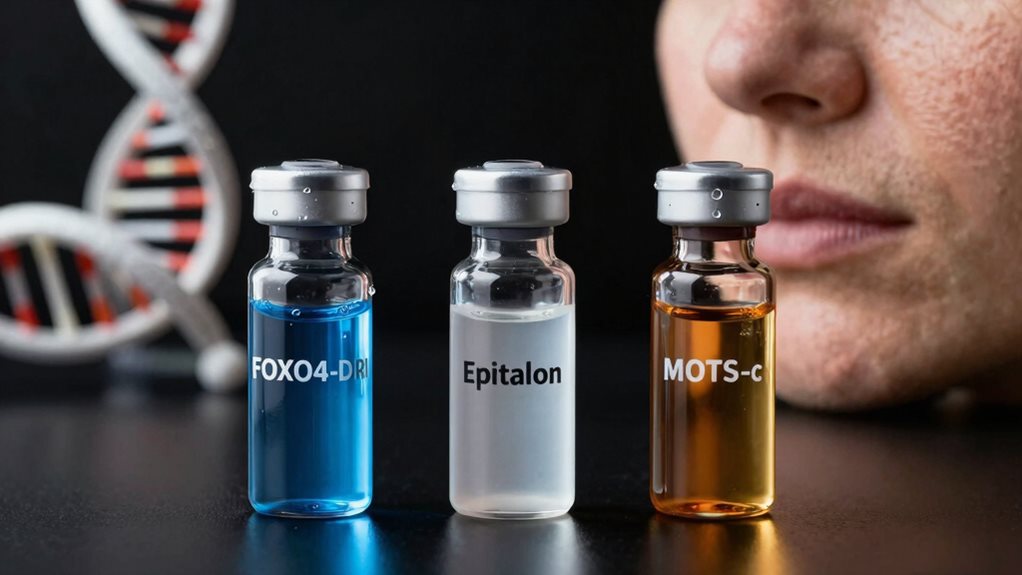
As you traverse the increasingly crowded terrain of longevity science in 2026, you’ll encounter three peptides that consistently surface in research discussions and clinical interest: FOXO4-DRI, Epitalon, and MOTS-c. FOXO4-DRI targets senescent cells through p53 disruption, remaining preclinical. Emerging evidence suggests these approaches are part of a broader effort to address cellular aging at the level of senescence and metabolic regulation, with ongoing debate about translational potential senescence targets.
Epitalon activates telomerase, extending rodent lifespans 12–40% without robust human trials.
MOTS-c regulates mitochondrial metabolism via AMPK and mTOR pathways, showing promise for metabolic aging with limited clinical data.
FDA-Approved vs. Research-Only: Which Peptides Can You Actually Access?
FDA-Approved vs. Research-Only: Which Peptides Can You Actually Access?
The regulatory terrain governing peptide access in 2026 creates a practical divide you’ll need to navigate carefully: some peptides are readily available through standard medical channels, while others remain confined to research settings or restricted compounding frameworks. You can obtain semaglutide, tirzepatide, and tesamorelin through licensed pharmacies with valid prescriptions, whereas BPC-157, TB-500, and CJC-1295 lack FDA approval and compounding authorization, limiting legitimate access to clinical trials or research supply chains. Understanding these distinctions protects you from legal complications and ensures you’re sourcing peptides through compliant, quality-controlled pathways rather than unregulated vendors. Follistatin-344 is a notable example of a peptide studied for muscle pathways, and its research status illustrates how certain substances are approached differently across medical and research contexts.
How Peptides Hijack Your Body’s Natural Signaling Systems
When you introduce synthetic peptides into your system, you’re essentially inserting foreign messengers that can mimic your body’s natural hormones by binding to the same cell-surface receptors—such as GPCRs or receptor tyrosine kinases—and triggering identical downstream responses, including changes in gene expression, enzyme activity, and metabolism. This receptor-level interaction means peptides don’t need to enter your cells directly; instead, they hijack existing communication pathways, amplifying signals through second messengers like cAMP and calcium that can produce disproportionately large effects from small doses. However, because your body’s signaling is designed to be transient and tightly regulated through feedback loops, sustained or mistimed peptide exposure can override your natural rhythms, potentially disrupting endocrine balance, immune function, or metabolic control in ways that vary markedly based on your individual receptor density, cell types, and the specific peptide’s stability and half-life. receptor signaling Historically, extensive research has focused on how depletion or modification of copper in GHK-Cu can influence tissue repair and anti-inflammatory activity, highlighting the importance of metal ion coordination in modulating biological responses.
Mimicking Natural Hormones
Why do synthetic peptides feel so familiar to your body? They’re built from amino-acid chains that mirror your natural signaling molecules, letting your cells read them as hormone-like messages rather than foreign intruders. This mimicry allows peptides to substitute, amplify, or redirect existing pathways—like GLP-1 drugs copying gut hormones or sermorelin mimicking growth-hormone-releasing signals—without forcing entirely new biological mechanisms upon your system.
Receptor Binding Mechanisms
Your body recognizes synthetic peptides as familiar messengers, yet that recognition hinges on a precise molecular handshake you’re about to understand. Class B receptors trap the peptide’s C-terminus first, concentrating it near the activation site before the N-terminus engages the core. This sequential binding triggers conformational shifts—outward TM6 movement creates a cavity for G-protein coupling, launching your cellular response.
Side Effects Doctors See Most (And Who Should Avoid Peptides)
How do clinicians decide whether peptide therapy is appropriate for you? They weigh your medical history against common side effects: nausea, diarrhea, and vomiting frequently accompany GLP-1 peptides, while injection-site reactions, headaches, and fatigue appear across categories. Cardiovascular effects, water retention, and hypoglycemia risks matter too. If you’re pregnant, breastfeeding, or managing complex conditions, you need medical supervision before starting. Additionally, researchers studying Dihexa suggest that cognitive outcomes may depend on synaptic modulation and receptor engagement, which clinicians consider when evaluating potential benefits and risks of nootropic peptide therapies. dihexa mechanisms
Red Flags That Signal a Sketchy Peptide Supplier

You can protect yourself from unreliable peptide suppliers by watching for three critical warning signs: vague claims about where products originate, promises that sound too good to be true, and missing or inadequate laboratory documentation. When a vendor can’t specify their manufacturing source, guarantees dramatic results without evidence, or fails to provide batch-specific certificates of analysis with chromatography and mass spectrometry data, you’re likely dealing with a questionable operation.
Recognizing these red flags early helps you avoid counterfeit, contaminated, or mislabeled products that could compromise your research and waste your investment.
Vague Sourcing Claims
Vague sourcing claims represent one of the most reliable warning signs that a peptide supplier isn’t operating with the transparency or accountability that research-grade compounds demand. When a vendor asserts “professional sourcing” or “pharmaceutical-grade” materials without verifiable licenses, pharmacy verification, or traceable supply chain documentation, you’re left trusting empty assurances rather than evidence.
Demand specifics: manufacturing facility names, quality certifications, and batch traceability that can be independently confirmed, because legitimate suppliers build credibility through documentation, not ambiguity.
Unrealistic Promises
While vague sourcing claims quietly erode trust through what they omit, unrealistic promises announce themselves loudly through what they claim—and that’s where scrutiny becomes equally important. You’ll spot these red flags when vendors promise clinical results without trial citations, display before-and-after photos as proof, or advertise impossibly low prices that undercut legitimate synthesis costs.
Crowded “peptide complex” labels hiding actual ingredients, human-use language on research products, and vague “performance” claims without mechanism details all signal marketing over substance—so you’ll want to verify every promise against documentation, not enthusiasm.
Missing Lab Testing
How exactly can you distinguish a legitimate peptide supplier from one that’s cutting corners on quality assurance? You start by demanding batch-specific COAs with HPLC and MS data, since mass spectrometry confirmation verifies peptide sequence integrity while chromatograms prove purity claims. You’ll reject generic certificates lacking lot numbers, internally generated reports, or vague “tested” terminology without defined methods, limits, or acceptance criteria.
Building a Peptide Stack: Combining Compounds Safely
Why do so many peptide protocols fail to deliver their promised results?
You often combine too many compounds without a clear, singular goal. Instead, you should define one primary objective—fat loss, recovery, or sleep—then select an anchor peptide that directly targets it.
You add a second compound only if a distinct bottleneck remains, ensuring each peptide contributes a unique, complementary mechanism rather than overlapping pathways.
And Finally
You’ve now explored how specific peptides target distinct biological pathways, from metabolic regulation to cellular repair, yet success depends entirely on matching the right compound to your individual physiology and goals, while sourcing from verified suppliers and working with qualified clinicians who understand contraindications, drug interactions, and proper dosing protocols. Your next step involves consulting a knowledgeable healthcare provider who’ll assess your candidacy, design an evidence-based protocol, and monitor your response through objective biomarkers rather than subjective impressions alone.
References
- https://www.youtube.com/watch?v=eMWFF6-aoDQ
- https://peptidehackers.com/blogs/beginners-guide-to-peptides/full-list-of-peptides
- https://www.youtube.com/watch?v=LA5KduDabRM
- https://www.webmd.com/a-to-z-guides/what-are-peptides
- https://www.innerbody.com/beginners-guide-to-peptide-therapy
- https://www.optimantra.com/blog/most-in-demand-peptides-in-2026-trends-benefits-and-clinical-insights
- https://www.youtube.com/watch?v=Cu9PVWM2fJo
- https://pliability.com/stories/best-peptides-for-athletic-performance
- https://vitalizemedical.com/the-ultimate-guide-to-peptides-2025-types-benefits-and-fda-regulations/
- https://prenuvo.com/blog/how-different-peptide-therapies-may-affect-your-body