
Semax and N-Acetyl Semax are synthetic peptides with neuroprotective and cognitive-enhancing properties; however, chemical modifications differentiate them. N-Acetyl Semax, with added acetyl groups, offers greater stability, prolonging its half-life and resistance to enzymatic degradation, compared to Semax. While both influence neurotrophic factors and brain function, their pharmacokinetics and therapeutic applications vary, with Semax being more widely researched, mainly in Russia. Understanding these distinctions clarifies their potential uses, and further details can inform your specific research or application goals.
TLDR
- Semax is a naturally derived heptapeptide, while N-Acetyl Semax is a chemically modified, more stable derivative.
- Acetylation in N-Acetyl Semax enhances resistance to enzymatic degradation, increasing its stability.
- Semax is widely used clinically in Russia for neurological conditions; N-Acetyl Semax is primarily research-grade.
- Both peptides promote neuroplasticity and neuroprotection, but Semax has more extensive clinical data supporting its efficacy.
- Neither peptide is FDA-approved, with regulatory restrictions and limited human trial data for N-Acetyl Semax.
What Are Semax and N-Acetyl Semax?

Semax and N-Acetyl Semax are both synthetic peptides that have garnered interest primarily due to their neuroprotective and cognitive-enhancing properties.
Although they differ in their chemical structure and potential applications, Semax is a heptapeptide derived from ACTH. It is used mainly in Russia for neurological conditions.
N-Acetyl Semax is a modified, more stable form often studied for similar benefits in research settings. Additionally, research often considers their safety profiles and potential therapeutic applications in neuroprotection and cognitive function peptide-based neuroprotection.
How Do Chemical Modifications Affect Their Structure and Stability?
Chemical modifications to peptides, such as acetylation, considerably influence their three-dimensional structure and stability by altering the chemical groups present at their terminal ends.
Acetylation caps the N-terminus, removing a reactive amine, which enhances resistance to enzymatic degradation, especially from aminopeptidases.
It slightly modifies the peptide’s charge profile, resulting in increased durability without compromising water solubility or core structure.
Extended half-life involves changes that can further reduce susceptibility to proteolytic enzymes at the N-terminus, contributing to greater stability in biological systems.
How Do Semax and N-Acetyl Semax Differ in Pharmacokinetics and Bioavailability?
Receptor interactions and downstream signaling pathways are essential to interpreting how these peptides exert distinct biological responses in neural tissues, receptor interactions and downstream signaling pathways.
What Are the Biological Effects and Potential Benefits of Semax and N-Acetyl Semax?
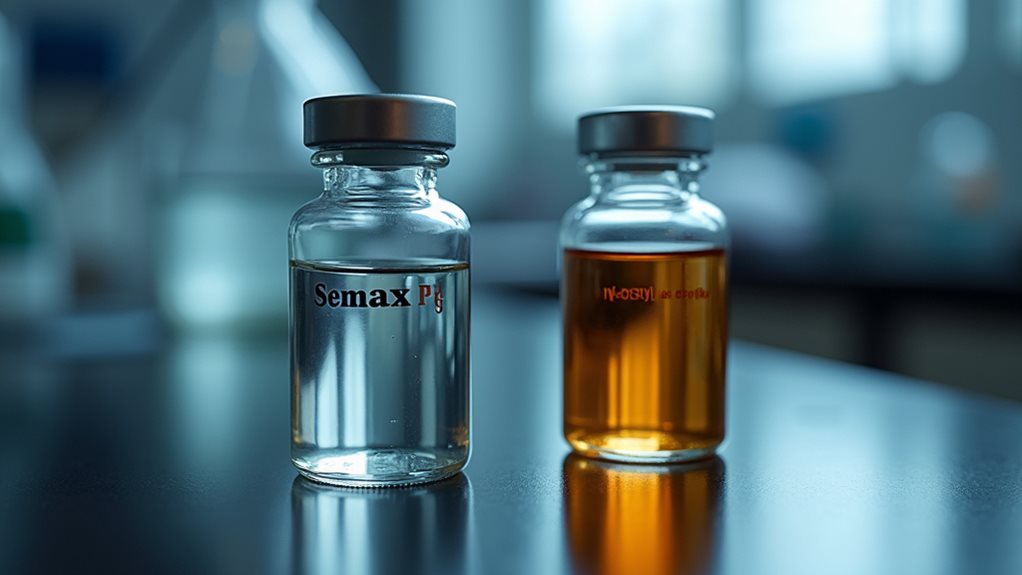
The biological effects and potential benefits of Semax and N-Acetyl Semax encompass a broad range of neurophysiological processes, reflecting their capacity to influence brain function and cellular health.
Semax particularly upregulates neurotrophic factors like BDNF and TrkB, supporting neuroplasticity, cognitive functions, and neuroprotection, especially under stress.
N-Acetyl Semax shares some properties, direct evidence remains limited, emphasizing the need for further research. BDNF upregulation
What Is the Clinical and Regulatory Status of These Peptides?
What Is the Clinical and Regulatory Status of These Peptides?
Understanding the clinical and regulatory status of Semax and N-Acetyl Semax is essential for making informed decisions about their use. Semax is well-established in Russia with documented clinical applications and official registration.
In contrast, evidence for N-Acetyl Semax remains limited and lacks formal approval.
In the United States and Europe, neither peptide has received approval for medical treatment. Their availability is primarily restricted to research or compounding settings.
This emphasizes the importance of recognizing legal and safety considerations.
Additionally, regulatory frameworks influence how these peptides are monitored and controlled
Regulatory Approval Status
Curiosity about the regulatory status of Semax and N-Acetyl Semax is common, but it’s important to recognize that neither has received approval from the U.S. Food and Drug Administration.
Both peptides are unapproved for human therapeutic use in the U.S., with no official indications or safety evaluations.
Although they’re registered medications in Russia, their status remains unconfirmed for widespread medical application.
Clinical Research Evidence
Investigating the current state of clinical research on Semax and N-Acetyl Semax reveals significant differences in the volume and scope of available evidence, which directly influences their regulatory and medical standing.
Semax has a larger clinical literature, mainly from Russian studies focusing on stroke recovery and neurologic conditions.
In contrast, N-Acetyl Semax has limited human data, primarily preclinical, making direct efficacy comparisons uncertain.
Which Peptide Is Better for Your Research Goals?
Choosing between Semax and N-Acetyl Semax for your research depends largely on your specific goals and the structure of your study.
If you need a peptide with a well-established clinical and regulatory history, Semax offers a more validated foundation.
However, if your focus is on testing stability and pharmacokinetics, N-Acetyl Semax’s increased resistance to degradation may provide important perspectives. Additionally, understanding the receptor and mechanism differences between GHRH- and GHRP-family peptides can inform how Semax and its acetylated form may behave in terms of receptor engagement and downstream effects receptor differences.
Frequently Asked Questions
Are There Any Known Side Effects Associated With N-Acetyl Semax?
You might experience nasal irritation, headache, restlessness, sleep issues, or increased anxiety with N-Acetyl Semax. These effects are mostly mild and transient, but long-term safety isn’t well-established, so monitor your response carefully.
How Does Administration Route Influence Semax Versus N-Acetyl Semax Effectiveness?
You should prioritize intranasal administration for Semax, as evidence shows it enhances brain effects effectively. For N-Acetyl Semax, data is limited; route choice impacts effectiveness mainly through delivery consistency, but no clear superiority has been established.
Can N-Acetyl Semax Cross the Blood-Brain Barrier More Efficiently?
Yes, N-Acetyl Semax likely crosses the blood-brain barrier more efficiently than standard Semax due to increased stability, higher lipophilicity, and improved pharmacokinetics, which enhance its ability to reach and penetrate the brain tissue effectively.
What Are the Cost Differences Between Semax and N-Acetyl Semax?
You’ll find that standard Semax costs about $7–$16 per mg, while N-Acetyl Semax is typically 20–40% more expensive per mg, often totaling $80–$150 for 10 mg vials, due to its increased stability and synthesis complexity.
Are There Any Long-Term Safety Studies on N-Acetyl Semax?
There are no long-term safety studies on N-Acetyl Semax. You should be cautious, as evidence mainly comes from short-term use and extrapolations from Semax, with no data on long-duration or chronic effects.
And Finally
Both Semax and N-Acetyl Semax serve as essential research tools, with N-Acetyl Semax offering enhanced stability and bioavailability due to chemical modifications. Your choice depends on your specific research goals, considering factors such as pharmacokinetics and regulatory status. Understanding their structural differences and biological effects allows you to select the most appropriate peptide for your experiments, ensuring accurate, reliable results while adhering to safety and ethical standards.




Pingback: Best Peptides for Anti-Aging Skin Backed by Science