Humanin is a naturally occurring mitochondrial peptide, primarily studied for its role in cell survival and stress response, but it remains in early research stages with limited clinical data. In contrast, SS-31 is a synthetically designed peptide that stabilizes mitochondrial membranes and supports energy production, with well-established safety profiles and ongoing human trials. Their differing origins, mechanisms, and development statuses mean that your choice depends on specific health goals, and exploring further offers a clearer understanding of their potential uses.
TLDR
- Humanin is a naturally occurring mitochondrial peptide, while SS-31 is a synthetic peptide designed for mitochondrial targeting.
- Humanin primarily functions via receptor signaling pathways to promote cell survival; SS-31 stabilizes mitochondrial membranes and enhances energy production.
- Humanin is in early research stages with limited safety data; SS-31 has advanced into human clinical trials and FDA approval.
- Humanin offers potential for neuroprotection and aging-related diseases; SS-31 is used to support mitochondrial energy in tissues.
- SS-31 has established tolerability and practical clinical use, whereas Humanin remains mainly research-focused with moderate stability.
What Are Humanin and SS-31? A Guide to Mitochondrial Peptides
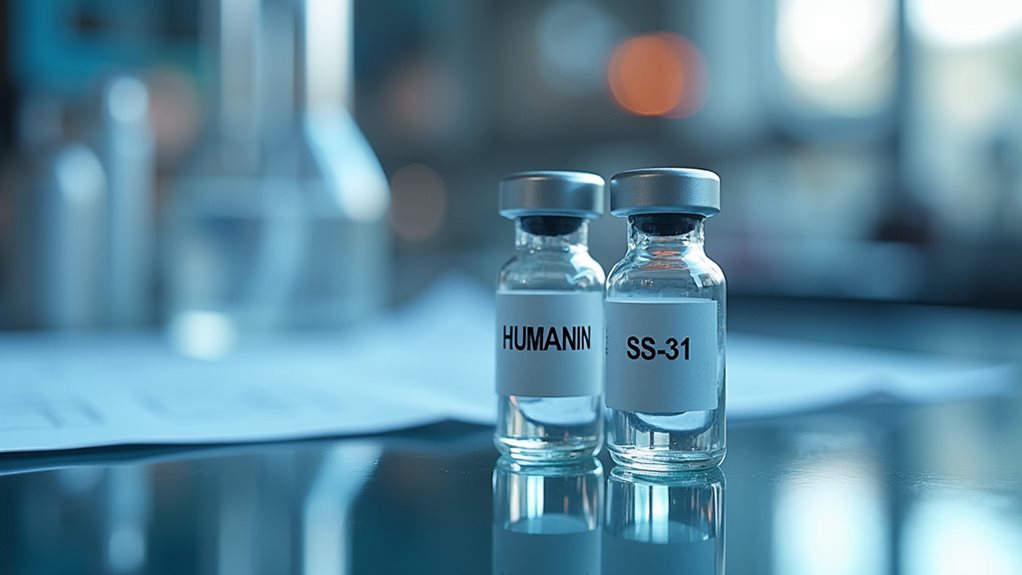
To understand the differences between Humanin and SS-31, it’s important to first recognize that both are categories of mitochondrial peptides, yet they differ considerably in their origin, structure, and functions.
Humanin is a naturally occurring 24-amino-acid peptide encoded in mitochondrial DNA.
While SS-31 is a synthetic tetrapeptide designed to target mitochondria, with distinct roles in cellular protection and therapy mitochondrial targeting.
How Do Humanin and SS-31 Work in Mitochondria? Exploring Their Mechanisms
Humanin and SS-31 operate via fundamentally different mechanisms within mitochondria, shaping their protective effects through distinct pathways.
Humanin primarily functions through signaling pathways involving receptor activation and protein interactions that influence cell survival, stress responses, and autophagy.
Meanwhile, SS-31 directly targets mitochondrial membranes, stabilizing structure and enhancing bioenergetics.
Understanding these mechanisms provides insight into their specialized roles in maintaining mitochondrial health and resilience against damage. Receptor signaling
Humanin’s Signaling Pathways
Understanding how Humanin functions within mitochondria involves examining its versatile signaling pathways that operate both outside and inside the cell.
Humanin interacts with specific receptors, activating pathways like JAK/STAT3, PI3K/AKT, and ERK1/2, which promote cell survival.
It also inhibits apoptotic factors and reduces oxidative stress by modulating mitochondrial functions and activating protective signaling networks.
SS-31’s Mitochondrial Stabilization
SS-31 exerts its mitochondrial stabilization primarily through direct interactions with the inner mitochondrial membrane, focusing on preserving membrane integrity and function.
It binds strongly to cardiolipin, a key membrane lipid, stabilizing cristae structure, supporting respiratory chain organization, and reducing oxidative damage.
This enhances electron transport, ATP production, and overall mitochondrial resilience, thereby improving cellular energy efficiency.
What Are Their Main Biological Roles? Cell Survival and Bioenergetics
You’re about to examine how Humanin and SS-31 play essential roles in supporting cell survival and maintaining mitochondrial function. Humanin primarily acts as a signaling molecule that activates protective pathways, reducing the likelihood of cell death under stress conditions. While SS-31 focuses on stabilizing mitochondrial structures to enhance energy production and reduce oxidative damage. Understanding these mechanisms helps clarify how each peptide contributes to cellular resilience, especially in tissues vulnerable to damage or aging. Mitochondrial signaling links can help readers connect how signaling pathways interface with mitochondrial protection.
Humanin’s Cytoprotective Signaling
Humanin’s cytoprotective signaling encompasses a versatile set of mechanisms that promote cell survival and maintain bioenergetic integrity under stress conditions.
It binds pro-death proteins like Bax, triggers receptor pathways such as FPRL1 and JAK2/STAT3, reduces oxidative stress by activating antioxidant responses, and supports mitochondrial function.
These actions collectively enhance cell resilience during various stressors and disease states.
SS-31’s Mitochondrial Stabilization
The primary biological role of SS-31 centers on its ability to stabilize the mitochondrial inner membrane, a critical component for maintaining cellular energy production and overall cell survival.
By binding to cardiolipin, SS-31 preserves membrane structure, enhances electron transfer, reduces oxidative damage, and prevents mitochondrial dysfunction.
Ultimately, this supports efficient ATP synthesis and protects cells under stress conditions.
How Do They Differ in Clinical Development and Research Status?
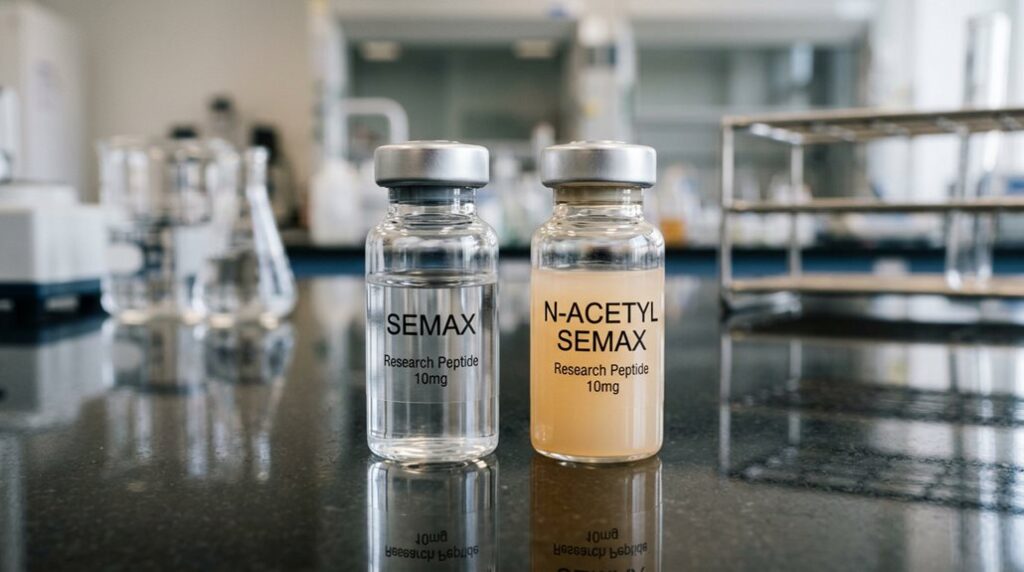
Although both Humanin and SS-31 are peptides associated with mitochondrial health and cellular resilience, their statuses in clinical development and research are markedly different. SS-31 has advanced into human trials, received FDA approval for a rare disease, and is actively studied across multiple conditions. In contrast, Humanin remains primarily in early research stages, with no approved clinical programs or regulatory approval. N-Acetyl Semax and Semax differ in their stability profiles and research trajectories, with the latter showing a more established translational path in some studies.
Safety, Stability, and Practical Use of Humanin vs SS-31
While both Humanin and SS-31 are peptides linked to mitochondrial health, their safety, stability, and practical use differ markedly.
Humanin, a research peptide with limited safety data and moderate stability, lacks formal dosing protocols and approval.
Conversely, SS-31 has been studied extensively in humans, showing good tolerability, although injection-site reactions are common, making it more practical for clinical applications.
Which Mitochondrial Peptide Is Better for Your Needs? Factors to Consider

Choosing between Humanin and SS-31 depends heavily on your specific health goals, targeted tissues, and the mechanisms through which you want these peptides to act.
Humanin primarily supports neuron survival and stress resistance through cell signaling pathways, making it suitable for neuroprotection.
SS-31 targets mitochondrial energy production directly, benefiting tissues with high energy demands, like the heart and muscles.
Linking concept: mitochondrial signaling Mitochondrial signaling and energy dynamics can influence how these peptides interact with cellular stress responses, context, and tissue-specific effects.
Future Therapeutic Potential of Humanin and SS-31
The future therapeutic potential of Humanin and SS-31 is rooted in their distinct mechanisms of action and the promising results observed in preclinical studies. These findings suggest they could address a wide range of age-related and disease-specific conditions. Humanin shows strong potential for neurodegeneration, metabolic health, cardiovascular protection, and possibly cancer. However, clinical applications remain unproven, requiring further research to confirm safety and efficacy in humans. mitochondrial-derived peptide has been identified as a factor in cellular protection and stress responses, expanding the scope of potential therapeutic strategies.
Frequently Asked Questions
Are There Any Known Side Effects of Humanin or SS-31 in Humans?
You’ll find that humanin’s side effects are mostly unknown, with limited data, while SS-31’s known side effects include injection-site reactions, nausea, and fatigue. Long-term safety for both remains largely unestablished.
Can Humanin or SS-31 Be Used Together for Enhanced Effects?
You can theoretically use Humanin and SS-31 together, as they work via different mechanisms, but since no human trials confirm their combined safety or efficacy, it’s best to proceed cautiously, monitor responses, and consult healthcare professionals.
How Stable Are Humanin and SS-31 During Long-Term Storage?
You should know that Humanin’s stability in plain aqueous solutions is poor, degrading considerably over time, even at refrigerated temperatures, unless stored in specialized formulations. SS-31’s long-term stability data are lacking, so its durability remains uncertain.
What Are the Cost Differences Between Research and Clinical-Grade Peptides?
You’ll find research-grade peptides are considerably cheaper, typically costing $25–$80 per vial, while clinical-grade peptides can range from $200–$1,500 per gram, mainly due to strict manufacturing, testing, and regulatory compliance costs.
Are There Specific Diseases Where One Peptide Is Clearly More Effective?
You’ll find SS-31 clearly more effective in conditions like Barth syndrome, primary mitochondrial myopathy, heart failure, dry AMD, and kidney injury, thanks to its advanced clinical development and targeted mitochondrial action, unlike Humanin, which remains mostly preclinical.
And Finally
Both Humanin and SS-31 hold significant promise for supporting mitochondrial health, with each peptide demonstrating unique mechanisms and potential therapeutic applications. While Humanin offers broad biological effects and is still advancing in research, SS-31 is more focused on stabilizing mitochondrial membranes and improving energy production, with a more established safety profile. When considering their use, evaluate your specific health goals, current research status, and consult healthcare professionals to determine the most suitable option based on your needs.