
You’re looking at a mitochondria-targeting tetrapeptide, discovered in 2003 and FDA-approved for Barth syndrome in September 2025, that binds cardiolipin in your inner mitochondrial membrane to stabilize energy production and reduce oxidative damage. Elamipretide concentrates roughly 1,000-fold in mitochondria, improving ATP synthesis and protecting tissues including heart, muscle, kidney, and eye without requiring new mitochondrial growth. Side effects are generally mild, with injection site reactions being most common—typically redness, itching, or stinging that resolves within 24 to 72 hours. Across 500-plus trial participants, no serious complications or deaths were attributed to treatment, and you’ll find the full picture of how this therapy works, where it shows promise, and how to access it explained in detail ahead.
TLDR
- Elamipretide binds cardiolipin in mitochondria to stabilize membranes and boost ATP production without increasing mitochondrial number.
- FDA approved for Barth syndrome in September 2025 after TAZPOWER trial showed significant muscle strength and functional improvements.
- Primary side effects are injection site reactions including erythema and pruritus, typically resolving within 24–72 hours.
- Phase 3 trials in primary mitochondrial myopathy failed to confirm functional benefits despite improved bioenergetics markers.
- Ongoing research explores applications in sarcopenia, kidney disease, and heart failure with preserved ejection fraction.
SS-31 (Elamipretide): Origins and Development

Scientific progress often begins with a single, well-chosen question—in this case, how to protect the cellular powerhouses we call mitochondria from the damage that accumulates with age and disease. You’re witnessing the story of SS-31, later named elamipretide, a synthetic tetrapeptide uncovered in 2003 by researchers Hazel Szeto and Peter Schiller at Weill Cornell Medicine.
You’ll find its development spanned two decades under Stealth BioTherapeutics, advancing from laboratory concept to FDA-approved therapy for Barth syndrome in September 2025. LL-37
How Elamipretide Binds Cardiolipin to Protect Mitochondria
You’ll need to understand cardiolipin’s unique architecture—two phosphate head groups and four fatty acid tails—before you can grasp how elamipretide’s positively charged residues lock onto those negatively charged phosphates through strong electrostatic attraction. Once bound, the peptide concentrates roughly 1,000-fold in the inner mitochondrial membrane, where it stabilizes cristae curvature, aggregates cardiolipin molecules even when oxidized, and recruits respiratory supercomplexes to boost ATP synthesis while simultaneously shielding the membrane from oxidative damage. This binding mechanism, driven more by surface charge density than by specific lipid identity, ultimately sustains bioenergetic function through what researchers describe as a “controlled down-tuning” of negative charge density in cardiolipin-rich bilayers.
Cardiolipin Structure Basics
Why does a single mitochondrial lipid matter so much for cellular energy? Cardiolipin, a diphosphatidylglycerol with four acyl chains, differs from ordinary phospholipids through its unique cone-shaped structure and central glycerol backbone linking two phosphatidic acid moieties. This distinctive architecture, formally named 1,3-bis(sn-3′-phosphatidyl)-sn-glycerol, enables cardiolipin’s specialized membrane interactions that you’ll soon see are critical for mitochondrial function.
Binding Mechanism Details
Cardiolipin’s distinctive design creates a molecular terrain that elamipretide, a small tetrapeptide, recognizes with remarkable precision. You can picture your mitochondria’s inner membrane, where cardiolipin’s negative charge attracts elamipretide’s positively charged amino acids, drawing the peptide into position. Hydrophobic interactions from its aromatic residues anchor it at the membrane interface, allowing reversible binding that tunes surface charge density. This electrostatic partnership clusters cardiolipin molecules, stabilizing the curved architecture your cristae depend upon.
Mitochondrial Protection Outcomes
Once elamipretide nestles into position along your mitochondrial inner membrane, its protective effects unfold across multiple levels of cellular function, converting a simple binding event into thorough organelle defense. You witness cristae architecture stabilize, supercomplexes recruit complex IV efficiently, and ATP synthesis surge while ROS generation plummets thousands-fold. Your membrane potential holds firm, mPTP opening aborts, and cytochrome c stays anchored—blocking apoptosis, preserving bioenergetics, and restoring cardiovascular mitochondrial health.
SS-31’s Impact on Cellular Energy and Oxidative Stress
How does a single tetrapeptide reshape the way your cells produce energy and defend against damage? SS-31 binds cardiolipin in your inner mitochondrial membrane, stabilizing cristae structure and enhancing ATP production while cutting H₂O₂ and oxidative stress. You’ll see improved electron transport efficiency, higher ATPmax, and reduced ROS damage without needing more mitochondria—just better, protected ones working smarter for your cellular energy needs. Regulatory status and safety context
FDA Approval for Barth Syndrome: The TAZPOWER Results

You’ll want to understand how elamipretide earned its FDA approval for Barth syndrome, a milestone that came through the TAZPOWER trial despite some unexpected twists in the data. In addition, the drug’s mechanism involves mitochondrial protection through improving electron transport efficiency, a concept that aligns with current discussions on targeted mitochondrial therapies Melanocortin receptor targets and how these approaches differ from other peptide-based strategies.
TAZPOWER Trial Design
What exactly did investigators hope to learn when they designed TAZPOWER, the pivotal trial that would eventually support elamipretide’s path toward FDA approval in Barth syndrome? You’ll find that TAZPOWER employed a randomized, double-blind, placebo-controlled crossover design, wherein participants received 40 mg subcutaneous elamipretide or placebo daily for three months before crossing over following a washout period. This structure, modeled after the earlier MMPOWER-2 study, represented the first clinical trial of any potential therapeutic in Barth syndrome, with daily self-injection central to both treatment phases and injection-site reactions occurring with both elamipretide and placebo, indicating procedure-related effects.
Muscle Strength Gains
Why did muscle strength become the pivotal endpoint that secured FDA approval for elamipretide in Barth syndrome? In the TAZPOWER trial, you’ll see that elamipretide demonstrated significant improvements versus natural disease course, with handheld dynamometry showing 40.8 N gains at 64 weeks and 56.7 N at 76 weeks (p=0.0005).
These strength gains translated into functional benefits you’ll value: more than 80 meters improvement in 6-minute walk distance, better sit-to-stand performance, and sustained gains through 168 weeks of open-label extension, confirming durable, clinically meaningful recovery in this first-approved mitochondria-targeted therapy.
SS-31 for Heart Failure: Where the Research Stands

Although mitochondria are often called the “powerhouses” of your cells, their role in heart failure extends far beyond simple energy production, which is precisely why researchers have spent years investigating whether SS-31—also known as elamipretide, Bendavia, or MTP-131—can protect failing hearts by stabilizing these critical structures. You may find promise in preclinical studies showing improved cardiac function, reduced fibrosis, and restored mitochondrial dynamics, particularly through SS-31’s binding to cardiolipin, a key inner-membrane phospholipid that supports electron transport chain organization. cardiolipin-targeted strategies align with efforts to preserve mitochondrial integrity in aging-related diastolic dysfunction and heart failure with preserved ejection fraction (HFpEF).
Elamipretide and Muscle Strength: Myopathy and Aging Studies
In Barth syndrome, a rare mitochondrial disorder affecting young males, elamipretide has shown meaningful improvements in cardiac and skeletal muscle function, suggesting particular promise for mitochondrial myopathies with clear energetic deficits. A broader context from cognitive research on mitochondrial-targeted therapies indicates that patient selection and disease mechanism are critical for detecting meaningful functional benefits mitochondrial dysfunction.
Barth Syndrome Evidence
How does a rare genetic disorder affecting cardiac and skeletal muscle help researchers understand whether a mitochondria-targeting peptide can strengthen weakened tissue? In Barth syndrome, elamipretide showed no short-term benefit but demonstrated meaningful improvements after 36 weeks, including 95.9 meters more walking distance, better knee strength, reduced fatigue, and improved symptom scores, suggesting extended treatment reveals mitochondrial therapy’s true potential in muscle disease.
Primary Mitochondrial Myopathy
Why do mitochondria matter so much to your muscles, and what happens when they fail? Your muscle cells demand enormous energy, which mitochondria supply through ATP production. In primary mitochondrial myopathy, this system breaks down, causing weakness and fatigue. Elamipretide, a tetrapeptide penetrating the inner mitochondrial membrane, binds cardiolipin to stabilize cristae architecture and improve respiration. Early trials showed dose-dependent exercise improvements and reduced fatigue, yet phase 3 MMPOWER-3 failed to confirm 6-minute walk test or fatigue benefits at 24 weeks, revealing inconsistent efficacy despite favorable short-term signals and well-tolerated safety profiles.
Sarcopenia Research Potential
Where might the next frontier for elamipretide lie? You’ll find promising avenues in sarcopenia research, where age-related muscle decline demands innovative solutions. Elamipretide binds cardiolipin in your mitochondria’s inner membrane, improving function and reducing oxidative stress without requiring mitochondrial biogenesis. In aged mice, you see restored muscle force, redox homeostasis, and exercise tolerance. Human trials show transient ATP production increases, though functional benefits remain under investigation.
SS-31 in Kidney and Eye Disease: Early Evidence
SS-31, also known as elamipretide, has emerged as a promising mitochondria-targeting compound in preclinical research for kidney and eye diseases, though you’ll find most evidence remains in early experimental stages rather than established clinical practice.
In kidney models, it binds cardiolipin to improve electron transfer, reduce ROS, and preserve ATP, lowering proteinuria, creatinine, and fibrosis markers like 8-OHdG and MDA. cardiolipin binding
Injection Site Reactions: What to Expect
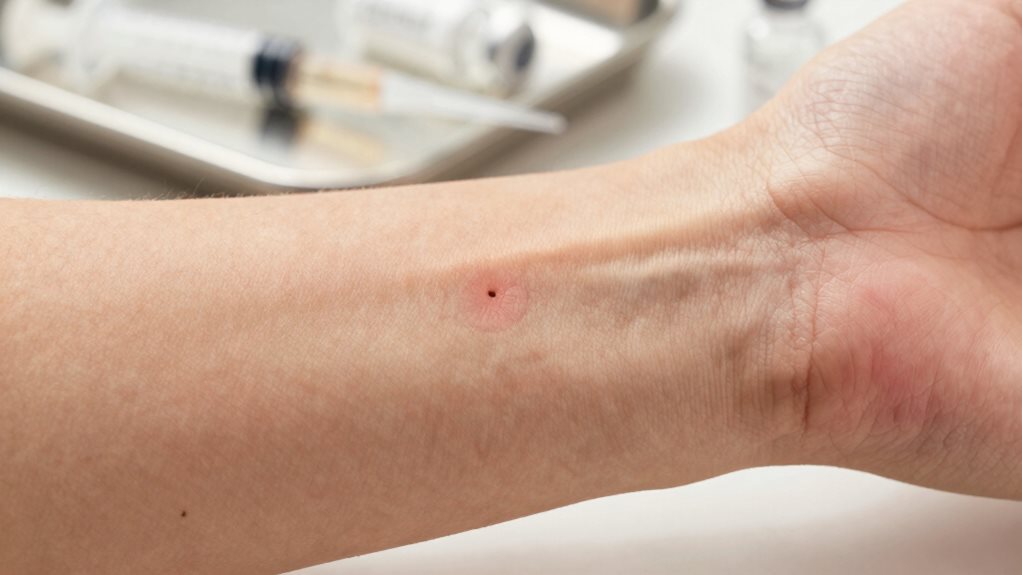
When you’re preparing to start treatment with SS-31, understanding what might happen at the injection site can help you anticipate, recognize, and manage the most common issue you’ll likely encounter. You’ll probably notice redness, itching, or mild pain where you inject, since over half of patients experience erythema and nearly half report pruritus. These reactions are typically transient, often resolving within 24 hours, and while you might also encounter stinging, swelling, or bruising, most symptoms remain mild and compatible with continued therapy. You can reduce irritation by rotating injection sites and using proper technique, and clinicians may recommend antihistamines or topical corticosteroids if needed.
Safety Data From 500+ Clinical Trial Participants
How reassuring is it to know that extensive clinical testing has already mapped out what you might experience with SS-31? Across 500+ participants, injection site reactions remained the primary concern, occurring in 10-15% of cases, while transient chromaturia, dysgeusia, and headache appeared less frequently. Nearly all events were mild or moderate, resolving within 24-72 hours without serious complications, discontinuations, or deaths attributed to treatment.
Future Elamipretide Trials and New Disease Targets
With safety established across hundreds of participants, you can now turn your attention toward where elamipretide research is headed next. ARA-290-related insights into tissue healing and mechanisms further illuminate how mitochondrial-targeted therapies may influence recovery in diverse tissues mitochondrial energetics. The ReNEW phase 3 trial in dry AMD, now 50% enrolled, represents a major priority, testing whether mitochondrial cardiolipin binding can slow this common, untreatable eye disease. Despite mixed phase 3 results in primary mitochondrial myopathy, continued research into mitochondrial energetics persists, while Barth syndrome’s 2025 approval as FORZINITY opens doors for long-term durability and real-world studies extending to 192 weeks.
Who Can Access SS-31 and How to Get It

Where exactly you stand in the regulatory landscape determines whether SS-31 is within reach, and understanding these boundaries before you pursue access will save considerable time and frustration.
If you’re a Barth syndrome patient, you’ll access FDA-approved FORZINITY through standard prescription channels.
Otherwise, you must enroll in clinical trials or work with a licensed physician and 503A compounding pharmacy for investigational use, as direct purchases remain federally noncompliant.
Frequently Asked Questions
How Long Does SS-31 Stay in Mitochondria?
SS-31 enters your mitochondria within minutes and remains bound to cardiolipin in the inner membrane for hours to days, even after it clears from your bloodstream.
Your mitochondria accumulate the peptide at ratios exceeding 1000:1 versus cytoplasm, driven by membrane binding and the negative mitochondrial potential.
While plasma levels drop below detection within 24 hours, functional effects may persist 3–5 days or longer in some tissues.
Can SS-31 Cross the Blood-Brain Barrier?
Yes, SS-31 crosses the blood-brain barrier, though you’ll find its brain concentrations are lower than in plasma.
Preclinical studies in mice and rats have detected the peptide in brain tissue and mitochondria, where it binds cardiolipin to exert protective effects.
While human BBB penetration data remain limited, the peptide’s small, cationic, aromatic structure enables membrane permeation and mitochondrial accumulation, supporting its potential for neurological applications.
Is Elamipretide Effective When Taken Orally?
No, elamipretide isn’t effective when you take it orally, as your digestive system rapidly breaks it down before it reaches your bloodstream.
Clinical trials and FDA approval rely exclusively on subcutaneous or intravenous injection, which delivers steady therapeutic levels.
You’ll need daily subcutaneous administration, typically 40 mg for adults weighing over 30 kg, because no oral formulation exists that can survive stomach acid and first-pass metabolism.
What Happens if I Miss a Dose?
If you miss a dose, skip it and take your next dose at the regular scheduled time. Don’t take two doses together to make up for the missed one, as this increases your risk of side effects without providing additional benefit. Consistent dosing helps maintain the drug’s support of mitochondrial function and muscle strength in Barth syndrome, but a single missed dose isn’t expected to cause serious harm. If you’re unsure about timing or have concerns, contact your healthcare provider for guidance.
Will Insurance Cover Off-Label SS-31 Use?
Your insurance might cover off-label SS-31, but you’ll likely need prior authorization and strong medical documentation. Coverage depends on whether your plan recognizes the specific use as medically necessary and supported by peer-reviewed literature or major drug compendia, which isn’t guaranteed for non-Barth syndrome indications.
If your insurer deems the use experimental or excludes off-label drugs entirely, you’ll probably pay out-of-pocket.
And Finally
You’ve now investigated how SS-31, or elamipretide, works to protect your mitochondria by binding cardiolipin and reducing oxidative damage, with proven benefits for Barth syndrome and ongoing research in heart failure and other conditions. While injection site reactions remain the most common side effect, extensive safety data from over 500 trial participants supports its manageable profile. As development continues, you’ll want to discuss access options with your healthcare provider, who can guide you toward appropriate clinical trials or approved pathways based on your specific diagnosis and eligibility.
References
- https://pmc.ncbi.nlm.nih.gov/articles/PMC11816484/
- https://www.peptidejournal.org/peptides/ss-31-mitochondrial-peptide
- https://pmc.ncbi.nlm.nih.gov/articles/PMC9192202/
- https://pmc.ncbi.nlm.nih.gov/articles/PMC8599536/
- https://www.frontiersin.org/journals/aging-neuroscience/articles/10.3389/fnagi.2021.600484/full
- https://pubmed.ncbi.nlm.nih.gov/42082001/
- https://www.peptidehub.wiki/peptides/ss-31/
- https://www.youtube.com/watch?v=cjUm5gkSwRk
- https://elifesciences.org/articles/55513
- https://rainbowpeptide.com/blog/ss-31-elamipretide-guide




Pingback: Humanin vs SS-31 - PeptAtlas