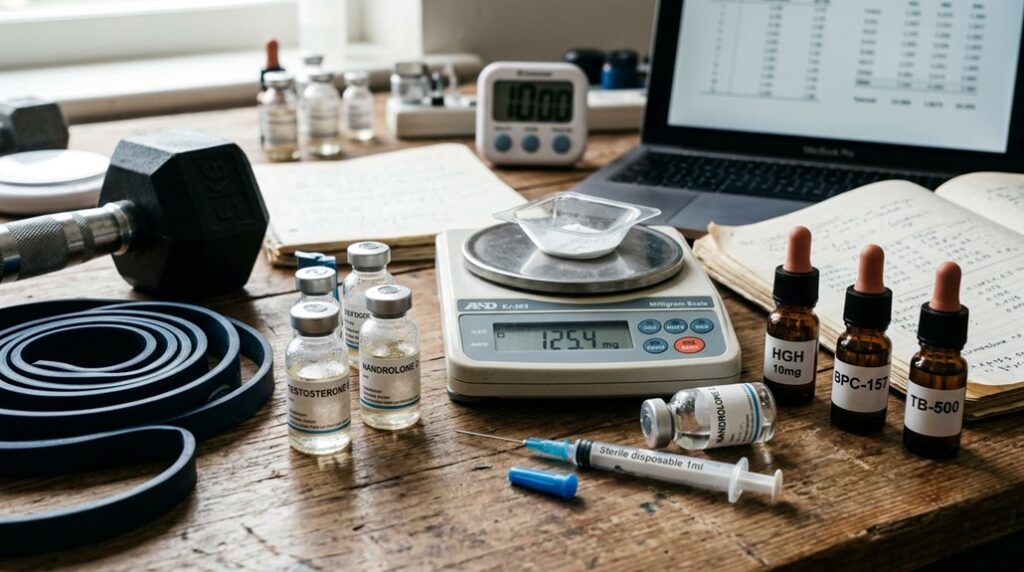
If you’re seeking peptides with measurable muscle-building effects, you’ll find CJC-1295 combined with Ipamorelin offers the most accessible evidence, showing 1.2–2.1 kg lean-mass gains in older adults over 8–16 weeks, while Tesamorelin carries stronger clinical data—roughly 1.4 kg over 26 weeks—but remains limited to HIV-associated lipodystrophy populations. MK-677 elevates growth hormone substantially, though early weight increases often reflect water retention rather than true hypertrophy, and IGF-1 LR3, despite impressive mechanistic potential through PI3K/Akt/mTOR activation, lacks robust human trials to substantiate its claims. Recovery peptides like BPC-157 and TB-500 won’t directly build tissue, yet they protect gains by accelerating healing and reducing downtime after injury. Whichever option you’re considering, physician supervision and baseline hormonal labs remain essential, and the details that follow will help you match the right peptide to your specific goal.
TLDR
- CJC-1295 plus Ipamorelin offers the most reliable clinical stack for moderate lean-mass gains.
- Tesamorelin preserves muscle best during fat loss but shows limited hypertrophy in healthy users.
- MK-677 produces modest long-term gains, though early weight increases often reflect water retention.
- IGF-1 LR3 has strong theoretical potential yet lacks direct human muscle-building trials.
- Recovery peptides like BPC-157 protect gains indirectly by accelerating healing and reducing downtime.
Which Peptides Actually Build Muscle? Evidence Review

When you’re sorting through the noise around muscle-building peptides, you’ll quickly notice that marketing claims often outpace actual human evidence, which is why you need to look closely at what the research actually shows rather than what online forums promise. GH secretagogues like CJC-1295 and MK-677 reliably elevate hormones but lack proven hypertrophy outcomes, while collagen peptides offer stronger nutritional support for lean mass when combined with training. Delivery challenges across the blood-brain barrier and the broader safety considerations highlighted in peptide research underscore the importance of prudent interpretation of any lifting-focused claims long-term plasticity and the need for rigorous human trials before drawing strong muscle-building conclusions.
Tesamorelin: Strongest Clinical Data (But Limited Populations)
Tesamorelin carries the most rigorous clinical backing among growth hormone-releasing peptides, though this evidence comes almost exclusively from studies in people living with HIV who’ve abdominal lipodystrophy—a condition involving abnormal fat distribution rather than typical bodybuilding contexts. In this specific population, tesamorelin has demonstrated meaningful preservation and modest increases in lean body mass, with responders showing improved trunk muscle density and approximately 1.4 kg gains in lean mass over 26 weeks of treatment. However, its muscle-related outcomes appear secondary to the drug’s primary effect on visceral fat reduction and may not translate directly to healthy individuals seeking hypertrophy. visceral fat reduction
HIV Population Focus
How does a peptide originally developed for HIV-associated body changes fit into a discussion about muscle growth? You’ll find tesamorelin sits in an unusual position, since its strongest evidence comes from reducing visceral abdominal fat in HIV-positive patients, not from building muscle directly.
The FDA approved it specifically for excess abdominal fat in HIV lipodystrophy, reflecting this narrow, population-limited indication rather than broad anabolic claims.
Lean Mass Preservation
Where might you turn if your goal isn’t dramatic muscle gain but rather holding onto hard-earned tissue while stripping away fat? Tesamorelin offers you precisely this advantage, with clinical trials demonstrating lean mass preservation alongside visceral fat reduction.
You’ll see skeletal muscle area and density improve over 26 weeks, making this peptide particularly valuable during cutting phases when muscle loss threatens your progress.
CJC-1295 + Ipamorelin: The Go-To Clinical Stack
If you’re looking for a peptide combination that’s gained traction in clinical and research settings, CJC-1295 paired with Ipamorelin stands out as the most frequently referenced stack for growth hormone stimulation.
You’ll find CJC-1295 extends GH release for days, while Ipamorelin adds pulsatile bursts, creating sustained anabolic signaling.
Research shows 1.2–2.1 kg lean-mass gains over 8–16 weeks in older adults, though evidence doesn’t demonstrate superiority over resistance training alone.
Knowledge is based on peptide pharmacology and GH axis modulation
MK-677: Most Studied, But Water Weight Tricks Scales
MK-677 elevates GH and IGF-1 substantially, yet most human trials show only modest lean gains—roughly 1–2 kg over 12–24 months in untrained populations—while early weight spikes often reflect water retention, glycogen storage, and appetite-driven intake rather than contractile muscle tissue. Endogenous rhythm remains a key consideration when comparing oral secretagogues to injected regimens.
IGF-1 LR3: Big Growth Claims, Thin Human Evidence
You have likely encountered bold claims about IGF-1 LR3’s muscle-building potential, yet the gap between its impressive mechanism and actual human proof remains strikingly wide. While this synthetic analog extends bioavailability and activates anabolic pathways like PI3K/Akt/mTOR, you should recognize that controlled hypertrophy trials in humans are essentially absent, leaving most assertions to rest on animal data and biological extrapolation rather than direct clinical validation. Until robust human research emerges, you’re navigating territory where the science is suggestive but far from settled, making informed skepticism your most reliable guide. Mechanism of action
Mechanism Versus Proof
How does a peptide with such persuasive biological machinery stack up when we actually look for proof it works in people? You encounter a striking disconnect: IGF-1 LR3’s mechanisms—IGF-1 receptor activation, PI3K/Akt/mTOR signaling, satellite cell stimulation, and prolonged half-life—are well-documented in preclinical models, yet human evidence for muscle growth remains negligible, limited largely to animal data and theoretical frameworks rather than sturdy clinical trials in trained individuals.
Clinical Uncertainty Remains
This gap between mechanism and human proof leaves you with a compound that’s theoretically captivating but practically unverified. You won’t find controlled trials showing IGF-1 LR3 builds muscle in healthy humans, nor any Phase II studies establishing proper dosing. The preclinical potency—roughly 2.5 times native IGF-1—doesn’t translate to validated clinical endpoints, leaving you without evidence-based guidance for muscle growth claims.
Recovery Peptides (BPC-157, TB-500): Protect Gains Through Faster Healing

When you’re pushing through heavy training cycles, the real enemy of progress isn’t always a lack of intensity—it’s the downtime that follows injury, strain, or the chronic wear that accumulates in muscle, tendon, and connective tissue. BPC-157, a synthetic peptide derived from gastric juice research, accelerates healing through angiogenesis and anti-inflammatory pathways, protecting your gains by reducing recovery time rather than directly building muscle. Angiogenesis mechanism noted as primary action in preclinical work vascular support and growth-factor signaling at the cell surface (FAK, eNOS pathways).
Best Peptide for Your Muscle Growth Goal
Whether you’re chasing your first real gains or trying to break through a stubborn plateau, the peptide landscape offers distinctly different paths depending on what “growth” actually means for your situation—overall body recomposition, rapid size accumulation, or sustainable long-term development without undue risk. For beginners, you’ll start with CJC-1295 and Ipamorelin, a gentle, well-tolerated combination that elevates growth hormone for six-plus days while supporting steady muscle fiber repair and fat loss. If rapid hypertrophy is your priority, IGF-1 LR3 delivers the highest anabolic ceiling through direct muscle protein synthesis stimulation, though you’ll need precise dosing protocols and medical oversight. Those prioritizing visceral fat reduction alongside lean mass preservation should consider Tesamorelin, which maintains muscle while targeting stubborn abdominal adiposity. Regardless of your goal, you’ll require physician supervision, baseline hormonal labs, and an 8-to-12-week cycle structure to maximize results responsibly.
Frequently Asked Questions
Do Peptides Require Cycling Like Steroids?
You don’t need to cycle peptides the way you’d steroids, since peptides work through different mechanisms and don’t cause the same hormonal shutdown. However, some peptides—particularly growth hormone secretagogues like Ipamorelin or CJC-1295—do require cycling to prevent receptor desensitization, typically following 8–12 weeks on, 4–6 weeks off protocols.
Healing peptides such as BPC-157 and continuous-use medications like semaglutide generally don’t need cycling at all.
Are Oral Peptide Supplements Effective?
Oral peptide supplements show limited effectiveness, though collagen peptides are the exception. You’ll find strong evidence that low-molecular-weight collagen peptides, specifically those between 2000–3500 daltons, improve muscle function and modestly increase mass when combined with resistance training.
However, most other oral peptides, including growth hormone secretagogues, lack sturdy human data for muscle building. Many break down into amino acids during digestion, preventing intact absorption.
Your safest, most evidence-based oral option remains collagen peptides paired with consistent training, while broader claims about oral peptides often exceed scientific support.
What’s the Legal Status of Research Peptides?
Research peptides occupy a legal gray area: they’re often sold “for research use only,” which doesn’t make them legal for human consumption, and FDA-approved versions require prescriptions.
You’re navigating a space where labeling matters, enforcement varies, and personal use carries real risk, so understanding your jurisdiction’s specific rules—rather than assuming blanket legality—is essential before you consider acquiring or using these compounds.
How Long Until Muscle Results Appear?
You’ll notice subtle improvements in sleep, energy, and recovery within 2–4 weeks, but visible muscle growth requires patience and consistency.
Significant lean mass gains typically emerge between 8–12 weeks, with peak changes appearing around 3–6 months. Your individual timeline depends on the specific peptide you’re using, your protocol adherence, and personal health factors, so tracking progress through body scans and performance metrics helps maintain realistic expectations throughout your journey.
Can Women Use These Same Protocols?
Yes, you can use similar protocols, though your results and dosing may differ. Research shows oral collagen peptides plus resistance training improves your fat-free mass and strength, with benefits appearing in 8–12 weeks.
However, growth hormone–releasing peptides like CJC-1295 lack robust sex-specific evidence, and injectable “performance peptides” carry limited human data and regulatory restrictions. You’ll want to prioritize well-supported options and consult a healthcare provider before starting any peptide regimen, especially if you’re over 50, pregnant, or managing health conditions.
And Finally
You’ve investigated the peptide milieu for muscle growth, and now you can make an informed choice that aligns with your specific goals and health profile. Tesamorelin offers the strongest clinical foundation for lean mass, while CJC-1295 with Ipamorelin provides a well-tolerated alternative, and recovery peptides like BPC-157 protect your progress through enhanced healing. Remember that peptides complement, not replace, consistent training and proper nutrition, so you’ll want to consult a qualified healthcare provider before beginning any regimen.
References
- https://www.peptidejournal.org/guides/best-peptides-for-muscle-growth-recovery
- https://www.youtube.com/watch?v=Cu9PVWM2fJo
- https://formblends.com/articles/peptide-hub/best-peptides-for-muscle-growth
- https://peptidepedia.org/guides/best-peptides-for-muscle-growth
- https://www.innerbody.com/best-peptides-for-muscle-growth
- https://alphamanclinic.com/best-muscle-building-peptides-the-complete-2025-guide/
- https://r2medicalclinic.com/best-muscle-growth-peptides/
- https://www.youtube.com/watch?v=QMNOhHz4BKU
- https://www.youtube.com/watch?v=PrVsLDGkBZw
- https://www.youtube.com/watch?v=uoTAFjCS5DU