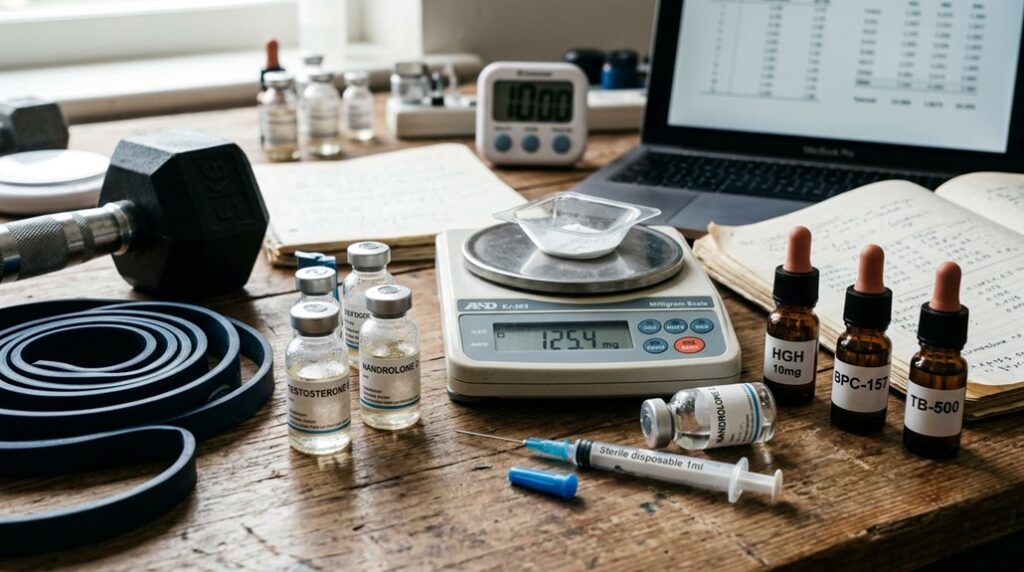
Tesamorelin and Sermorelin both stimulate your pituitary to release growth hormone through identical receptor pathways, yet they deliver distinctly different experiences based on your goals. Tesamorelin binds more intensely, producing robust GH pulses and FDA-approved visceral fat reduction of 15–20% over 26 weeks, but requires a strict daily 2 mg evening dose with higher risks of joint pain and glucose intolerance. Sermorelin offers gentler, rhythm-preserving stimulation that mimics your natural circadian patterns, allowing flexible scheduling with fewer metabolic concerns, though it lacks comparable clinical evidence for fat loss. Your choice hinges on whether you prioritize proven abdominal adiposity reduction with disciplined commitment, or prefer adaptable, lower-intensity support with potentially smoother integration into your lifestyle, and the sections ahead will clarify which approach aligns with your specific circumstances.
TLDR
- Tesamorelin binds GHRH receptors 3× longer than Sermorelin, producing stronger GH pulses.
- Tesamorelin is FDA-approved for visceral fat reduction; Sermorelin lacks this indication.
- Sermorelin mimics natural circadian rhythm with gentler, intermittent GH release patterns.
- Tesamorelin carries higher diabetes risk; Sermorelin shows milder metabolic side effects.
- Both peptides require injections, but Tesamorelin demands strict daily bedtime dosing.
Tesamorelin vs Sermorelin: Which Matches Your Goal?

Tesamorelin vs Sermorelin: Which Matches Your Goal?
Whether you’re exploring growth hormone-releasing hormone analogs for the first time or evaluating options after prior research, you’ll quickly notice that Tesamorelin and Sermorelin serve distinctly different purposes despite their shared mechanism of action. Choose Tesamorelin when visceral fat reduction is your priority, as it delivers targeted, evidence-backed results. In contexts of long-term wellness and aging considerations, Sermorelin offers gentler, more gradual support with a broader potential for sustained benefits delivery methods and safety considerations.
How These Peptides Trigger Growth Hormone Differently
You’ll notice that Tesamorelin and Sermorelin engage your GHRH receptors with markedly different intensities and timelines, which directly shapes how growth hormone pulses unfold in your body.
While Tesamorelin’s engineered structure locks onto pituitary receptors with exceptional strength—sustaining activation long enough to generate powerful, high-amplitude GH bursts—you’ll find that Sermorelin follows a gentler course, amplifying your natural secretion rhythm without overriding it.
These contrasting approaches to receptor binding, release patterns, and overall potency mean you’re choosing between a robust, prolonged hormonal surge and a more measured, physiologically integrated response. GHRH receptor binding helps define how pulses are generated and shaped over time, influencing both the amplitude and rhythm of growth hormone release.
Receptor Binding Dynamics
Receptor binding dynamic reveals the core functional differences between tesamorelin and sermorelin, even though both peptides target the same molecular machinery in your pituitary gland.
Tesamorelin’s modified structure gives you longer receptor occupancy—roughly 26–38 minutes versus sermorelin’s 7–12 minutes—producing more sustained GH release.
You’ll experience briefer pulses with sermorelin, which mimics natural physiology more closely, while tesamorelin delivers amplified, prolonged signaling through identical Gs-cAMP-PKA pathways.
Release Pattern Differences
How do these two peptides actually differ once they reach your pituitary gland? Tesamorelin engages your GHRH receptors longer, generating a stronger, sustained GH pulse—peaking at 15–40 ng/mL within hours—while elevating IGF-1 more persistently.
Sermorelin, by contrast, triggers gentler, intermittent bursts that mirror your body’s natural circadian rhythm. You choose tesamorelin for amplified metabolic signaling, or sermorelin when preserving physiologic pulsatility matters most.
Potency And Duration
When you’re comparing these two peptides side by side, the first thing that stands out is how dramatically they differ in sheer pharmacologic force. Tesamorelin delivers a markedly stronger punch, producing peak growth hormone levels of 15–40 ng/mL and IGF-1 increases of 30–100%, thanks to its stabilized, DPP-IV-resistant structure and 26–38 minute half-life. You’ll experience a bigger, longer pulse that sustains receptor activation for hours.
Sermorelin, the milder 29-amino-acid fragment, generates gentler GH elevation with modest 15–30% IGF-1 rises and a brief 7–12 minute half-life, mimicking subtler, more frequent natural signaling rather than robust pharmacologic stimulation.
Visceral Fat Reduction: Clinical Evidence Compared
When you’re weighing these two peptides for visceral fat reduction, you’ll want to look closely at what the clinical evidence actually shows for each compound, since tesamorelin carries FDA approval and robust trial data specifically targeting abdominal adiposity, while sermorelin operates in a broader, less documented space.
Tesamorelin has demonstrated consistent, measurable results in randomized controlled trials, particularly among adults with HIV-associated lipodystrophy, where it reduced visceral adipose tissue by roughly 15% to 20% over 26 weeks without sacrificing subcutaneous fat.
Sermorelin, by contrast, lacks comparable FDA-approved indications or trial-backed outcomes for visceral fat, positioning it more as a general growth hormone support agent rather than a targeted solution for central obesity.
Growth hormone pathways provide a framework for understanding how these peptides influence fat distribution and metabolic processes, with tesamorelin showing targeted effects on abdominal adiposity in clinical populations.
Tesamorelin Clinical Outcomes
Where does tesamorelin stand when you’re evaluating its ability to reduce visceral fat, and what does the clinical evidence actually show?
You’re looking at a synthetic 44-amino acid GHRH analogue with sturdy, placebo-controlled trial data specifically in HIV-associated lipodystrophy.
Clinical trials demonstrate approximately 15–20% visceral adipose tissue reduction over 26 weeks, with about 70% of participants achieving meaningful response, while preserving subcutaneous fat and improving metabolic parameters.
Sermorelin Comparative Evidence
Although tesamorelin carries sturdy, indication-specific data for visceral fat reduction, you’ll find that sermorelin’s evidence base looks quite different when you examine it closely.
No controlled trial establishes sermorelin as a weight-loss agent in healthy adults, and its visceral fat claims rely on class-wide GHRH physiology rather than direct proof.
You’re seeing metabolic support potential, not validated anti-obesity outcomes, with effects varying by your baseline IGF-1 levels.
Dosing Reality: Daily Commitment vs Flexible Schedules
Tesamorelin demands daily commitment, with 2 mg each evening forming a fixed bedtime habit over months, while sermorelin offers flexibility, allowing intermittent or cycling schedules that reduce injection burden when convenience matters most. daily HGH peptide provides sustained, physiology-mimicking amplification of GH release, supporting a regular routine and predictable outcomes.
Side Effects and Long-Term Safety Trade-offs
When you inject either peptide beneath your skin, you’re inviting a familiar set of local responses—redness, itching, and discomfort at the needle site—which remain the most common experience for users of both tesamorelin and sermorelin, though tesamorelin’s 24.5% incidence rate in pooled trials offers clearer quantification than the anecdotal reports surrounding sermorelin.
Beyond these surface reactions, you’re facing more substantial trade-offs with tesamorelin: joint pain affects roughly 13% of users, while fluid retention and limb discomfort emerge in about 6%, consequences of its stronger growth hormone stimulation.
The metabolic stakes prove more serious, as tesamorelin carries a 3.3-fold increased diabetes risk with documented glucose intolerance, demanding blood sugar monitoring that sermorelin’s gentler IGF-1 rise typically avoids.
Treatment Cost and Access Considerations
Wherever you’re weighing these two peptides against each other, you’re inevitably confronting practical barriers that extend well beyond clinical effects into questions of eligibility, expense, and reliability of supply. In addition, the choice may hinge on whether a particular peptide aligns with long-term cognitive resilience goals rather than immediate short-term effects therapeutic access factors.
Making Your Decision: A Framework for Choice
Having weighed the practical constraints of cost and availability, you’re now positioned to move from external considerations toward an internal assessment of what you actually need these compounds to accomplish. In evaluating Tesamorelin versus Sermorelin, consider how each aligns with the body’s natural GH/IGF-1 axis dynamics and the potential appetite and metabolic effects described for GHRH analogs. GH/IGF-1 axis
Frequently Asked Questions
Can I Stack Both Peptides Together?
Yes, you can stack tesamorelin and sermorelin together, though this combination is generally considered redundant rather than synergistic, since both are GHRH analogs competing for the same pituitary receptors. If you choose this route, you’ll need careful monitoring—check your IGF-1 every 90 days, keeping levels below 280–300 to minimize water retention, joint pain, and insulin resistance.
For better results, most clinicians prefer pairing a GHRH analog with a ghrelin-mimetic like ipamorelin instead.
Do These Peptides Affect Sleep Quality?
You may notice sleep changes with either peptide, though evidence differs. Sermorelin carries more user reports of deeper sleep, especially when taken before bed, yet clinical trials haven’t confirmed this.
Tesamorelin lacks direct sleep studies entirely, with any benefit being speculative through growth hormone mechanisms.
Neither guarantees improved rest, and responses vary individually.
If sleep quality matters to you, sermorelin has more anecdotal support, but both remain unproven for this purpose.
Will My Natural GH Production Recover After Stopping?
Yes, your natural GH production will recover after stopping, as these peptides stimulate your body’s own hormone release rather than replacing it directly. Clinical data for tesamorelin shows endogenous GH pulsatility resumes after discontinuation, with no permanent suppression reported. While effects like elevated IGF-1 may persist for about two weeks post-cessation, your hypothalamic-pituitary axis typically returns to baseline function, and sermorelin’s natural-mimicking profile suggests similar recovery expectations.
Can Women Use These Peptides Safely?
You can use tesamorelin safely if you’re not pregnant or breastfeeding, as these are clear contraindications due to potential fetal harm. You’ll need effective contraception while taking it, and you should stop immediately if pregnancy occurs or is planned.
Common side effects you may experience include injection-site reactions, mild joint pain, and minor fluid retention, while your menstrual cycle and reproductive hormones won’t be directly affected by the medication itself.
Do I Need to Cycle These Peptides Long-Term?
You don’t need mandatory cycling for either peptide, though you’ll want different approaches. With tesamorelin, you’ll likely need ongoing use or maintenance planning since visceral fat returns within months of stopping, making 6–12 month initial courses with reassessment sensible.
For sermorelin, many practitioners treat it as a longer-term wellness tool, but you should still schedule periodic lab reviews rather than assuming indefinite use without evaluation.
And Finally
You’re now equipped to weigh tesamorelin’s targeted, clinically proven visceral fat reduction against sermorelin’s gentler, more flexible approach to overall vitality, recognizing that your specific health profile, budget, and tolerance for daily injections will ultimately determine which peptide aligns with your goals, so consult a qualified practitioner, review your priorities, and proceed with confidence knowing you’ve made an informed, personalized choice.
References
- https://swolverine.com/blogs/blog/tesamorelin-vs-sermorelin-which-growth-hormone-peptide-is-right-for-you
- https://nrgclinic.com/sermorelin-vs-tesamorelin/
- https://www.eden.health/post/tesamorelin-vs-sermorelin-comparison
- https://trufamed.com/blog/tesamorelin-vs-sermorelin/
- https://medisearch.io/blog/tesamorelin-vs-sermorelin
- https://plexusdx.com/blogs/learn/tesamorelin-vs-sermorelin
- https://www.tryeden.com/post/tesamorelin-vs-sermorelin-comparison
- https://beyondmd.com/blog/tesamorelin-vs-sermorelin-key-differences-explained/
- https://www.victoryselect.com/tesamorelin-vs-sermorelin-what-every-athlete-must-know/
- https://apexlaboratory.org/tesamorelin-vs-sermorelin/