You’ll calculate your peptide dosage by converting milligrams to micrograms, determining concentration through reconstitution, then measuring your dose against that concentration—typically converting to insulin syringe units for precision. Start conservatively at 25–33% of target, increasing gradually every 2–4 weeks while monitoring for side effects, and time your dosing intervals according to half-life, which ranges from multiple daily administrations for short-acting compounds to weekly schedules for longer-lasting ones. Always verify that any recommended dose aligns with robust clinical evidence rather than speculation, since peptide dosing lacks universal standards and must instead be tailored to your specific compound, subject characteristics, and research objectives. The sections ahead break these principles into actionable steps you can apply immediately.
TLDR
- Peptide dosage requires calculating concentration from vial mass and reconstitution volume before determining injection volume.
- Conservative titration begins at 25–33% of target dose with small increments every 2–4 weeks.
- Dosing frequency depends on half-life, with intervals set at 1.5–2× half-life for optimal research outcomes.
- Evidence quality varies widely; validate doses against Phase III trials, pilot studies, or animal data accordingly.
- No universal formula exists—dosing must adapt to compound type, subject metabolism, and experimental goals.
Calculate Your Peptide Dosage and Reconstitution Step by Step
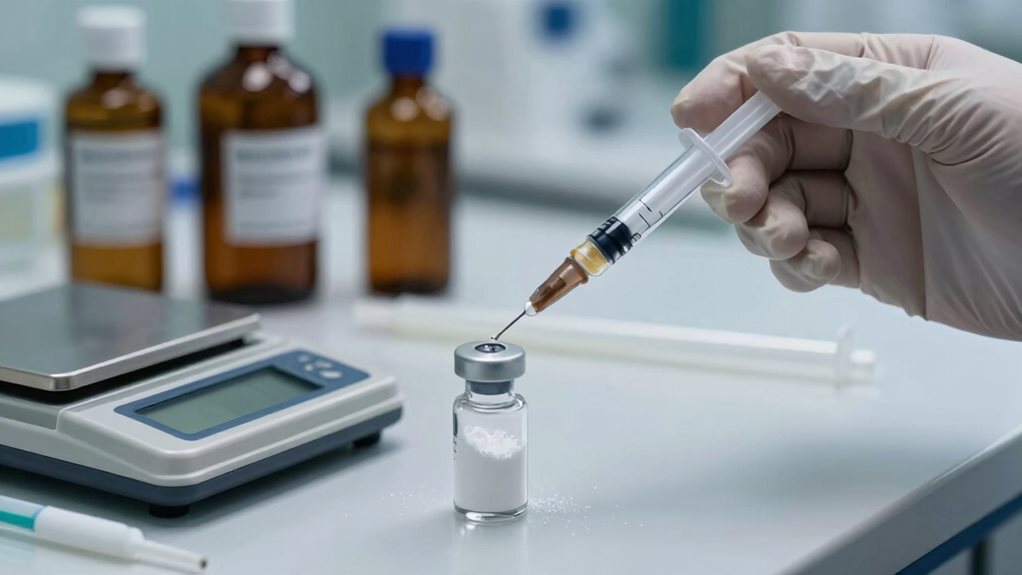
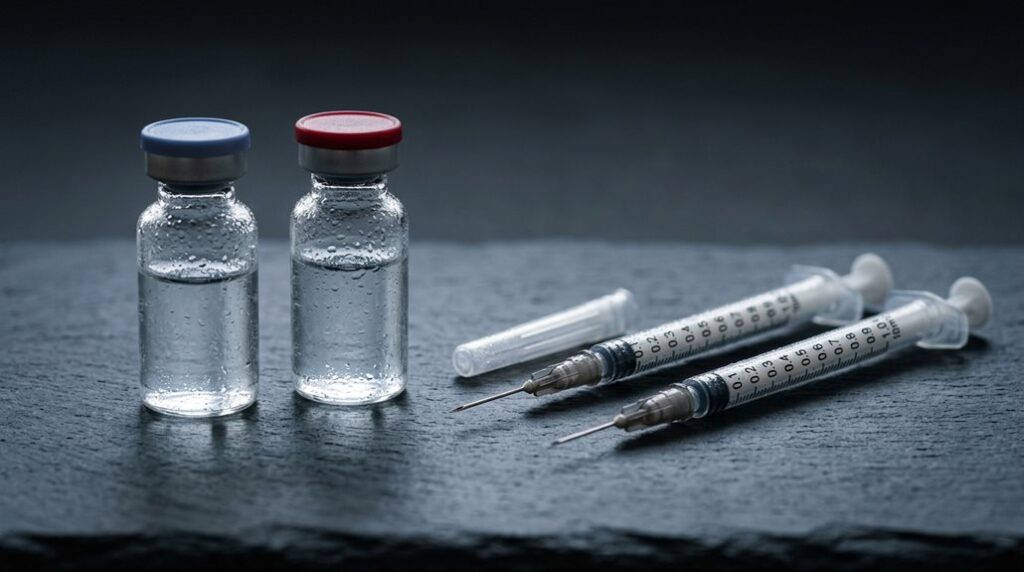
How do you convert a dry peptide vial into an accurately measured dose? First, multiply your vial’s milligrams by 1,000 to get total micrograms, then divide by your chosen water volume to find concentration. For your dose, divide desired micrograms by concentration to get milliliters, and multiply by 100 for insulin syringe units. DSIP targets delta-wave sleep directly, which can influence sleep architecture and recovery when used in research contexts. sleep architecture considerations are central to interpreting any measured outcomes in peptide-based sleep strategies.
Start With a Conservative Peptide Dosage Titration Plan
Three core principles guide every responsible peptide protocol: you’ll begin with a fraction of the anticipated therapeutic dose, advance through measured increments only when tolerance permits, and hold each level long enough to observe your body’s response before proceeding further. Start at 25–33% of your target dose, increase by similar small percentages every 2–4 weeks, and never escalate while side effects persist—your lowest effective dose remains the goal.
Time Your Peptide Dosing by Half-Life and Research Goals
When you’re designing a peptide protocol, you’ll find that timing isn’t merely a matter of convenience—it’s the bridge between pharmacokinetics and your actual research outcomes, and half-life sits at the center of every calculation you’ll make.
You’ll dose short half-life peptides multiple times daily to maintain exposure, while long half-life compounds often suit weekly schedules.
Match your interval to 1.5–2× half-life, align sampling with peak and trough, and plan washouts across 5–7 half-lives for clean data.
Check the Evidence Level Before Trusting Any Peptide Dose

Why should you accept a peptide dose at face value when the difference between a rigorously validated protocol and an unverified recommendation could fundamentally alter your research integrity? You’ll want to examine whether the dose rests on Phase III human trials, small pilot studies, animal data, or mere speculation, because credibility varies dramatically across these tiers. FDA-approved compounds carry validation unmatched by experimental alternatives clinical validation.
Why Peptide Dosing Has No Universal Formula (And Why That Matters)
How do you determine the right amount when every peptide, every research subject, and every experimental goal introduces its own variables?
You recognize that peptide dosing isn’t universal because each compound, body composition, and metabolic baseline creates unique responses.
Research doses are context-specific parameters, not transferable standards.
Assuming otherwise risks underdosing, overtreatment, or false conclusions about efficacy.
And Finally
You’ve now learned how to calculate reconstitution, start conservatively, time doses by half-life, and evaluate evidence quality, yet you must remember that peptide dosing remains highly individualized, requiring careful adjustment based on your specific research parameters, compound characteristics, and observed responses rather than fixed formulas. Apply these principles methodically, document your protocols thoroughly, and you’ll develop reliable, reproducible dosing strategies that serve your investigative goals while maintaining scientific rigor and safety standards.
References
- https://www.peptideregenesis.com/blogs/peptide-blog/peptide-calculator-research-guide
- https://peptideguides.org/guides/peptide-dosing-ranges-research-protocol-framework
- https://bestpeptidesforyou.com/guides/how-to-calculate-dosage
- https://deltapeptides.com/dosing-guidelines.html
- https://xenopeptides.com/peptide-dosing-research/?v=28886f13f578
- https://ironmountainlabz.com/peptides-dosage-chart/
- https://puretestedpeptides.com/commonly-researched-typical-dosages-for-peptides/
- https://primepeptides.co/peptide-calculator/
- https://protopep.co.za/dosing-protocols
- https://dkdermal.com/blog/how-to-inject-peptides-and-determine-proper-dosage/