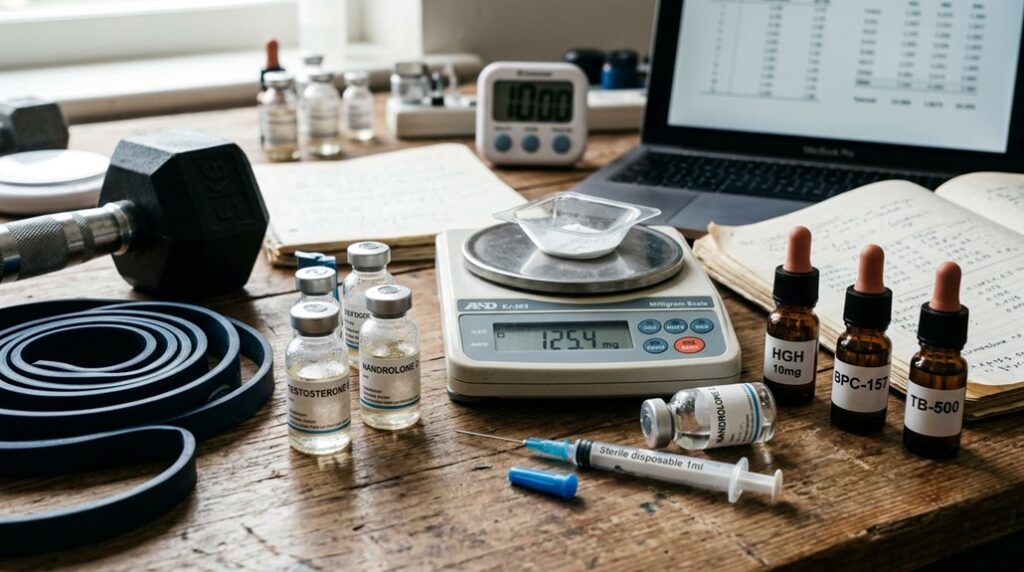
Injectable peptides deliver 65–100% bioavailability directly to your bloodstream, while unmodified oral forms typically achieve less than 2% due to stomach acid, digestive enzymes, and intestinal barriers, meaning you’d need roughly 150–250 mg orally to match a 5 mg injection for systemic effects. Most peptides, including BPC-157 and sermorelin, remain injectable because their size and structure cannot survive gastrointestinal destruction without advanced formulation technology. You should choose injection for muscle, tendon, or bone research goals, though oral delivery may suit localized intestinal targets, and continuing below reveals which specific peptides break these rules and how new absorption technologies are changing the landscape.
TLDR
- Injectable peptides reach nearly 100% bioavailability, while unmodified oral forms often fall below 3%.
- Stomach acid, digestive enzymes, and intestinal barriers destroy 95–99% of most oral peptide doses.
- Systemic goals like muscle or tendon repair require injections; local gut targets may suit oral delivery.
- Oral formulations need absorption enhancers or protective tech to achieve meaningful bioavailability.
- Route choice depends on tissue target, cost, evidence quality, and regulatory constraints like WADA bans.
Injectable vs. Oral Peptides: Which Actually Works Better?

Injectable peptides achieve nearly complete bioavailability, while standard oral forms struggle below 3%, meaning you’d need roughly 150–250 mg orally to match a 5 mg injection. In addition, regulatory and safety considerations mean that most peptide products lack FDA approval for muscle growth in healthy adults, and WADA bans apply to certain peptides in sport, so choosing a delivery method also involves oversight and compliance considerations regulatory context.
The Bioavailability Gap: Why Oral Peptides Deliver Less
You’ve seen the numbers—injectable peptides reach your system almost completely intact, while their oral counterparts face a gauntlet that strips away nearly all of their potency. Your stomach acid, digestive enzymes, and the intestinal wall’s tight junctions work together to break down or block most oral peptides before they enter your bloodstream, leaving you with bioavailability often below 1%, even with advanced formulations. Dihexa research highlights how small changes in peptide delivery can dramatically influence brain exposure and activity knowing, and understanding these mechanisms is crucial for evaluating therapeutic potential and safety.
Three Barriers Every Oral Peptide Must Survive
Why does a promising oral peptide treatment so often fall short of expectations? You face three sequential barriers: harsh stomach acid that denatures structure, pervasive digestive enzymes that cleave 95–99% of your dose, and mucus trapping combined with tight junction limits that block epithelial entry. Each barrier compounds the last, capping unmodified oral bioavailability below 1–2%.
Which Peptides Can Be Taken Orally: and Which Can’t?

The three barriers you just encountered—acid denaturation, enzymatic cleavage, and epithelial resistance—aren’t insurmountable for every peptide, and understanding which compounds survive this gauntlet helps you make informed decisions about administration routes. You can take desmopressin, cyclosporine A, linaclotide, and oral semaglutide by mouth, as these established drugs use specialized formulations or local gut action. BPC-157, sermorelin, and ipamorelin appear in compounded oral or sublingual forms, though evidence varies. Most therapeutic peptides, however, remain injectable because their size and structure can’t withstand gastrointestinal destruction, leaving you with subcutaneous or intravenous administration as your only reliable option for the majority of peptide therapies. immune modulation
Matching Your Goal to the Right Administration Route
How you administer a peptide isn’t merely a matter of convenience—it’s a decision that fundamentally shapes whether your compound reaches its intended destination in concentrations sufficient to produce the effect you’re pursuing. For systemic goals involving muscle, tendon, or bone research, you’ll want injectable delivery, which bypasses digestion and achieves predictable blood levels. When your target lies within the gastrointestinal tract itself, oral administration becomes logical, as local exposure suffices and systemic absorption isn’t required. Consider your peptide’s bioavailability: unmodified compounds offer less than 2% orally, while subcutaneous injection delivers 65–100%. Match your route to your tissue, your evidence needs, and your formulation capabilities.
Oral vs. Injectable Peptides: The Real Cost Difference
Oral Wegovy lists at $149–$299 monthly without insurance, while injectable versions run about $300, though insurance often equalizes both at $25 or less.
However, oral bioavailability frequently falls below 5% versus 70–85% for injections, meaning you’ll need 2–3 times higher doses for comparable systemic effects.
For gut-targeted conditions like intestinal repair, oral BPC-157 at $40–$80 monthly may prove cost-effective, but musculoskeletal injuries typically justify injectable delivery despite higher sticker prices.
Ultimately, your cost-per-clinical-effect matters more than the label price alone.
Bioavailability drives the dose difference and overall cost efficiency between oral and injectable peptides, shaping how manufacturers and clinicians weigh value in different therapeutic contexts.
New Peptide Tech: Oral Formulations Worth Watching

Where does oral peptide delivery stand now that it’s moved past mere feasibility? You’re witnessing optimization, with approved products and Phase III candidates replacing experimental dreams. Leading platforms—Peptelligence™, GIPET®, POD™, and device-based RaniPill™—use absorption enhancers, enzyme inhibitors, and targeted release to overcome GI barriers. These innovations transform injectable peptides into tablets, offering you genuine alternatives worth tracking closely. LL-37 provides insight into immune-related mechanisms that inform peptide stability and function in biological systems immune mechanisms.
And Finally
You’ve now seen how injectable and oral peptides each carry distinct advantages, limitations, and cost considerations that must align with your specific health objectives. While injections deliver superior bioavailability for most compounds, emerging oral technologies continue expanding viable non-invasive options. Your optimal choice depends on the specific peptide, your tolerance for administration, and your budget. Consult a qualified healthcare provider to determine which route best serves your evidence-based goals.
References
- https://exploring-peptides.com/article/oral-vs-injectable-peptides/
- https://peptidepublicus.com/he/blog/oral-vs-injectable-peptides-bioavailability
- https://www.peptidepilot.me/blog/oral-vs-injectable-peptides
- https://pharmagradepeptides.com/oral-vs-injectable-peptides/
- https://www.valencia-med.com/blog/injectable-vs-oral-peptides-knoxville
- https://www.seekpeptides.com/injectable-vs-oral-peptides
- https://www.youtube.com/watch?v=yFnoOee0yJ8
- https://revolutionhealth.org/blogs/news/oral-vs-injectable-bpc-157
- https://meto.co/blog/bpc-157-injection-vs-oral-peptide
- https://formblends.com/compare/oral-vs-injectable-peptides