
If you’re choosing between DSIP and melatonin for sleep, it’s important to understand their differences: melatonin is a hormone that regulates circadian rhythms and is well-supported by extensive research, making it effective for sleep onset issues and circadian disruptions with a known safety profile. Conversely, DSIP is a neuropeptide studied mainly in experimental settings, with limited evidence and unclear mechanisms affecting sleep architecture, often used in research rather than clinical practice. Exploring these distinctions will help clarify which option may suit your sleep needs better.
TLDR
- Melatonin is well-researched, regulates circadian rhythms, and effectively reduces sleep onset issues, unlike DSIP, which has limited evidence.
- DSIP is an experimental neuropeptide with uncertain effects on sleep depth and architecture, whereas melatonin’s mechanisms are well understood.
- Melatonin is available over-the-counter with a strong safety profile; DSIP requires injections and lacks comprehensive safety data.
- Melatonin is suitable for circadian-related sleep problems; DSIP may target sleep quality and fragmentation, but evidence remains weak.
- Overall, melatonin is the preferred, evidence-based option, while DSIP remains experimental with limited clinical support.
What Are Melatonin and DSIP? An Overview of Sleep-Related Peptides and Hormones
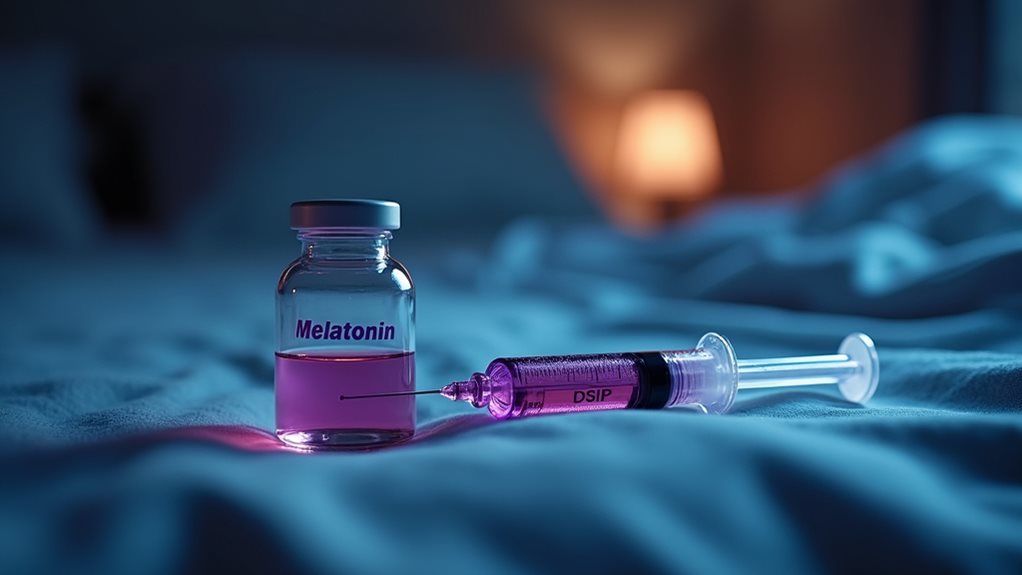
Understanding the distinct roles of melatonin and DSIP in sleep regulation requires recognizing that they belong to different categories of biological substances, each with unique origins and functions.
Melatonin is a hormone produced mainly by the pineal gland, signaling night and regulating the sleep-wake cycle.
In contrast, DSIP is a neuropeptide linked to sleep architecture, especially slow-wave sleep, and is primarily studied in research settings.
Linking sleep mechanisms Sleep-related peptides and hormones may interact to coordinate recovery processes and circadian rhythms, suggesting a broader context for how these substances influence sleep quality.
How Do Melatonin and DSIP Affect Your Sleep? Mechanisms Explained
Melatonin influences sleep primarily through hormonal signaling that aligns your internal clock with the light-dark cycle, affecting both sleep onset and circadian timing.
While DSIP’s mechanisms are less clearly defined, they are thought to involve modulation of sleep architecture and neuroendocrine functions.
The timing of melatonin intake plays a vital role in whether it shifts your biological rhythms or simply promotes sleep.
In contrast, DSIP’s effects on sleep quality and stages are still under investigation, with limited understanding of its precise pathways.
Understanding these mechanisms helps clarify how each substance may support or alter your sleep patterns, although uncertainties remain, especially regarding DSIP’s exact role in sleep regulation. mitochondrial signaling
Hormonal Signaling and Timing
Hormonal signaling plays a crucial role in regulating sleep by transmitting timing cues and influencing the brain’s readiness for rest. Melatonin, released by the pineal gland in response to darkness, acts on specific receptors to signal night and promote sleep onset.
Feedback loops with the circadian clock reinforce synchronization.
In contrast, DSIP’s mechanism remains less defined, lacking clear timing signals.
Sleep Architecture Modulation
While both melatonin and DSIP influence sleep architecture, they do so through different mechanisms that impact various stages of sleep in distinct ways.
Melatonin primarily regulates sleep timing and circadian rhythm, helping you fall asleep at the right biological time.
Whereas DSIP modulates sleep stages, often increasing NREM and slow-wave sleep, and supporting a more natural sleep pattern without heavily altering overall sleep structure.
Mechanistic Uncertainties
Understanding how melatonin and DSIP influence sleep involves examining their mechanisms, which differ markedly in clarity and established scientific basis.
Melatonin’s role as a circadian signal, with well-defined receptor pathways, contrasts with DSIP’s unclear, inconsistent effects lacking a confirmed receptor or pathway.
This uncertainty makes DSIP’s influence on sleep less predictable and more speculative than melatonin’s well-understood biological actions.
What Sleep Problems Can Melatonin and DSIP Help With?
Both melatonin and DSIP are studied for their potential to address various sleep disturbances, although their applications differ based on the underlying causes.
Melatonin may help with jet lag, delayed sleep phase disorder, insomnia onset, and circadian rhythm issues.
While DSIP is primarily researched for sleep fragmentation, poor sleep depth, and stress-related sleep disruptions, though evidence remains limited.
A mechanistic perspective from incretin-weighted sleep research suggests that understanding how sleep-regulating signals interact with metabolic pathways can inform treatment choices. incretin pathways
Do Melatonin and DSIP Improve Sleep Onset and Sleep Depth?

Although melatonin and DSIP are both examined for their potential to improve sleep onset and depth, they differ considerably in the strength and consistency of the evidence supporting their effects.
Melatonin has stronger, replicated evidence showing modest reductions in sleep latency, especially in circadian misalignment.
In contrast, DSIP’s effects are limited, inconsistent, and lack firm confirmation for significant improvements in sleep depth or onset.
Epitalon, while discussed in other contexts, is not established as a sleep aid and carries long-term safety uncertainties. telomerase activation
When Should You Use Melatonin or DSIP for Better Sleep?
While melatonin and DSIP are both examined as sleep aids, they serve different purposes and are suited to distinct situations based on current clinical understanding.
Use melatonin to adjust sleep timing, especially when seeking to advance or reset sleep schedules temporarily, such as jet lag or delayed sleep phase.
DSIP remains experimental, typically reserved for specialized or research settings.
Additionally, N-Acetyl Semax and Semax differ in stability profiles, which can influence their suitability for specific research or therapeutic contexts. stability profile
What Scientific Evidence Supports Using Melatonin and DSIP?
The scientific evidence supporting melatonin is relatively strong, with numerous clinical trials demonstrating modest improvements in sleep onset, duration, and quality, especially for specific conditions like delayed sleep phase syndrome and primary insomnia.
In contrast, DSIP has limited research backing its effectiveness, with very few well-designed studies or meta-analyses to confirm its benefits, making its scientific support much weaker.
Additionally, melatonin has gained regulatory approval in many countries, providing further assurance of its safety and efficacy, whereas DSIP remains largely unregulated and unsupported by official guidelines. mechanisms of peptide metabolism
Evidence Quality Comparison
When comparing the scientific evidence supporting melatonin and DSIP as sleep aids, it becomes clear that melatonin has a much stronger and better-documented research base.
Multiple systematic reviews and meta-analyses support its use, providing quantifiable effects on sleep latency, duration, and quality.
In contrast, DSIP lacks comparable high-quality evidence, making melatonin the more reliably supported option based on current scientific standards.
Clinical Trial Availability
Have you ever wondered about the scientific backing behind using melatonin and DSIP as sleep aids? Melatonin has extensive clinical trial data, including over 35 randomized controlled trials, showing improvements in sleep onset and quality, particularly for circadian rhythm disorders and insomnia.
Ongoing studies continue to investigate its effectiveness, providing a solid foundation for understanding its potential benefits.
Regulatory Approvals Status
Understanding the regulatory status of melatonin and DSIP helps clarify their legitimacy and safety as sleep aids, especially considering how different authorities oversee their use.
Melatonin is available over-the-counter in the U.S., but quality varies.
DSIP lacks approval from major agencies like the FDA, EMA, and Health Canada, limiting its official medical use and indicating the need for caution and informed evaluation.
How Do You Take Melatonin and DSIP? Dosage, Administration, and Access

Administering melatonin and DSIP involves distinct approaches that depend on their respective forms, purposes, and available evidence.
Making it essential to understand the appropriate dosages, methods of intake, and access options for each.
Melatonin is usually taken orally, with doses ranging from 0.5 to 10 mg before bed.
While DSIP is administered through injections in research settings, with dosing varying widely and lacking standardization.
Are There Risks or Side Effects of Using Melatonin and DSIP?
Both melatonin and DSIP are used to promote sleep, but their safety profiles and potential side effects differ considerably due to their distinct nature and levels of scientific understanding.
Melatonin may cause daytime drowsiness, headaches, dizziness, and mood changes. There is also some risk of falls or allergic reactions.
DSIP’s safety data are limited, and its broad physiological effects require further research to understand potential risks fully. In addition, DSIP is often discussed in the context of limited regulatory and clinical data, underscoring the need for cautious interpretation of safety information insufficient evidence.
Which Sleep Aid Is Right for You: Melatonin or DSIP?
Deciding between melatonin and DSIP as your sleep aid depends largely on the specific nature of your sleep difficulties, as each targets different underlying issues.
Melatonin, supported by extensive research, primarily helps with sleep onset and circadian rhythm disruptions, making it suitable for timing issues.
In contrast, DSIP, though less proven, may benefit those experiencing poor sleep quality, fragmentation, or shallow sleep.
Frequently Asked Questions
Can DSIP Be Legally Obtained for Sleep Treatment?
You can legally obtain DSIP only through a licensed compounding pharmacy with a prescription, as it’s not FDA-approved for sleep. Online research products are risky, unregulated, and not intended for human use, so caution is essential.
How Quickly Does Melatonin Typically Work for Sleep Onset?
Melatonin usually works within 20 to 60 minutes, especially with immediate-release forms, helping you fall asleep faster. Its effects depend on dose, formulation, timing, and individual factors like age and lifestyle, so responses can vary.
Are There Long-Term Safety Concerns With DSIP Use?
You should be cautious about long-term DSIP use because safety data are limited, and potential risks include hormonal disruption, sleep cycle changes, neuropsychiatric effects, immune reactions, and unknown organ effects, especially with unregulated, poorly tested products.
Can DSIP Improve Sleep Quality Without Changing Sleep Timing?
You might experience improved sleep quality with DSIP, but evidence is limited and inconsistent. While it can enhance sleep efficiency and continuity, it’s unclear if it consistently leaves sleep timing unchanged, as research on this aspect remains inconclusive.
Is There Any FDA Approval for DSIP as a Sleep Medication?
There’s no FDA approval for DSIP as a sleep medication. It remains investigational, with safety concerns and limited evidence. You shouldn’t rely on DSIP for sleep, as it’s not officially approved or regulated for that purpose.
And Finally
Choosing between melatonin and DSIP depends on your specific sleep needs and health considerations. Both agents have distinct mechanisms and evidence supporting their use, but they also carry potential risks. Consulting with a healthcare professional can help determine the most appropriate option, ensuring safe and effective sleep management customized to your individual circumstances. Understanding their differences enables you to make informed decisions, promoting better sleep quality through scientifically supported approaches.