AOD-9604 and HGH fragment 176-191 are both synthetic peptides derived from human growth hormone but differ structurally; AOD-9604 includes a tyrosine addition and cyclization for stability, while native HGH fragment 176-191 is unmodified. Both promote fat breakdown by targeting adipose tissue, with AOD-9604 designed to avoid influencing growth or IGF-1 levels, making them safer options. Their effectiveness varies, and ongoing research highlights the importance of understanding their distinct features—continue exploring to gain a clearer overview.
TLDR
- AOD-9604 has structural modifications, including tyrosine addition and cyclization, enhancing stability and fat-burning effects compared to native HGH fragments.
- Both peptides promote lipolysis but do not significantly influence IGF-1 or blood sugar levels, focusing on fat metabolism rather than growth promotion.
- AOD-9604 is designed to resist enzymatic breakdown, improving bioavailability, whereas HGH Fragment 176-191 is less stable without modifications.
- Clinical evidence for both is limited; AOD-9604 has a better safety profile but lacks regulatory approval, unlike the more studied native fragment.
- Their mechanisms involve targeting adipose tissue to increase fat oxidation without systemic hormonal effects.
What Are the Structural and Functional Differences Between AOD-9604 and HGH Fragment 176-191?
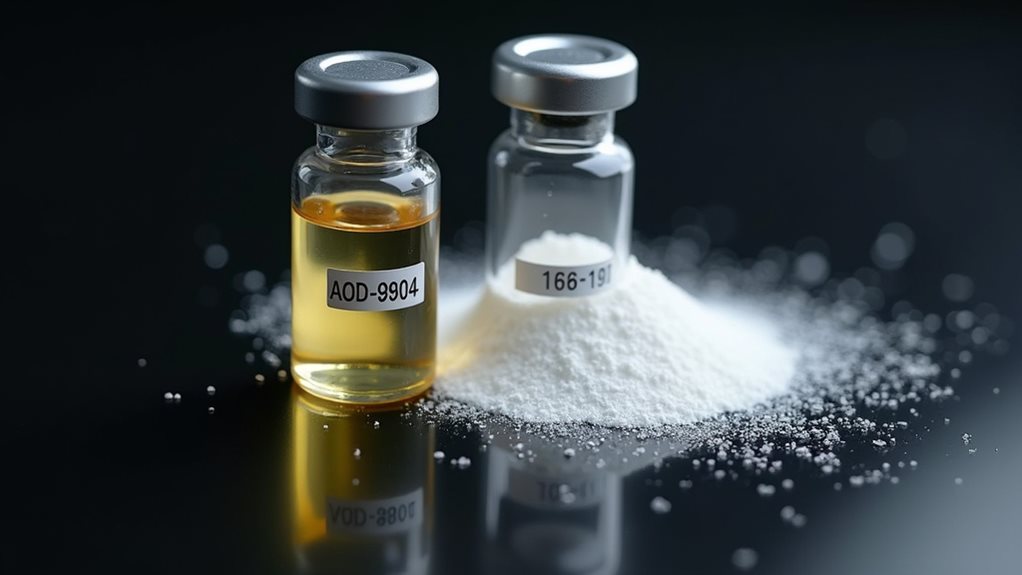
AOD-9604 includes an added tyrosine and forms a cyclized peptide, designed to preserve fat-burning effects without promoting growth or IGF-1. While both Epitalon and Thymosin Alpha-1 target different systems in longevity research, AOD-9604 and HGH fragment 176-191 originate from the same region of human growth hormone (hGH) but have distinct structural and functional profiles. In contrast, the native fragment is unmodified, primarily studied for lipolytic activity. No direct link to the broader pharmacology of growth hormone fragments
How Stable Are These Fat Loss Peptides and What Affects Their Bioavailability?
The stability of these fat loss peptides depends heavily on their molecular structure and the specific modifications designed to resist enzymatic breakdown, with AOD-9604 featuring stabilizing elements like N-terminal tyrosine and disulfide bonds. However, factors like temperature, handling, and formulation greatly influence their bioavailability, as rapid degradation can occur in biological fluids and during storage or administration. Understanding these variables is vital to optimize delivery methods and guarantee consistent absorption and effectiveness. Glutathione
Structural Modifications Enhance Stability
Structural modifications to fat loss peptides like AOD-9604 and HGH Fragment 176-191 aim to improve stability within biological systems. However, their effectiveness varies depending on factors such as temperature, sample handling, and biological matrices.
While these modifications, like adding N-terminal tyrosine and preserving disulfide bridges, enhance structural rigidity, rapid metabolism still limits their circulating lifespan and bioavailability.
Enzymatic Resistance Improves Bioavailability
Enzymatic resistance plays a crucial role in determining how effectively fat loss peptides like AOD-9604 and HGH Fragment 176-191 can reach and persist in systemic circulation, directly influencing their bioavailability.
Structural features, such as stabilizing bonds in AOD-9604, enhance resistance to degradation by proteolytic enzymes, allowing more molecules to survive and be absorbed.
Although this increased resistance helps, rapid metabolism still limits their longevity in the bloodstream.
Formulation Strategies Influence Absorption
Understanding how formulation strategies influence the absorption of fat loss peptides like AOD-9604 and HGH fragment 176-191 is essential for maximizing their effectiveness.
Stability directly impacts how much of the active compound survives until it reaches systemic circulation. Proper storage, temperature control, moisture prevention, and careful reconstitution greatly enhance bioavailability.
These practices ensure consistent and reliable results from these peptides.
How Do These Peptides Impact Fat Metabolism and Lipolysis?
Both AOD-9604 and HGH fragment 176-191 are peptides that primarily influence fat metabolism and lipolysis by targeting adipose tissue, not through broad systemic effects of growth hormone.
They promote fat breakdown and increase fat oxidation, with mechanisms involving enhanced responsiveness of fat cells and suppression of new fat formation.
Ultimately, they encourage the mobilization and utilization of stored fats.
AOD-9604 may interact with fat metabolism pathways related to lipolysis and fat oxidation, reflecting its proposed targeted action on adipose tissue lipolysis mechanisms.
Do AOD-9604 and HGH Fragment 176-191 Affect IGF-1 Levels or Blood Sugar?
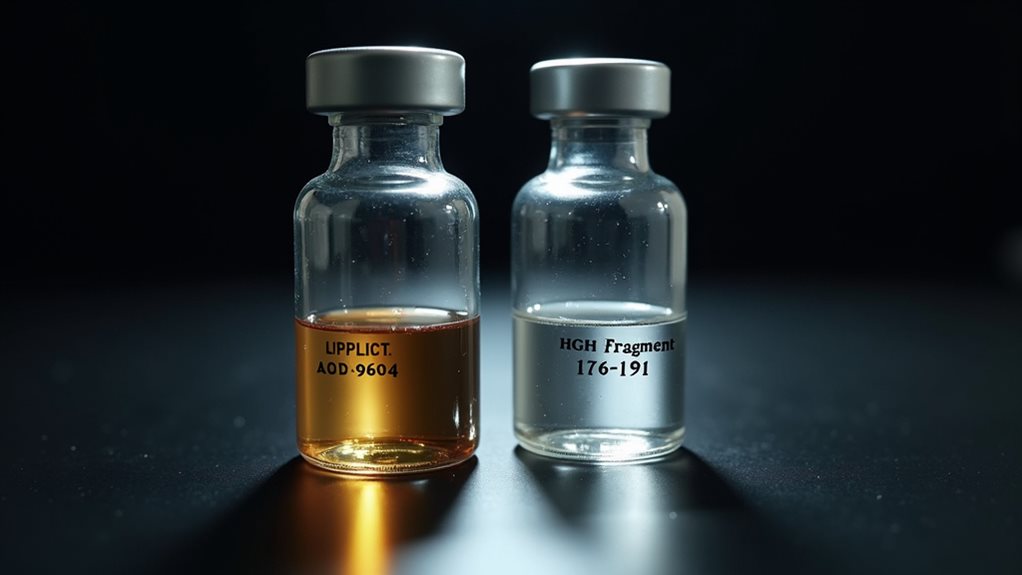
While both AOD-9604 and HGH Fragment 176-191 are designed primarily to influence fat metabolism without directly stimulating growth hormone pathways, their effects on IGF-1 levels and blood sugar regulation are notable points of interest. Tirzepatide’s dual incretin mechanism demonstrates a contrasting approach to glycemic control and weight loss, highlighting how targeted receptor activation can meaningfully influence glucose-dependent insulin release and appetite signals dual incretin across metabolic pathways. Evidence indicates these peptides don’t increase IGF-1 or impair glucose metabolism, making them distinct from full HGH, which can boost IGF-1 and affect blood sugar.
What Does the Research Say About Their Effectiveness and Clinical Use?
Although both AOD-9604 and HGH Fragment 176-191 have been studied for fat loss and metabolic effects, clinical evidence remains limited and inconsistent.
AOD-9604 shows modest, variable results in trials involving obese adults, with a favorable safety profile, yet no regulatory approval exists.
HGH Fragment 176-191 lacks comparable human data, and both compounds are considered experimental rather than approved therapies.
New data from purity testing emphasize that accurate identification of active components is essential for interpreting study results purity testing.
Which Peptide Is Better for Your Fat-Loss Goals and Safety?
Determining which peptide—AOD-9604 or HGH fragment 176-191—is better suited for your fat-loss goals depends on several factors, including their mechanisms, safety, and the strength of scientific evidence.
While both are considered similar molecules, existing research offers limited, inconsistent human data.
Safety profiles favor AOD-9604’s tolerability.
Ultimately, neither provides definitive, reliable fat-loss benefits based on current evidence. Limited human data
Frequently Asked Questions
Can AOD-9604 or HGH Fragment 176-191 Cause Side Effects?
You might experience mild side effects like headaches, gastrointestinal discomfort, or injection-site reactions with AOD-9604 or HGH fragment 176-191. Serious adverse effects are rare, and clinical trials suggest they’re generally well tolerated, but individual responses can vary.
Are There Differences in Dosing Protocols for These Peptides?
You won’t find meaningful differences in dosing protocols for these peptides; both are typically administered once daily, in the morning, at doses of 250–500 mcg, with variations mainly in scheduling, cycle length, and reconstitution methods.
How Long Does It Take to See Results With Each Peptide?
You’ll typically notice results around 4–6 weeks with both peptides, with the most visible changes often occurring between weeks 7 and 12. Consistent training and proper nutrition considerably influence how quickly you see noticeable improvements.
Are There Any Legal Restrictions on Using These Peptides?
You can’t legally use these peptides without proper authorization. In the U.S., they’re unapproved, tightly regulated, and banned in sports. International restrictions vary, so make certain you understand your country’s laws before considering usage.
Do These Peptides Interact With Other Medications or Supplements?
You should monitor for interactions, especially with insulin, sulfonylureas, or warfarin, as they may cause additive effects like hypoglycemia or bleeding risks. Supplements are less likely to interact, but caution remains advised due to limited data.
And Finally
Both AOD-9604 and HGH Fragment 176-191 are promising peptides for fat loss, with distinct structural and functional profiles that influence their stability and effectiveness. Understanding their impact on lipolysis, IGF-1 levels, and blood sugar is essential for making informed choices aligned with your safety and goals. Consulting with a healthcare professional guarantees proper use, helping you select the peptide best suited to your individual needs while minimizing potential risks and maximizing benefits.
References
- https://www.youtube.com/watch?v=Qo-JOsCGHfM
- https://purehealthpeptides.com/hgh-176-191-vs-aod9604-understanding-the-differences/
- https://peptidejournal.org/compare/fragment-176-191-vs-aod-9604-fat-loss-peptides
- https://www.reddit.com/r/Peptides/comments/13czw3f/a0d9604_vs_frag176191/
- https://www.chemverify.com/learn/aod-9604-vs-hgh-fragment
- https://clinicalpeptide.org/blog/aod-9604-vs-hgh-frag-176-191-comparison/
- https://www.peptidejournal.org/compare/fragment-176-191-vs-aod-9604-fat-loss-peptides
- https://themetabolicjournal.com/compare/aod-9604-vs-hgh-fragment
- https://tidelabs.co.uk/blogs/articles/aod-9604-gh-frag-176-191-research-on-body-fat-metabolism
- https://jofem.org/index.php/jofem/article/view/213/278