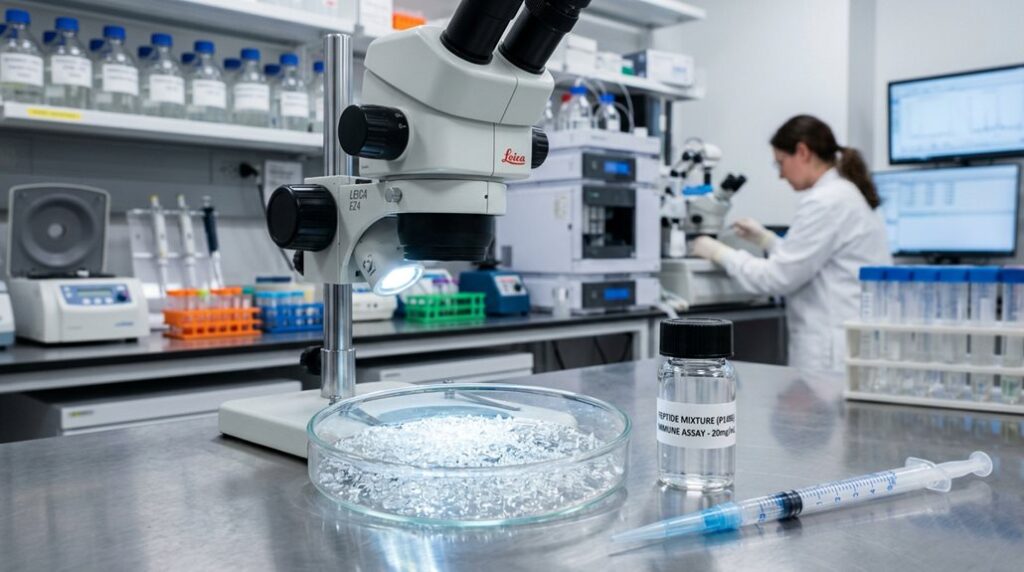
LL-37 is a powerful peptide that directly targets and kills a broad range of microbes while also modulating immune responses and promoting wound healing, making it suitable for acute infections and wound care. Conversely, KPV primarily reduces inflammation by suppressing immune signaling pathways and supporting tissue repair, making it more appropriate for chronic inflammatory conditions. Both peptides have distinct mechanisms—antimicrobial versus anti-inflammatory—and understanding their differences can help guide targeted therapeutic use as you investigate further.
TLDR
- LL-37 is a broad-spectrum antimicrobial peptide that directly kills bacteria, fungi, and viruses, whereas KPV primarily acts as an anti-inflammatory regulator.
- LL-37 promotes wound healing and immune signaling, while KPV focuses on reducing chronic inflammation and supporting tissue repair.
- LL-37 has higher production costs, stability issues, and potential toxicity risks compared to KPV, which is easier to synthesize and more stable.
- LL-37 is suitable for acute infections and microbial defense, whereas KPV is better for managing long-term inflammatory conditions.
- Both peptides have distinct mechanisms—LL-37 disrupts pathogen membranes, while KPV suppresses cytokine production and stabilizes tissue barriers.
Introduction: What Are LL-37 and KPV in Innate Immunity?

In the complex environment of innate immunity, peptides such as LL-37 and KPV play distinct but interconnected roles in defending the body against threats and maintaining immune balance.
LL-37 acts as a direct antimicrobial and immune signaling molecule produced by immune cells and epithelial tissues.
Meanwhile, KPV primarily functions as an anti-inflammatory peptide, modulating immune responses and controlling inflammation to support overall immune regulation. peptide signaling
How Does LL-37 Fight Microbes and Promote Wound Healing?
LL-37 exerts its antimicrobial effects through a combination of mechanisms that target the bacterial cell membrane and intracellular components. Consequently, it plays an essential role in defending against infections and facilitating tissue repair. It binds strongly to bacterial surfaces, permeabilizes membranes rapidly, and damages cell walls and internal molecules. It also penetrates biofilms and neutralizes toxins, supporting effective wound healing. It also interacts with host immune receptors to modulate inflammatory responses and recruit immune cells to sites of injury membrane disruption.
What Is KPV’s Role in Reducing Inflammation and Supporting Barriers?
KPV plays a significant role in reducing inflammation by suppressing key signaling pathways, such as NF-κB and MAPK. These pathways are responsible for activating many pro-inflammatory genes.
It also helps support barrier functions by preserving the integrity of epithelial tissues, especially in the gut. In this area, inflammation often damages the lining and impairs tissue repair.
Understanding these mechanisms provides insight into how KPV may help mitigate inflammatory responses and maintain tissue health in various tissues affected by chronic inflammation.
Cytokine Suppression Mechanisms
KPV plays a central role in reducing inflammation by actively suppressing key signaling pathways that promote cytokine production, which are essential mediators of immune responses and tissue damage.
It inhibits NF-κB signaling by stabilizing IκBα and preventing p65/RelA nuclear translocation, thereby lowering the production of pro-inflammatory cytokines like TNF-α, IL-1β, and IL-6.
This action supports tissue health and barrier integrity.
Epithelial Barrier Enhancement
Enhancement of the epithelial barrier is a critical aspect of reducing inflammation and maintaining tissue integrity, especially within the gastrointestinal tract.
KPV supports this by being actively transported into epithelial cells via PepT1, promoting tight-junction stability, reducing permeability during inflammation, and accelerating healing after injury.
These effects help preserve barrier function, limiting harmful substances from entering tissues and supporting overall gut health.
Anti-Inflammatory Pathways
The ability of KPV to reduce inflammation is primarily mediated through its impact on key cellular signaling pathways that govern inflammatory responses. It inhibits NF-κB and MAPK pathways, lowering cytokine production and stabilizing immune functions.
Comparing How LL-37 and KPV Work: Antimicrobial vs. Anti-Inflammatory Actions

LL-37 primarily works by directly disrupting bacterial membranes and attacking various microbial targets.
KPV mainly suppresses inflammatory pathways, such as NF-κB signaling, to protect tissues.
Recognizing these differences helps guide therapeutic strategies, emphasizing LL-37’s broad-spectrum microbicidal activity and KPV’s role in reducing inflammation and supporting tissue repair.
A potential synergy between antimicrobial action and controlled inflammation could enhance healing in infected tissues immune signaling and warrants further exploration.
Mechanisms of Action
While both LL-37 and KPV are peptides involved in immune responses, they operate through distinctly different mechanisms that reflect their unique roles in host defense and inflammation regulation.
LL-37 kills bacteria mainly by disrupting membranes and targeting intracellular processes.
In contrast, KPV modulates inflammation primarily by inhibiting signaling pathways like NF-κB, reducing cytokine production, and supporting tissue integrity without directly attacking pathogens.
Targets and Effects
Examining the specific targets and resulting effects of LL-37 and KPV reveals distinct modes of action aligned with their respective roles in immune defense and inflammation regulation.
LL-37 directly targets bacterial cell membranes, disrupting their integrity and preventing biofilm formation.
Meanwhile, KPV primarily modulates immune responses by dampening inflammatory pathways in epithelial and mucosal tissues, without direct microbial killing.
Research Focus Areas
How do LL-37 and KPV differ in their research focus areas, particularly regarding their roles in antimicrobial activity versus anti-inflammatory regulation?
LL-37 primarily targets microbes through membrane disruption, biofilm prevention, and endotoxin neutralization. It also modulates immune responses.
Conversely, KPV mainly focuses on reducing inflammation by suppressing cytokines and immune cell activation, emphasizing regulation over direct microbial killing.
Which Peptide Is Better for Acute Infections and Wound Care?
In considering which peptide offers greater efficacy for acute infections and wound care, it’s essential to understand the distinct mechanisms by which LL-37 and KPV operate, as well as their current research profiles.
LL-37 directly kills pathogens and promotes tissue repair, making it more suitable for managing microbial load. Cationic antimicrobial peptide also interacts with modulating inflammatory responses, which can influence healing dynamics.
Whereas KPV mainly modulates inflammation, which is less effective for immediate infection control.
Is KPV More Effective for Chronic Inflammatory Conditions?
Given the complex nature of chronic inflammatory conditions, KPV has garnered attention primarily because of its demonstrated anti-inflammatory effects in preclinical models, especially within gastrointestinal diseases like IBD.
Evidence shows KPV reduces inflammation, improves tissue health, and acts inside cells to lower inflammatory pathways without broad immune suppression, making it a promising candidate for managing long-term inflammation more safely than traditional therapies.
Additionally, research on Glutathione highlights its role as a tripeptide antioxidant that supports cellular redox balance and may influence inflammatory signaling pathways, potentially complementing approaches like KPV in chronic inflammatory conditions glutathione’s antioxidant function.
What Are the Challenges in Synthesizing and Using LL-37 and KPV?
Synthesizing and utilizing LL-37 and KPV as therapeutic agents present distinct challenges rooted in their structural complexity, stability, and delivery requirements.
LL-37’s longer sequence increases production costs, susceptibility to rapid degradation, and toxicity risks, necessitating advanced formulations for stability and targeted delivery.
Conversely, KPV’s smaller size simplifies synthesis and enhances stability, but both peptides face ongoing obstacles in efficient, safe clinical application.
Purity testing with HPLC and mass spectrometry remains essential to confirm the actual composition of peptide vials and to detect impurities that could affect efficacy and safety, underscoring the need for rigorous quality control in peptide development Purity Testing.
What Does Research Say About the Efficacy of LL-37 and KPV?
Research indicates that the efficacy of LL-37 and KPV varies considerably depending on their specific biological activities and the environment in which they’re tested.
LL-37 demonstrates broad antimicrobial activity against bacteria, fungi, and viruses, with notable anti-biofilm effects.
However, its effectiveness can be reduced in human serum.
Conversely, KPV’s evidence mainly highlights anti-inflammatory effects, with limited data on direct antimicrobial potency.
The differences in their action stem from distinct roles in inflammation pathways and immune responses, as well as how the peptides interact with host environments such as skin vs. mucosal tissues. anti-inflammatory effects
How Do Their Potential Clinical Uses Differ?
While both LL-37 and KPV hold promise for clinical applications, their potential uses differ considerably due to their distinct biological activities and targeted therapeutic areas.
LL-37’s broad, system-level roles focus on wound healing, infection control, and immune modulation, mainly through topical applications.
In addition, N-Acetyl Semax and Semax differ in stability profiles, which can influence their suitability for specific delivery methods and longer-lasting effects in clinical settings.
Pros and Cons of LL-37 and KPV for Future Therapies

Understanding the advantages and limitations of LL-37 and KPV is essential as you consider their potential roles in future therapies.
While LL-37 offers broad-spectrum antimicrobial activity and immune modulation, it faces challenges related to bioavailability, stability, and possible toxicity, which can hinder systemic application. Additionally, LL-37 has been studied for its effects on inflammatory pathways and wound healing, which may influence its therapeutic window Mitochondrial-derived peptides and potential context-dependent outcomes.
Conversely, KPV’s anti-inflammatory properties and easier synthesis make it promising for localized treatments, but its limited clinical data and narrower mechanism of action present uncertainties that require further investigation.
Antimicrobial Versus Anti-inflammatory
The decision to develop therapies based on antimicrobial versus anti-inflammatory properties involves balancing the distinct yet interconnected roles these functions play in disease management.
LL-37 combines microbial killing with immune regulation, making it effective for infections and wound healing, but it also risks promoting inflammation or toxicity.
Understanding this balance helps guide safer, more targeted therapy development.
Developmental and Application Challenges
Developing therapies based on LL-37 and KPV presents distinct challenges that considerably influence their potential for clinical application. LL-37 faces stability issues, safety concerns, high costs, and delivery difficulties.
KPV struggles with undefined dosing, limited safety data, and delivery challenges.
Both require further research to overcome formulation, regulatory, and mechanistic obstacles before becoming viable treatments.
Summary: Choosing Between LL-37 and KPV for Your Needs
Deciding whether to use LL-37 or KPV depends on your specific research goals and the biological processes you want to influence.
LL-37 is ideal for antimicrobial and host-defense studies, disrupting pathogens directly.
KPV is better suited for managing inflammation, reducing cytokines, and promoting tissue repair in chronic inflammatory conditions.
Each peptide serves distinct, non-interchangeable purposes.
Frequently Asked Questions
Can LL-37 and KPV Be Used Together for Combined Antimicrobial and Anti-Inflammatory Effects?
You can’t confidently use LL-37 and KPV together yet, as research hasn’t proven their combined safety or effectiveness. While promising in theory, more studies are needed to understand ideal dosing, interactions, and clinical benefits before considering combined use.
What Are the Potential Side Effects of Using LL-37 or KPV Therapeutically?
You risk local skin irritation, redness, or discomfort with LL-37 or KPV. LL-37 may cause immune overactivation, inflammation, or cell toxicity at high doses, while KPV’s safety profile is milder but less well-studied.
How Stable Are LL-37 and KPV in Various Biological Environments?
You’ll find LL-37 is less stable due to high salt sensitivity, protease susceptibility, and environmental factors, while KPV, being a shorter fragment, likely offers enhanced stability and resistance, though direct data on KPV’s stability are limited.
Are There Any Ongoing Clinical Trials Involving LL-37 or KPV?
Currently, there are no confirmed ongoing clinical trials involving LL-37 or KPV based on available data. LL-37 has completed early-phase studies, while KPV shows no evidence of active human trials at this time.
How Do LL-37 and KPV Differ in Tissue Penetration and Stability?
You’ll find LL-37 penetrates tissues more deeply due to its membrane-disrupting ability, but it’s less stable, vulnerable to proteases. KPV, being smaller, offers better stability and easier delivery but doesn’t penetrate tissues as aggressively.
And Finally
Choosing between LL-37 and KPV depends on your specific needs, as each peptide offers distinct benefits—LL-37 excels in antimicrobial activity and wound healing, while KPV primarily reduces inflammation and supports barrier function. Understanding their mechanisms and applications can guide effective use in clinical or therapeutic settings. By carefully evaluating their strengths and limitations, you can make informed decisions that optimize patient outcomes, ensuring targeted and appropriate interventions for infections or inflammatory conditions.